


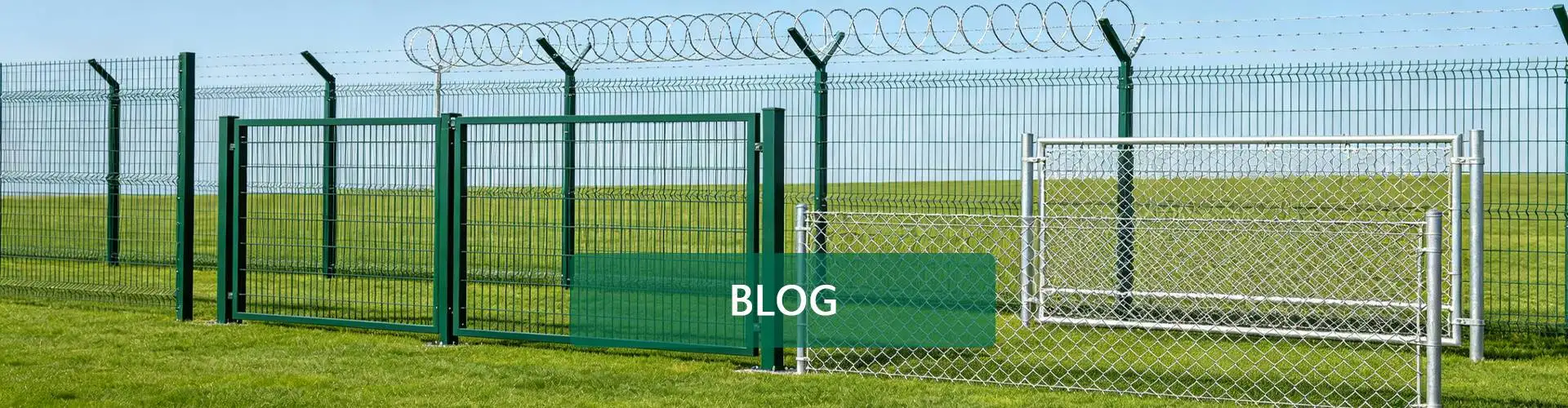
A school fence has to do more than mark the edge of a property. It must separate public areas from student facilities, control access and allow staff to maintain visibility across the campus. These requirements can influence the choice between a tubular picket fence and other welded steel fencing systems.
BDFENCE manufactures Steel Tubular Fence with square and round pickets, different rail arrangements and matching gate options. However, a product that looks suitable for a school does not automatically meet the project’s safety specification. South African education projects need to consider picket openings, top profiles, gate gaps, post connections and corrosion protection before approving a design.
The distinction becomes particularly important when reviewing South Africa’s School Infrastructure Safety and Security Guidelines. These guidelines describe specific welded mesh requirements for school perimeter security. They do not establish ordinary tubular picket fencing as an automatic alternative. Understanding that difference can help contractors avoid submitting an unsuitable product or ordering panels that later require changes.
What Makes School Fencing Different from Commercial Perimeter Fencing?
A factory boundary and a school boundary may use similar steel components, but their daily operating conditions are not the same.
Factories mainly need to separate operational areas, protect equipment and manage staff or vehicle access. Schools have additional considerations because children use the surrounding spaces every day.
Look at the areas within a typical school campus:
- Main entrances used by students, parents and visitors.
- Outdoor playgrounds and recreational spaces.
- Classroom buildings and administrative offices.
- Parking areas and vehicle circulation routes.
- Sports fields and shared facilities.
- Service entrances and maintenance areas.
Each location may need a different access arrangement. A fence beside a playground, for example, should not automatically use the same top profile or opening arrangement as a restricted service boundary.
Visibility matters as well. Teachers and school staff need suitable sightlines around outdoor activity areas. A visually heavy boundary can make supervision more difficult, while poorly planned landscaping may create places where people cannot easily see what is happening.
Consequently, school fencing should be considered as part of the campus layout rather than as an isolated product purchase.
What Do South African School Security Guidelines Actually Specify?
This is where buyers need to be particularly careful.
South Africa’s Department of Basic Education School Infrastructure Safety and Security Guidelines describe a Class A high-security perimeter fence with specific welded mesh construction.
The main requirements include:
| Design Item | Guideline Requirement |
|---|---|
| Minimum Fence Height | 1,800 mm above finished ground level |
| Higher Fence Options | 2,100 mm or 2,400 mm following risk assessment |
| Mesh Construction | Welded high-tensile steel mesh |
| Mesh Aperture | 76.2 mm horizontal × 12.7 mm vertical, centre to centre |
| Wire Diameter | 4 mm horizontal and vertical |
| Panel Reinforcement | Four recessed V-formations, 50 mm deep |
| Panel Width | Maximum 3,500 mm |
| Panel Fixings | Anti-scale clamps and anti-vandal bolts |
These requirements describe a particular security mesh system, not a standard tubular picket panel.
The guidelines also state that woven diamond mesh or chain-link mesh should not be used as the specified school security barrier. They separately identify concerns about traditional palisade fencing.
Importantly, the document does not specifically approve ordinary tubular picket fencing as a direct substitute for its Class A welded mesh system.
Therefore, a contractor proposing Steel Tubular Fence for a school should obtain approval from the project designer or relevant authority. The manufacturer must also demonstrate that the proposed construction meets the actual performance requirements where an alternative is permitted.
Picket Spacing: A Measurement That Needs More Explanation
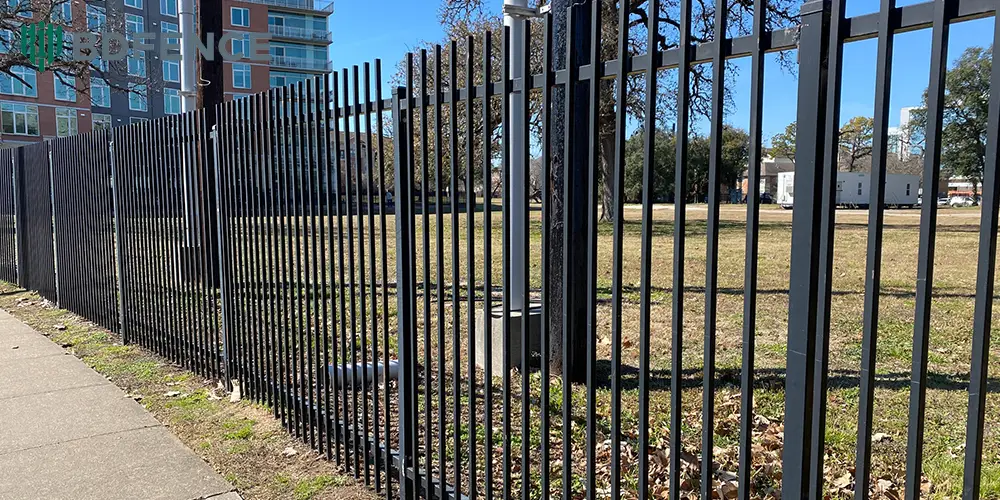
For tubular fencing, picket spacing affects the appearance of the panel and the size of the openings between vertical members.
BDFENCE publishes several spacing options:
- 100 mm
- 110 mm
- 120 mm
The product schedule should identify whether these figures represent centre-to-centre spacing or the clear distance between adjacent pickets.
Consider a panel using 19 mm square pickets. If 100 mm describes the centre distance, the nominal clear opening is approximately 81 mm, before allowing for dimensional tolerances and any coating build-up.
That is very different from a welded mesh aperture measuring 76.2 × 12.7 mm.
The two constructions cannot be treated as equivalent simply because their overall panel heights are similar.
Why the clear opening matters
A school specification may place restrictions on openings to address access, entrapment or climbing concerns.
For that reason, buyers should not rely on a catalogue description such as 100 mm picket spacing. The approved drawing should show the actual clear opening and measurement method.
Also consider the intended location. A decorative boundary around a separate administrative area may have different requirements from a primary security barrier surrounding classrooms.
Where the tender specifies a particular aperture, the manufacturer should work from that dimension rather than substitute a standard catalogue spacing.
Flat Top or Spear Top: The Choice Is Not Only About Appearance
BDFENCE offers several tubular fence top designs, including flat top, spear top, bending top and aluminum top.
For school environments, the top profile deserves a safety review before production.
A pointed top can create a different physical contact risk from a flat or rounded design. Its suitability depends on the location, the users, the intended security function and the approved school specification.
Consider three common options:
| Top Design | Design Consideration |
|---|---|
| Flat Top | Simple finish for areas where projecting points are not required |
| Spear Top | Provides a pointed appearance but needs careful safety and approval review |
| Aluminum Top | Offers a finished upper edge with a different visual appearance |
| Bending Top | Creates a formed upper profile according to the panel design |
There is no reason to select spear tops simply because a school fence is intended to provide security. The responsible designer should first establish whether that feature is suitable for the intended users and location.
For Grade R areas, the Department of Basic Education provides separate requirements. These include restrictions on exposed wire ends, climbing aids and certain materials. The design must account for the age of the children using the space.
Gate Design: The Entrance Must Follow the Fence Requirements
A school perimeter can have a well-designed fence and still leave a weak point at the entrance.
Pedestrian and vehicle gates need separate attention because they serve different users and operate in different ways.
Pedestrian gates
Students, staff, parents and visitors use pedestrian entrances throughout the school day. Their design should allow controlled movement without creating unnecessary openings around the frame.
The South African school security guidelines specify that the gate should match the fence system in quality and general security performance.
They also identify several important details:
- A robust frame around the gate.
- Suitable locking arrangements.
- Hinges that prevent the closed gate from being lifted off.
- A maximum 12.7 mm gap between the gate and its supporting posts for the specified swing-gate arrangement.
- Compatible corrosion protection.
These are requirements in the guideline’s specified school security system. If a tubular gate is proposed as an alternative, the project designer should confirm how the relevant requirements apply to its frame, infill and hardware.
Vehicle gates
Vehicle entrances serve staff parking, deliveries, maintenance vehicles and emergency services.
The gate opening must suit the vehicles using the site. Its frame, posts, hinges or sliding hardware need to support the selected gate dimensions.
For sliding gates, the guidelines also address arrangements that prevent the gate from being lifted off its track.
Another detail concerns the ground beneath the gate. The specified school security arrangement calls for a reinforced concrete slab between the gate posts, extending at least 1 m beyond both sides of the gate.
This provision supports the track installation and helps address digging and ground erosion around the entrance.
For a tubular fence project, the gate supplier and civil contractor should coordinate these details before manufacturing starts.
Coastal and Inland Schools Need Different Corrosion Reviews
Surface treatment can influence the long-term maintenance cost of a school fence.
South Africa has very different environmental conditions. A school near the coast may face salt-bearing air and higher corrosion exposure, while an inland campus may experience a different combination of rain, dust and sunlight.
The Department of Basic Education guidelines distinguish between coastal and inland applications when discussing protective finishes.
For coastal schools, they specify hot-dip galvanizing followed by fusion-bond epoxy powder coating or a similar system. For inland schools where corrosion is not a major concern, the guideline identifies fusion-bond epoxy powder coating or a similar finish.
When a tubular fence is considered, the buyer should check the actual coating process rather than rely only on a color description.
BDFENCE publishes hot-dip galvanized and powder-coated tubular fence options. The technical quotation should confirm the agreed treatment for:
- Vertical pickets.
- Horizontal rails.
- Fence posts.
- Gate frames.
- Brackets and exposed fittings.
It is also important to confirm whether the specified coating is applied before or after fabrication. Welded areas, cut ends and exposed connections need suitable protection under the approved manufacturing process.
For a closer look at tube dimensions and surface-related purchasing decisions, see the Steel Tubular Fence Tube Size and Wall Thickness Guide.
Posts and Foundations Must Match the Panel Design
A tubular fence panel cannot be assessed separately from its supporting posts.
For example, BDFENCE publishes square steel posts in 50 × 50 mm, 60 × 60 mm and 80 × 80 mm configurations, with wall thickness options of 1.5 mm, 1.8 mm and 2.0 mm.
Those dimensions provide manufacturing choices, but they do not establish that every combination is suitable for a school perimeter.
The design team needs to consider the fence height, panel width, post spacing, installation method and relevant site loads.
The South African school security guidelines also address post strength, locking arrangements, end caps and foundations. Their Class A system specifies minimum post dimensions and foundation details for that particular fence design.
When a tubular alternative is proposed, the contractor should provide the following information:
- Post outside dimensions.
- Steel wall thickness.
- Total post length.
- Panel connection method.
- Base plate or embedded installation.
- Foundation dimensions and concrete requirements.
Do not copy foundation dimensions from another school or commercial project without reviewing the actual ground conditions and approved structural drawings.
Appearance Matters in an Educational Environment
A school fence remains visible to students, parents, staff and the surrounding community every day.
The South African education guidelines specifically state that the school security fence should blend with the architectural design and should not create a prison-like appearance.
This is an important design consideration for tubular fencing.
Vertical pickets create a regular visual pattern. Square and round tubes also produce different appearances, while the number of horizontal rails changes the overall look of the panel.
For a school with modern buildings and landscaped grounds, the designer may want a simple, consistent fence line rather than a heavily industrial finish.
Color selection should also consider the surrounding buildings and landscaping. BDFENCE offers different powder-coated color options, subject to project confirmation.
However, appearance should never override the approved security and safety requirements.
What BDFENCE Can Manufacture for Tubular Fence Projects
The published BDFENCE Steel Tubular Fence range includes several configurations that can be reviewed for commercial and educational projects.
| Component | Published Options |
|---|---|
| Square Pickets | 16 × 16 mm / 19 × 19 mm |
| Round Pickets | Ø16 mm / Ø19 mm |
| Picket Wall Thickness | 0.8–1.5 mm, depending on profile |
| Picket Spacing | 100 / 110 / 120 mm |
| Horizontal Rails | 25 × 25 / 40 × 40 / 45 × 45 mm |
| Rail Quantity | 2 / 3 / 4 rails |
| Panel Height | 1,200–2,400 mm |
| Panel Width | 1,500–3,000 mm |
| Post Size | 50 × 50 / 60 × 60 / 80 × 80 mm |
| Top Design | Flat / Spear / Bending / Aluminum Top |
Not every combination is suitable for every school. The final panel should follow the approved drawing, clear-opening requirement and supporting structure.
For more information about dimensions and manufacturing options, visit the Steel Tubular Fence Panel Size Guide.
A School Project Reference: Coordinating Panels and Gates
BDFENCE has also supplied a Steel Tubular Fence system for a school campus project in Canada.
That project involved academic buildings, outdoor activity areas, parking facilities and service access points. The supply package included tubular fence panels, steel posts, pedestrian gates, vehicle gates, brackets and installation accessories.
One important part of the project was the coordination of pedestrian movement and vehicle access. The gate frames followed the surrounding fence design, while the panel and post specifications remained consistent across the campus.
This Canadian project is a manufacturing and supply reference. It does not establish compliance with South African school requirements.
Read the full project: Steel Tubular Fence Project for a School Campus.
What Should a South African School Fence RFQ Include?
A request for quotation should describe the intended fence system rather than simply ask for a price per metre.
For a tubular fence proposal, the following information will help the manufacturer prepare a more accurate offer:
- School site layout and total fence length.
- Required fence height and finished ground level.
- Square or round picket profile.
- Picket dimensions and wall thickness.
- Clear opening between pickets.
- Horizontal rail dimensions and quantity.
- Post profile, wall thickness and installation method.
- Pedestrian and vehicle gate schedule.
- Gate gaps, locking and hinge requirements.
- Surface treatment and color.
- Foundation and civil work requirements.
- Applicable school safety specifications and approval documents.
- BOQ and delivery destination.
If the project specification calls for a particular welded mesh security system, identify that requirement clearly. A tubular picket alternative should be submitted for approval with its drawings and technical details before the manufacturer starts production.
This approach helps avoid a common procurement problem: receiving a quotation for a product that looks similar to the requested fence but does not meet its actual technical requirements.
Discuss Your Steel Tubular Fence Project with BDFENCE
BDFENCE manufactures Steel Tubular Fence systems for educational facilities, residential developments, commercial properties and industrial projects.
The available product range includes customized pickets, horizontal rails, posts, pedestrian gates, vehicle gates and compatible fixing components.
For South African school projects, BDFENCE can review the supplied site layout, panel drawings, picket spacing, gate schedule and required surface treatment before preparing a manufacturing quotation.
Our Steel Tubular Fence Installation Guide provides further information about post layout, foundations, panel connections and gate installation.
For a project-based quotation, send your drawings, BOQ or technical requirements through Contact BDFENCE.
FAQ
Is Steel Tubular Fence suitable for every South African school?
No. The suitability depends on the school layout, intended use and approved security specification. South African school guidelines describe a specific welded mesh security system, so ordinary tubular picket fencing should not automatically be treated as an equivalent.
What fence height do South African school guidelines specify?
The Class A school perimeter guidance specifies a minimum height of 1,800 mm. A risk assessment may require 2,100 mm or 2,400 mm, subject to the stated maximum height of 2,400 mm.
What picket spacing does BDFENCE offer?
BDFENCE publishes 100 mm, 110 mm and 120 mm picket spacing options. Buyers should confirm whether the selected dimension represents centre-to-centre spacing or the clear opening between adjacent pickets.
Should school gates have the same height as the fence?
The South African school security guidelines specify that pedestrian and vehicle gates should match the height of the relevant fence system. The gate frame, locking arrangement and supporting hardware also need to meet the approved design.
Which top design is suitable for school fencing?
Flat, spear, bending and aluminum top options are available. The project designer should consider user safety, location and the approved security requirements before choosing a profile.
What surface treatment is suitable for coastal school projects?
The South African school security guidelines identify hot-dip galvanizing followed by fusion-bond epoxy powder coating or a similar system for coastal school fencing. The final coating specification should be confirmed against the project documents.
Can BDFENCE manufacture customized tubular fence panels for schools?
Yes. BDFENCE can review the required picket profile, spacing, rail arrangement, panel dimensions, posts and gates. The proposed system must still receive the necessary project approval.
Contact BDFENCE
Hebei Bendin Industrial Technology Co., Ltd. (BDFENCE)
Planning a Steel Tubular Fence project for a school or education facility in South Africa? Send your drawings, BOQ or technical requirements for a quotation covering panels, posts, pedestrian gates and vehicle gates.
WhatsApp: +86 18703287372
Email: info@bd-fence.com
Website: https://bd-fence.com/
Inquiry: Contact BDFENCE