



10.5 kilometres of perimeter fencing, 3,850 steel posts and 40 access gates. This water treatment plant project required more than supplying a large quantity of chain link mesh. The contractor needed a coordinated fencing package that could cover several operational areas while keeping maintenance and vehicle access available.
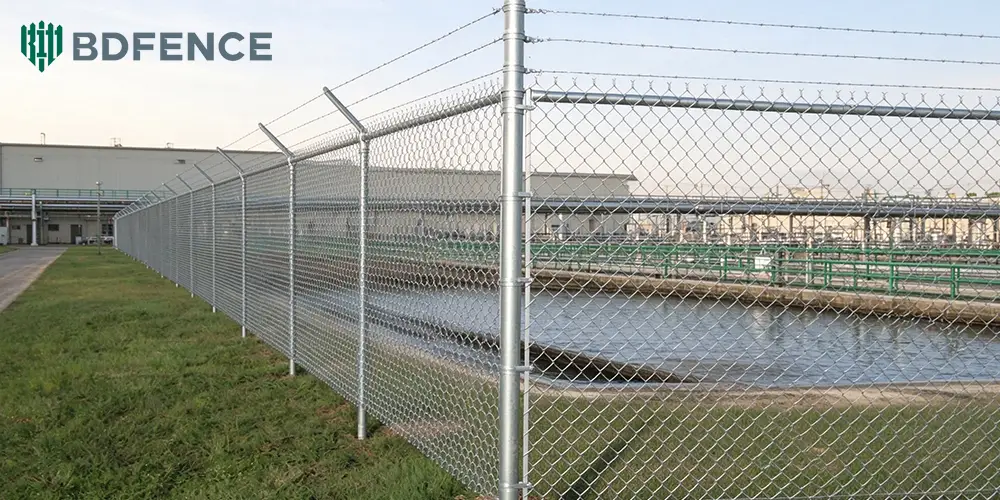
BDFENCE supplied a Hot-Dip Galvanized Chain Link Fence system for the project. The specification used 2,400 mm-high mesh, 50 × 50 mm openings and 4.0 mm wire. Steel posts, pedestrian gates, vehicle gates and installation fittings formed part of the same supply package.
One of the main procurement challenges was the number of different components involved. A water treatment plant has pumping stations, equipment areas, chemical storage zones, workshops and vehicle routes. Each section needs a suitable boundary, but maintenance teams must still reach the facilities they operate.
This project shows how BDFENCE handled the material coordination, manufacturing, inspection and export preparation for a large infrastructure perimeter.
Project Overview: 10,500 Metres of Chain Link Fencing
| Project Information | Details |
|---|---|
| Project Type | Municipal Water Treatment Plant |
| Country | Not disclosed |
| Main Product | Hot-Dip Galvanized Chain Link Fence |
| Total Fence Length | Approximately 10,500 m |
| Fence Height | 2,400 mm |
| Mesh Opening | 50 × 50 mm |
| Wire Diameter | 4.0 mm |
| Steel Posts | Approximately 3,850 pcs |
| Pedestrian Gates | 24 sets |
| Vehicle Gates | 16 sets |
| Surface Treatment | Heavy Hot-Dip Galvanized |
| Supply Scope | Mesh, Posts, Gates, Fittings and Tension Components |
The project covered approximately 10.5 km of fencing around the main operational areas. It also required 40 pedestrian and vehicle gate sets, making access coordination an important part of the order.
Why Did the Water Treatment Plant Need a Complete Perimeter System?
A water treatment facility contains equipment and working areas that cannot remain freely accessible to the public.
The project included several operational sections:
- Water treatment buildings.
- Pumping stations.
- Equipment and utility areas.
- Maintenance workshops.
- Chemical storage zones.
- Control buildings.
- Internal vehicle service roads.
These areas do not all have the same access requirements. Maintenance personnel may need regular entry to pumping equipment, while chemical storage and other restricted sections require controlled access.
The perimeter therefore needed to separate operational areas without preventing the movement of authorized workers, equipment and service vehicles.
The contractor also wanted to avoid purchasing mesh, posts, gates and fittings from several unrelated suppliers. If the components do not match, installation teams may face delays when they discover missing brackets, unsuitable posts or incompatible gate connections.
The 4.0 mm Wire Specification Was Only One Part of the Decision
The project used 50 × 50 mm chain link mesh with 4.0 mm steel wire.
That combination established the basic mesh specification, but it did not define the complete fence structure.
For a perimeter extending over 10 kilometres, the contractor also needed to consider the post arrangement, tensioning components, gate openings and corrosion protection.
Each component had to match the approved project drawings.
Why use 50 × 50 mm mesh?
The 50 × 50 mm diamond opening provides a relatively compact mesh pattern while maintaining visibility through the fence.
For this water treatment project, visibility mattered because security personnel needed to observe important perimeter sections. The open mesh also allowed the facility to maintain a clear boundary without constructing a continuous solid wall.
The selected opening and wire diameter followed the confirmed project requirements. They should not be treated as a universal specification for every water treatment facility.
Why confirm the actual wire diameter?
Chain link suppliers may describe wire using millimetres or gauge numbers. These descriptions need a common measurement reference before the buyer compares quotations.
For this project, the specified diameter was 4.0 mm. The purchasing team could therefore use the metric dimension as the basis for checking the supplied mesh.
Other details, including galvanizing requirements, edge finish, roll height and roll length, also need to appear in the production specification.
For buyers comparing different wire options, the BDFENCE Chain Link Fence product range provides the available mesh and wire configurations.
3,850 Posts: Why the Supporting Structure Needed Different Configurations
The project required approximately 3,850 steel posts. However, using one identical post arrangement throughout the entire perimeter would not have suited every location.
A long straight fence section has different support requirements from a corner or gate opening.
| Post Type | Position in the Project |
|---|---|
| Line Posts | Regular straight fence sections |
| Corner Posts | Changes in perimeter direction |
| Terminal Posts | Fence ends and tension points |
| Gate Posts | Pedestrian and vehicle entrances |
This distinction affected manufacturing and packing. Each post type needed the correct dimensions, connection details and identification.
The post schedule also had to match the fence layout. If a contractor changes the gate position or corner location after manufacturing, the original post quantities may no longer fit the installation plan.
For this reason, the team coordinated the post categories with the perimeter drawings before preparing the complete supply package.
Forty Gates Had to Work with the Fixed Fence Sections
The project included 24 pedestrian gates and 16 vehicle gates.
These were not interchangeable components. Each gate type served a different operational purpose.
Pedestrian access
Plant operators, maintenance personnel, security staff and authorized visitors needed designated walking entrances.
The pedestrian gates used a coordinated design with the surrounding chain link fence. Their frames, mesh infill, hinges and locking components had to match the approved gate schedule.
With 24 sets distributed around the facility, consistent dimensions and hardware preparation were important.
Vehicle access
The facility also required entrances for service trucks, equipment deliveries, maintenance vehicles and emergency access.
These openings needed suitable gate frames and supporting posts. Their dimensions and operating arrangements had to follow the available road space and site layout.
Matching chain link infill helped maintain a consistent appearance across the fixed perimeter and gate sections.
For BDFENCE, the important manufacturing point was to treat the gates as part of the main fencing package rather than as separate products added after the mesh order.
Heavy Hot-Dip Galvanizing for Long-Term Outdoor Exposure
Water treatment facilities often contain humid areas and equipment that operates outdoors throughout the year. Corrosion protection was therefore an important part of the project specification.
The selected system used heavy hot-dip galvanized protection.
The treatment covered the main fencing components according to the confirmed project requirements, including the mesh and steel supporting structure.
However, buyers should not assume that the word galvanized establishes a complete coating specification. The required coating standard, zinc coating mass and inspection method should be identified separately in the purchase documents.
For an infrastructure project, the buyer should also consider the condition of the gate frames, posts, fittings and exposed connections. Protecting the mesh while overlooking the supporting components would leave the system with an inconsistent corrosion-protection schedule.
Manufacturing a 10.5 km Order: Keeping Every Batch Consistent
At this scale, production consistency becomes a practical issue rather than a minor factory detail.
The order involved thousands of mesh rolls, posts, gates and small accessories. If dimensions changed between batches, the contractor could face problems when joining sections on site.
BDFENCE organized production around the approved technical information.
Mesh production
The factory prepared the woven mesh according to the 50 × 50 mm opening and 4.0 mm wire specification.
Production checks focused on:
- Wire diameter.
- Mesh opening dimensions.
- Roll height and length.
- Weaving consistency.
- Edge condition.
- Galvanized surface appearance.
These checks helped keep the mesh consistent across multiple production batches.
Post manufacturing
Posts were prepared according to their positions within the perimeter.
Line, corner, terminal and gate posts were identified separately. The team checked their dimensions, length, wall thickness and surface condition before packing.
Gate fabrication
The 24 pedestrian gates and 16 vehicle gates followed separate fabrication requirements.
Gate production included frame preparation, mesh infill, welding, hinge positioning and locking component preparation.
Each gate configuration followed the approved gate schedule so the receiving contractor could match the components to the intended opening.
Quality Inspection Covered More Than the Mesh Rolls
A project with thousands of supporting components cannot rely on a visual check of the finished mesh alone.
BDFENCE inspected the main product groups separately.
| Component | Inspection Focus |
|---|---|
| Chain Link Mesh | Wire diameter, mesh opening, roll dimensions, weaving and edge condition |
| Steel Posts | Dimensions, wall thickness, length, straightness and surface treatment |
| Tension Components | Type, dimensions and required quantities |
| Fence Fittings | Compatibility, specifications and packing quantities |
| Pedestrian Gates | Frame alignment, hinges, mesh infill and locking hardware |
| Vehicle Gates | Overall dimensions, opening movement and supporting components |
| Finished Surface | Galvanized condition and visible damage |
Small fittings received particular attention. A missing tension band or an incorrect gate component can delay installation even when all the main fence rolls have arrived.
Therefore, the accessories were checked against the project supply list before shipment.
Export Packing and Delivery Planning
The order contained different types of materials, and each group needed a suitable packing arrangement.
The mesh rolls were secured for transportation. Steel posts were bundled according to their type, while small fittings were packed separately and identified by category.
Gate components received separate protection because their dimensions and hardware requirements differed from ordinary fence materials.
The loading plan considered:
- Mesh roll dimensions.
- Steel post lengths and bundle weights.
- Gate frame dimensions.
- Fittings and accessory quantities.
- Container weight distribution.
- Loading and unloading sequence.
For the receiving contractor, clear identification was just as important as product protection. It helped the site team verify quantities and distribute materials to the correct installation areas.
Installation: From Site Setting-Out to Final Inspection
After delivery, the local construction team installed the fence according to the approved perimeter drawings and foundation design.
The work followed a practical sequence:
- Confirm the fence alignment, corners and access positions.
- Mark the locations of line, corner, terminal and gate posts.
- Install the posts and check their spacing and vertical alignment.
- Prepare the required rails, braces and tension components.
- Position and stretch the chain link mesh.
- Secure the mesh with the specified tension bars, bands and fittings.
- Install pedestrian and vehicle gates.
- Inspect the complete perimeter and check gate operation.
Special attention went to corners, fence ends and gate openings. These locations carry different connection requirements from ordinary straight sections.
The final inspection covered mesh tension, post stability, gate alignment, fixing connections and visible surface damage.
What Did the Project Achieve?
The completed supply and installation produced approximately 10.5 km of continuous perimeter fencing around the water treatment facility.
| Project Requirement | Delivered Configuration |
|---|---|
| Large Perimeter | Approximately 10,500 m of chain link fencing |
| Fence Height | 2,400 mm |
| Mesh Construction | 50 × 50 mm opening with 4.0 mm wire |
| Supporting Structure | Approximately 3,850 steel posts |
| Personnel Access | 24 pedestrian gates |
| Vehicle Access | 16 vehicle gates |
| Corrosion Protection | Heavy hot-dip galvanized finish |
The coordinated package helped the contractor manage the different perimeter sections without sourcing the main fence components from several manufacturers.
It also maintained visibility through the boundary, supported designated access points and provided a modular fence arrangement for future maintenance.
What This Project Means for South African Infrastructure Buyers
South Africa has a wide range of water infrastructure, municipal utility and industrial perimeter projects. Contractors working on these facilities often need more than mesh rolls. They need posts, gates, tension components and fittings that match the approved design.
This water treatment project offers a useful supply reference for that type of procurement, although its country has not been disclosed.
For a comparable South African project, buyers should pay particular attention to three areas.
Complete quantities: Separate mesh, line posts, corner posts, terminal posts, gate posts and fittings in the BOQ.
Environmental requirements: Confirm the required galvanizing specification according to the actual site exposure and project documents.
Gate coordination: Identify pedestrian and vehicle openings before finalizing the mesh and post schedule.
These details help suppliers prepare a more accurate quotation and reduce the risk of missing components during installation.
How BDFENCE Can Support Your Chain Link Fence Project
BDFENCE supplies galvanized and PVC-coated chain link fencing for industrial facilities, water infrastructure, logistics centres and other large perimeter projects.
The product range includes different wire diameters, mesh openings, roll heights, roll lengths, steel posts, top rails, tension components and compatible fittings.
For a South African EPC contractor or distributor, BDFENCE can review the following project information:
- Total perimeter length and fence height.
- Mesh opening and wire diameter.
- Galvanizing or PVC coating requirements.
- Line, corner, terminal and gate post quantities.
- Pedestrian and vehicle gate schedules.
- Site layout and installation drawings.
- BOQ and delivery destination.
For another large-scale industrial reference, see the 8,000 m Galvanized Chain Link Fence Industrial Project.
You can also review the Chain Link Fence Installation Guide for further information about mesh tensioning, posts and fittings.
To discuss a project or request a factory quotation, send your drawings or BOQ through Contact BDFENCE.
FAQ
How much chain link fencing did the water treatment plant project require?
The project involved approximately 10,500 metres of chain link fencing around the main operational areas.
What mesh specification did BDFENCE supply?
The project used 50 × 50 mm mesh openings with 4.0 mm steel wire and a 2,400 mm fence height.
How many posts and gates were included?
The supply package included approximately 3,850 steel posts, 24 pedestrian gates and 16 vehicle gates.
Why was heavy hot-dip galvanizing selected?
The project required outdoor corrosion protection for a water treatment facility with humid operating conditions. The final coating requirements followed the confirmed project specification.
Can BDFENCE supply mesh, posts and gates together?
Yes. BDFENCE can supply chain link mesh, line posts, corner posts, terminal posts, gate posts, pedestrian gates, vehicle gates, tension components and related fittings as one coordinated package.
Can BDFENCE quote for a South African water infrastructure project?
Yes. South African contractors and project buyers can provide their drawings, BOQ and technical specifications for a quotation based on the required product configuration and supply scope.
Contact BDFENCE
Hebei Bendin Industrial Technology Co., Ltd. (BDFENCE)
Planning a chain link fence project for a water treatment plant, municipal utility or industrial facility in South Africa? Send your drawings, BOQ or technical requirements for a project-based quotation.
WhatsApp: +86 18703287372
Email: info@bd-fence.com
Website: https://bd-fence.com/
Inquiry: Contact BDFENCE