


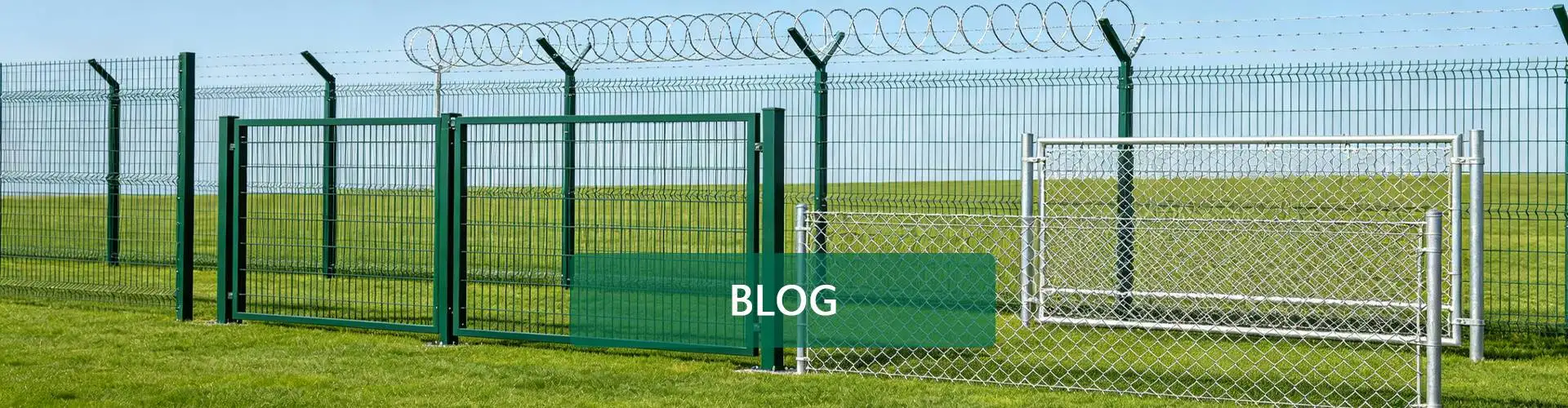
A chain link fence can have the correct mesh size, wire diameter and height, yet still develop problems after installation. One common reason is an unsuitable post layout.
Not every post along a fence line does the same job. Line posts support the mesh between sections, while straining posts hold the tension at key points. Corner posts, gate posts and stays also have their own roles.
This difference matters on long South African industrial boundaries. If a contractor uses the wrong post arrangement, the mesh may pull the end posts out of line or place too much pressure on the supporting structure. The problem often becomes clear only after the crew stretches the mesh.
For fencing contractors and project buyers, a good post schedule is just as important as the mesh specification. Let’s look at how these components work and what to check before preparing a chain link fence BOQ.
Five Types of Posts You May Need for One Fence
A long fence rarely uses one type of post from beginning to end. The layout changes whenever the fence reaches a corner, an entrance or the end of a tensioned section.
| Post Type | Main Job | Typical Position |
|---|---|---|
| Line Post | Supports the mesh along a straight section | Between major posts |
| Straining Post | Holds the tension in a mesh section | At the ends of tension bays |
| Corner Post | Supports changes in fence direction | At boundary corners |
| Gate Post | Supports the gate and its hardware | On both sides of an entrance |
| Stay | Supports a major post against pulling forces | Beside selected straining and corner posts |
Some fence systems combine more than one function in a specially designed post. However, a standard line post cannot automatically replace a straining post.
Each position needs the right support for its job. This becomes especially important on long boundaries where the contractor must stretch the mesh across several sections.
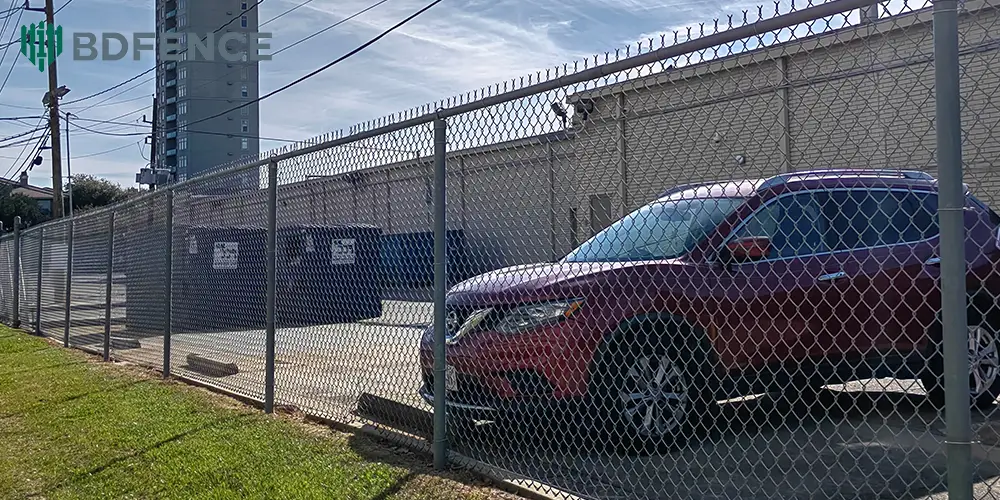
Why Does a Straining Post Need More Support?
Chain link mesh has a woven structure. The installer pulls it tight between supporting points before securing it to the posts.
That tension creates a continuous pulling force along the fence. The end posts must hold this force, while the intermediate posts keep the mesh in line.
Now consider what happens at a corner. The fence changes direction, so the post must deal with forces from two adjoining sections. A simple line post may not provide enough support for this position.
If the contractor overlooks this difference, several problems can appear:
- End posts may lean towards the stretched mesh.
- Corner posts may move out of position.
- The mesh can lose its tension and develop uneven areas.
- Stay connections may loosen under repeated movement.
- The installation team may need to repair the affected section.
A thicker mesh does not solve an unsuitable post layout. In fact, heavier wire can increase the load on the supporting structure.
For this reason, the contractor must check the posts, stays, foundations and mesh together rather than choose each item separately.
How Far Apart Should Straining Posts Be?
There is no single spacing that works for every chain link fence. The fence height, wire diameter, ground conditions and tensioning method all affect the layout.
For general diamond mesh fencing in South Africa, approximately 30 m is often used as a preliminary reference for major straining post intervals. However, this is a planning guide, not a universal SANS requirement.
The actual distance depends on the approved project specification and site conditions.
A practical example: 300 metres of straight fencing
Take a warehouse boundary with a straight fence run of 300 m. If the preliminary design uses tension sections of around 30 m, the contractor can divide the run into ten sections.
Each section needs suitable end support. The final post quantity will also depend on the terminal arrangement and the actual installation system.
The calculation changes once the boundary includes corners, gates or changes in direction. Those positions may need additional major posts and stays.
Therefore, do not calculate the straining post quantity using total perimeter length alone.
Line post spacing is a different measurement
Line posts support the mesh between the major tension points. In common South African diamond mesh installations, contractors often use approximately 3 m centres for intermediate standards.
That spacing does not apply automatically to every post system. A round-post system with a top rail may follow a different layout from a traditional Y or K standard system.
Check the project drawing before placing the order. The fence height, rail arrangement and selected post type all matter.
Two Common Ways to Support Chain Link Mesh
South African chain link projects often use one of two general support arrangements. The selected system affects the post types, fittings and installation method.
Round posts with a top rail
This arrangement uses round steel posts along the fence line. A horizontal top rail connects the supporting posts, while the mesh attaches to the terminal posts through tension bars and bands.
Line posts support the fabric between the ends. Depending on the design, the system may also include bottom tension wire, additional rails and brace assemblies.
This layout suits many warehouse, commercial and industrial boundaries.
BDFENCE offers round post diameters of 40 mm, 48 mm, 60 mm and 75 mm. Available wall thickness options include 1.5 mm, 1.8 mm, 2.0 mm and 2.5 mm.
These are product options, not a standard specification for every straining post. The engineer must confirm the required section and thickness for each position.
Straining wires with intermediate standards
Another arrangement uses major straining posts, diagonal stays, horizontal tension wires and intermediate standards.
The major posts hold the tension sections. Meanwhile, the intermediate standards support the mesh between those points.
A typical material schedule may include:
- Major straining posts.
- Diagonal stays and stay bolts.
- Intermediate Y or K standards.
- Horizontal straining wires.
- Diamond mesh and binding wire.
These components work as one system. Therefore, avoid mixing different post and support arrangements unless the project designer approves the change.
Corner Posts and Gate Posts Need Separate Planning
A straight fence run has a fairly simple tension direction. At a corner, however, the direction changes. The supporting post must handle the forces from the adjoining sections.
Gate posts have another job. They support the gate frame, hinges or sliding hardware, and the weight of the moving gate.
One City of Tshwane municipal fencing specification provides a useful example. It requires separate straining arrangements at certain gate positions rather than treating the gate posts as ordinary straining posts.
This is a project-specific requirement, but it highlights an important point for buyers: a gate post does not automatically replace a straining post.
Before preparing the gate schedule, confirm:
- Gate opening width and height.
- Gate post dimensions and wall thickness.
- Hinges or sliding hardware.
- Locking components.
- Adjacent straining posts and stays.
- Concrete foundation requirements.
A wide vehicle entrance may need a different support arrangement from a small pedestrian gate. The contractor should follow the gate drawing and approved structural details.
What Does a Stay Actually Do?
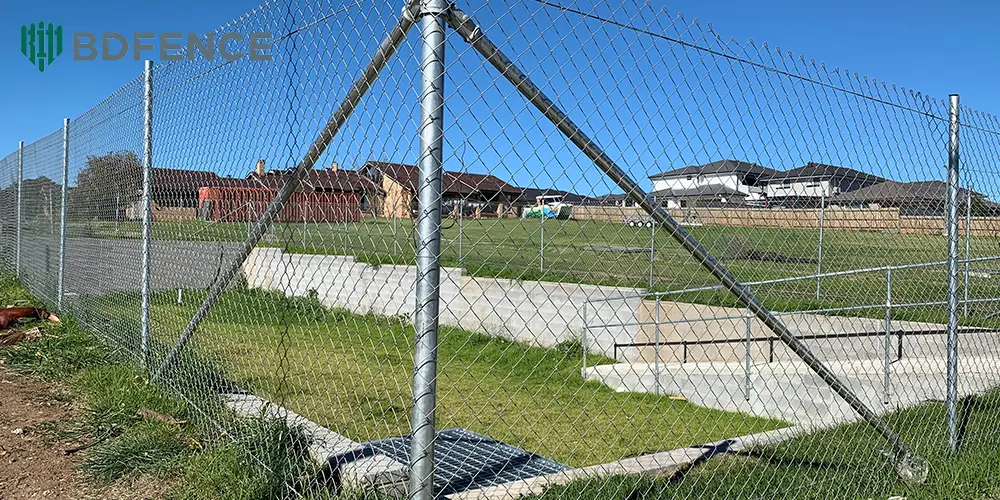
A stay is a diagonal support connected to a major post. It helps the post resist the pull created when the installer stretches the mesh.
At a terminal position, the stay supports the post against the tension from the adjoining fence section. At a corner, the arrangement must also account for the direction of the next fence run.
South African diamond mesh installation guidance commonly shows two stays at major straining or corner positions. However, the engineer or approved drawing must confirm the actual number and arrangement.
The stay itself also needs the correct dimensions and connections. Check these details:
- Stay profile and steel dimensions.
- Connection position on the main post.
- Stay angle and direction.
- Bolts and fixing method.
- Concrete footing dimensions.
- Soil condition around the foundation.
Do not copy a footing size from another site without checking the ground. Sandy soil, loose fill and other weak ground conditions may need a different foundation design.
South African Specifications: Check the Mesh and Supporting Parts Separately
South African road and municipal specifications often describe chain link mesh, posts, stays and tension wires as separate items.
For example, a SANRAL routine road maintenance specification references SANS 1373 for diamond mesh fencing and lists a particular combination of wire diameter, mesh size and edge finish.
One published reference includes:
| Specification | Example Requirement |
|---|---|
| Wire Diameter | 2.5 mm |
| Mesh Opening | 64 × 64 mm |
| Edge Finish | Clinched or barbed on both sides |
| Wire Finish | Fully galvanized |
These values belong to that particular specification. They do not define every chain link fence in South Africa.
The important point is that the mesh description alone does not complete the material schedule. Posts, stays, wires, gates and foundations also need clear requirements.
Available Chain Link Fence and Post Options from BDFENCE
BDFENCE publishes several chain link mesh and supporting component options for overseas projects.
| Product Detail | Published Options |
|---|---|
| Wire Diameter | 2.5 / 3.0 / 3.5 / 4.0 / 4.5 mm |
| Mesh Opening | 40 × 40 / 50 × 50 / 60 × 60 / 75 × 75 / 100 × 100 mm |
| Roll Height | 1.2 / 1.5 / 1.8 / 2.0 / 2.4 / 2.8 / 3.0 m |
| Roll Length | 9 / 10 / 15 / 18 / 20 / 25 / 30 m |
| Round Post Diameter | 40 / 48 / 60 / 75 mm |
| Post Wall Thickness | 1.5 / 1.8 / 2.0 / 2.5 mm |
| Top Rail Diameter | 32 / 40 / 48 mm |
These options give buyers a starting point when preparing a chain link fence order. However, they do not determine the final post layout.
For example, a 2.4 m mesh roll with 3.5 mm wire may need a different supporting arrangement from a shorter roll with lighter wire.
The designer must also check the tension sections, post spacing, ground conditions and gate positions.
Visit the BDFENCE Chain Link Fence product page to review the available mesh and post options.
Where Does Poor Post Planning Increase Project Costs?
The mesh quantity may stay the same when the contractor changes the post layout. However, the supporting material schedule can change considerably.
Additional straining posts require more steel, stays, bolts and concrete. Corners and gate openings may also need special connections.
There is another cost that buyers sometimes overlook: repair work after installation.
If a major post moves under tension, the crew may need to loosen the mesh, repair the support and stretch the fabric again. On a long industrial boundary, this can delay work across several sections.
For a more accurate quotation, separate the material quantities:
| Material | How to Calculate It |
|---|---|
| Chain Link Mesh | Total fence area and roll quantity |
| Line Posts | Approved intermediate post spacing |
| Straining Posts | Number of tension sections and end positions |
| Corner Posts | Changes in fence direction |
| Gate Posts | Number and type of entrances |
| Stays | Approved major post support arrangement |
| Rails and Tension Wires | Selected fence system and height |
| Fittings | Tension bars, bands, clips and fasteners |
| Foundations | Approved footing design |
A complete BOQ makes it easier to compare supplier quotations. It also reduces the chance of missing important components during installation.
Information to Send Before Requesting a Quotation
A total perimeter length gives the manufacturer a useful starting point. Still, it does not show where the contractor needs corners, gates or tension sections.
For a South African industrial or infrastructure project, prepare these details where available:
- Site layout and total fence length.
- Mesh height, opening and wire diameter.
- Proposed line-post spacing.
- Straining post and corner locations.
- Gate positions and opening dimensions.
- Post profiles and wall thicknesses.
- Stay and tension wire requirements.
- Top rail and bottom tension wire details.
- Ground conditions and foundation drawings.
- Galvanized or PVC-coated finish requirements.
- BOQ and delivery destination.
If the tender already specifies post spacing or footing dimensions, include those requirements in the enquiry. The manufacturer should quote against the actual document rather than replace its requirements with general catalogue suggestions.
Where the layout remains unfinished, a site plan and preliminary BOQ can help the supplier understand the expected material scope.
Chain Link Fence Supply for South African Projects
BDFENCE supplies chain link mesh, round steel posts, top rails and related fittings for overseas fencing projects.
For South African contractors and distributors, the company can review the requested mesh dimensions, roll quantities, post options and supporting accessories against the project information.
On a long perimeter, it is especially useful to list ordinary line posts separately from straining posts, corner posts and gate supports.
For more installation information, read the Chain Link Fence Installation Guide.
You can also review the 8,000 m Galvanized Chain Link Fence Industrial Project for a large-scale supply reference.
Send your site layout, BOQ or technical specification through Contact BDFENCE for a project quotation.
FAQ
What is the difference between a line post and a straining post?
A line post supports the mesh along a normal fence section. A straining post holds the tension at the end of a section and needs a suitable support arrangement.
How far apart should chain link fence straining posts be?
Approximately 30 m is a general planning reference in some South African diamond mesh installation guidance. However, the actual spacing depends on fence height, wire, ground conditions and the approved design. It is not a universal SANS requirement.
Can a gate post also serve as a straining post?
It depends on the approved design. Some South African project specifications require separate straining posts beside gate openings. Check the drawings before combining these functions.
How many stays does a chain link fence need?
Two stays are a common arrangement at major straining or corner posts in traditional diamond mesh systems. The actual number and footing design depend on the project requirements.
Does SANS 1373 specify the spacing of fence posts?
SANS 1373 relates to chain link fencing fabric requirements. Post spacing and foundation details should also follow the applicable project drawings and other specified engineering requirements.
Can BDFENCE supply chain link mesh, posts and fittings together?
BDFENCE publishes chain link mesh, round posts, top rails and related fittings. Buyers should provide their BOQ so the required quantities and product combinations can be confirmed.
Contact BDFENCE
Hebei Bendin Industrial Technology Co., Ltd. (BDFENCE)
Planning a chain link fence project in South Africa? Send your site layout, post schedule or BOQ for a quotation covering mesh rolls, posts, rails and compatible fittings.
WhatsApp: +86 18703287372
Email: info@bd-fence.com
Website: https://bd-fence.com/
Inquiry: Contact BDFENCE