


Two steel picket fence quotations arrive for the same commercial project. Both specify a 2.0 m-high panel, 19 × 19 mm square pickets and the same surface finish. However, one quotation includes two horizontal rails, while the other offers three.
The price difference is noticeable. Does the additional rail justify the extra cost?
The answer depends on the complete panel design. Horizontal rails do more than hold the pickets in position. They connect the vertical members, help the panel act as one structure and transfer loads towards the supporting posts.
A two-rail panel, a three-rail panel and a four-rail panel can therefore have different construction requirements, even when they share the same picket dimensions.
For fencing contractors, developers and overseas buyers, understanding these differences helps when preparing specifications and comparing factory quotations. This guide explains how rail quantity affects a Steel Tubular Fence, what else needs to be checked, and how to choose a configuration that suits the project.
What Do Horizontal Rails Actually Do?
A steel picket fence panel normally contains three main structural elements: vertical pickets, horizontal rails and connections between the panel and supporting posts.
The pickets create the visible fence pattern. The horizontal rails connect these members and help maintain the panel’s shape.
Think about a panel with two horizontal rails. One rail runs near the top and another near the bottom. The vertical pickets connect to both rails, creating a framed panel.
When the manufacturer adds another rail, the panel gains an additional connection line. This can reduce the unsupported length of the vertical pickets and help control movement.
A fourth rail adds another connection point. However, the actual benefit depends on where the rails sit, their dimensions, wall thickness, welding quality and the overall panel design.
Therefore, rail quantity should never be considered separately from the rest of the fence specification.
Two-Rail Steel Picket Fence: A Simpler Panel Construction
How does a two-rail panel work?
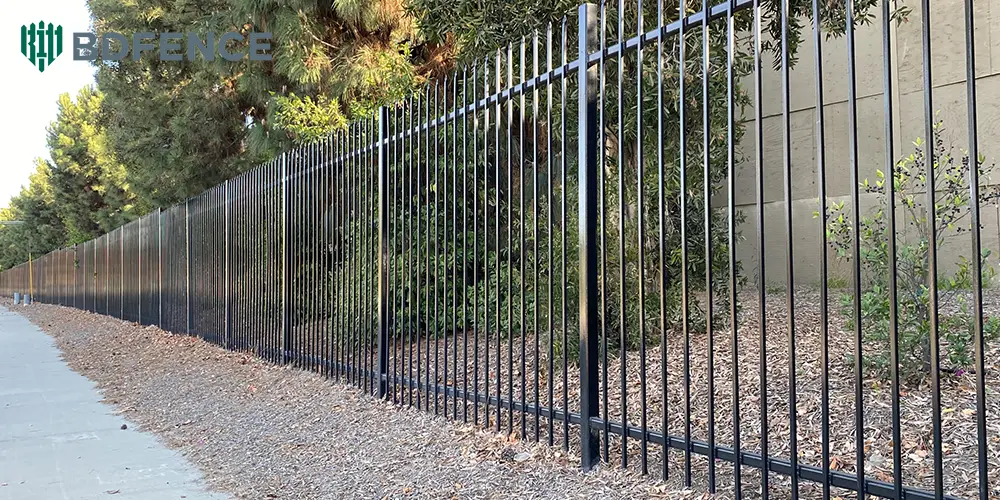
A two-rail steel tubular fence normally uses one upper rail and one lower rail. The vertical pickets connect to these two horizontal members.
This arrangement creates a relatively simple panel structure. It also uses fewer horizontal tubes than three-rail and four-rail configurations.
For projects where the approved design permits a lighter panel construction, two rails may provide a practical option.
Typical considerations include:
- Fewer horizontal steel members.
- Lower material consumption compared with otherwise identical panels using additional rails.
- Less welding and fewer rail-to-picket connection points.
- A simpler horizontal appearance.
- Potentially lower panel weight and handling requirements.
However, two rails are not automatically suitable for every fence height or panel width.
A taller panel has longer vertical pickets. A wider panel may also place different demands on the horizontal members and supporting posts. The designer needs to review those dimensions before selecting the rail arrangement.
Where can two rails be considered?
Two-rail configurations can suit lower or lighter tubular fence designs, decorative boundaries and projects where the approved panel structure does not require additional intermediate support.
For example, a commercial property may use a relatively low decorative boundary around a landscaped area. If the panel dimensions and structural requirements permit it, a two-rail arrangement may be sufficient.
By contrast, a taller industrial boundary with heavier pickets may need a different configuration.
The important point is to select the rail count from the actual panel design rather than assume that every standard fence needs only two rails.
Three-Rail Steel Picket Fence: Adding an Intermediate Support
What changes when the manufacturer adds a third rail?
A three-rail panel usually has upper, middle and lower horizontal rails. The additional middle rail creates another connection point between the pickets and the panel frame.
This changes how the vertical members are supported.
Instead of relying only on the top and bottom connections, the pickets also connect to an intermediate rail. Depending on the panel dimensions and tube specifications, this can help reduce picket movement and improve overall panel rigidity.
There are also practical manufacturing considerations. The factory needs to position the middle rail consistently across the panel and maintain the required picket alignment during welding.
For a long commercial or industrial boundary, consistent rail positioning helps maintain a uniform appearance from one panel to the next.
When is a third rail worth considering?
A third rail deserves consideration when the panel becomes taller, wider or heavier.
For example, a 2.4 m-high fence with relatively heavy square pickets may require more support than a shorter decorative panel. The designer can review whether an intermediate rail helps meet the required panel arrangement.
It may also be useful where the project places greater emphasis on panel rigidity and repeated use around commercial or industrial properties.
However, adding a third rail does not automatically make an unsuitable post system acceptable. The posts, foundations and panel connections must still match the project requirements.
For this reason, a supplier should provide the rail position and dimensions on the manufacturing drawing rather than simply write “three rails” in the quotation.
Four-Rail Steel Picket Fence: More Connection Points, More Material
How does a four-rail panel differ?
A four-rail configuration uses four horizontal members across the vertical pickets. Depending on the panel design, this arrangement creates several intermediate connection points between the upper and lower sections.
For a panel with longer pickets or a project-specific support requirement, the additional rails may help control movement across the panel.
The arrangement also changes the appearance. Four horizontal lines create a denser visual structure than a two-rail panel.
From a manufacturing perspective, the factory needs more steel tubes, additional weld connections and more time to position and assemble the panel.
These changes can affect several parts of the quotation:
- Total horizontal tube consumption.
- Panel weight.
- Number of welded connections.
- Fabrication time.
- Coating area and material consumption.
- Packing and international shipping weight.
Does every tall fence need four rails?
No. A four-rail panel is not automatically the best solution for every tall fence.
For some projects, three rails combined with suitable picket and rail dimensions may meet the approved design. Other applications may require four rails because of the panel geometry or specific project requirements.
The designer should compare the complete panel construction rather than choose the highest rail count available.
Using additional steel without a clear design reason can increase the purchase price and handling weight without providing a meaningful benefit for the intended application.
Two, Three or Four Rails: A Direct Comparison
The following table summarizes the main differences buyers should consider.
| Comparison | 2-Rail | 3-Rail | 4-Rail |
|---|---|---|---|
| Horizontal Rails | 2 | 3 | 4 |
| Intermediate Support | None in the usual top-and-bottom arrangement | One additional support line | Two additional support lines |
| Steel Consumption | Lowest of the three, with otherwise identical specifications | Higher | Highest |
| Welded Connections | Fewer | More | More again |
| Panel Weight | Generally lower | Generally higher | Generally highest |
| Visual Appearance | Simple horizontal structure | More balanced horizontal divisions | Denser horizontal pattern |
| Potential Application | Lower or lighter panel designs | Taller or heavier panel designs where additional support is useful | Project-specific panels requiring additional rail connections |
| Price Consideration | Lower rail material consumption | Additional material and fabrication | Highest rail material consumption |
This comparison assumes that the picket dimensions, panel width, rail section and other specifications remain the same.
In an actual quotation, the results can differ because suppliers may also change the rail size, wall thickness, post arrangement or picket spacing.
That is why buyers should compare the complete technical drawings rather than judge a fence by the number of horizontal rails alone.
Rail Size and Wall Thickness Matter as Much as Rail Quantity
A four-rail panel does not automatically outperform a two-rail panel if the rail sections are unsuitable for the application.
Consider two quotations. The first specifies three rails measuring 40 × 40 mm with a 1.5 mm wall. The second offers four rails measuring 25 × 25 mm with a 1.0 mm wall.
The second quotation includes more horizontal tubes, but each rail has a different cross-section and wall thickness.
Which panel has the required rigidity? The rail count alone cannot answer that question.
BDFENCE publishes the following horizontal rail options for its standard tubular picket fence range:
| Rail Outside Dimensions | Published Wall Thickness Options |
|---|---|
| 25 × 25 mm | 1.0 mm / 1.2 mm / 1.5 mm / 1.8 mm / 2.0 mm / 2.5 mm |
| 40 × 40 mm | 1.0 mm / 1.2 mm / 1.5 mm / 1.8 mm / 2.0 mm / 2.5 mm |
| 45 × 45 mm | 1.0 mm / 1.2 mm / 1.5 mm / 1.8 mm / 2.0 mm / 2.5 mm |
These are published product options. Not every size and thickness combination is automatically suitable for every panel or rail count.
For a technical comparison, ask the supplier to state the rail dimensions and wall thickness separately. A quotation that only says “heavy-duty three-rail fence” leaves too much room for interpretation.
For more information, read the Steel Tubular Fence Tube Size and Wall Thickness Guide.
Panel Height and Width Can Change the Required Rail Arrangement
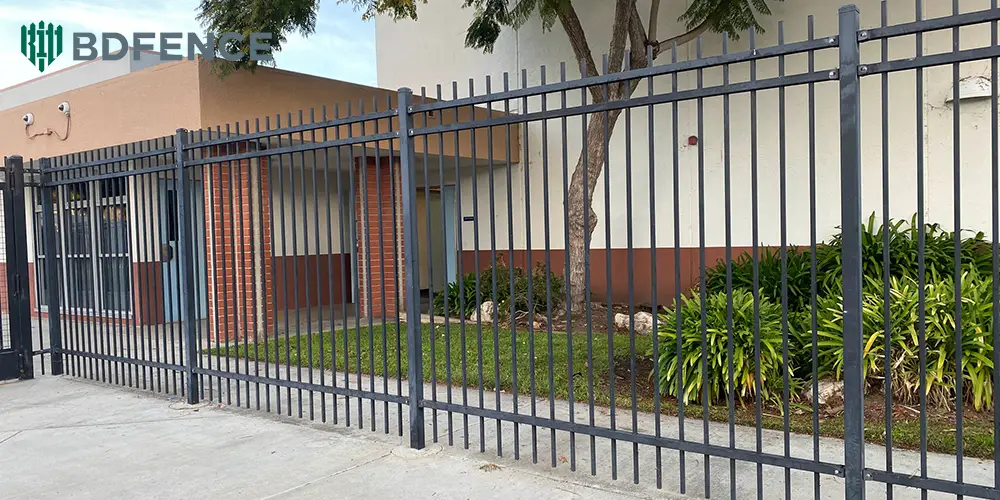
Rail quantity should be reviewed together with panel dimensions.
A short panel with light pickets does not create the same design conditions as a tall panel with heavier vertical tubes. The length of the pickets, panel width and post spacing can all influence the required rail arrangement.
BDFENCE publishes tubular fence heights from 1,200 mm to 2,400 mm and panel widths from 1.5 m to 3.0 m.
For example, consider two panels:
- A 1,200 mm-high panel with a 1.8 m width.
- A 2,400 mm-high panel with a 3.0 m width.
Even if both use the same picket profile, their dimensions are quite different. The second panel has longer vertical members and a wider span between supporting posts.
The designer may therefore need to review rail quantity, rail section, wall thickness and post dimensions together.
It is also worth checking the distance between the rails. A three-rail panel with poorly positioned rails may not provide the intended support arrangement.
The manufacturing drawing should show the height of each rail position, not simply the total number of rails.
Picket Size and Spacing Must Match the Rails
Vertical pickets and horizontal rails work together. If the pickets become heavier or the spacing changes, the panel’s material consumption and connection requirements may also change.
BDFENCE publishes square picket options of 16 × 16 mm and 19 × 19 mm, as well as round picket options of Ø16 mm and Ø19 mm.
The published picket spacing options include 100 mm, 110 mm and 120 mm.
Closer spacing places more pickets within the same panel width. This increases the amount of vertical steel and the number of connections to the horizontal rails.
Consequently, a panel with closely spaced pickets and four rails may contain considerably more steel and welded joints than a two-rail panel with wider picket spacing.
Buyers should also confirm whether the spacing refers to the clear gap or the centre-to-centre distance. The drawing needs to identify the measurement method.
These details affect both the appearance and the final quotation. They should be agreed before the manufacturer prepares the production drawings.
How Rail Quantity Affects the Total Project Cost
When comparing two, three and four rails, the first difference is the amount of horizontal steel used in each panel.
However, the purchase price does not depend on rail material alone.
Adding another rail can also increase the number of welded joints, fabrication time and coating requirements. The finished panel may become heavier, which can affect handling, pallet loading and international freight.
For a large commercial or industrial order, these differences can add up across hundreds or thousands of panels.
Consider a project with 500 identical panels. Moving from two rails to three adds 500 additional horizontal rail members, based on one additional rail per panel.
The exact increase in steel weight depends on the rail dimensions and panel width. The factory can calculate this from the confirmed drawing and material schedule.
Before accepting a higher-priced quotation, ask whether the supplier has changed only the rail count or also the rail size, wall thickness and picket configuration.
A proper comparison should separate these factors instead of treating the rail quantity as the only price driver.
Which Rail Configuration Suits Different Applications?
Different projects place different demands on the fence. The following examples show how buyers can approach the initial selection.
Residential and decorative boundaries
Some residential developments prioritize appearance, moderate fence height and a consistent panel pattern.
A two-rail arrangement may be considered for suitable lower panel designs. However, the picket size, panel width and supporting structure still need to meet the project requirements.
Commercial buildings and business parks
Commercial properties often need a balance between appearance and a clearly defined boundary.
A three-rail configuration may be considered for taller or heavier panel designs where an intermediate support helps control picket movement.
The selected rail dimensions should also match the architectural style. A panel with unnecessarily large horizontal members may look different from the approved design.
Factories and industrial properties
Industrial facilities may use taller panels, heavier pickets and wider vehicle entrances.
Three or four rails may be considered depending on the panel geometry, site exposure and project specification. However, a higher rail count does not replace suitable posts or foundations.
Gate frames also need their own specifications. A vehicle gate may require different tube sections from the fixed fence panels because it moves and carries its own weight.
For this reason, the rail configuration should be selected as part of the complete fence system rather than copied from another project without review.
How to Check Rail Quality Before Ordering
Many buyers focus on the number of rails and the overall panel height when requesting a quotation. They may overlook rail wall thickness, position and connection quality.
These details can create problems during installation if the delivered panels do not match the approved drawing.
Before production, check the following items:
| Inspection Item | What Buyers Should Verify |
|---|---|
| Rail Quantity | Two, three or four horizontal members per panel |
| Rail Dimensions | Outside width and depth |
| Wall Thickness | Specified steel thickness for each rail |
| Rail Position | Height and spacing between horizontal members |
| Welded Joints | Connection consistency and agreed inspection criteria |
| Picket Alignment | Vertical spacing and panel appearance |
| Panel Dimensions | Overall height, width and squareness |
| Post Connection | Bracket or clamp compatibility |
| Surface Treatment | Galvanizing and powder-coating requirements |
For custom projects, request a dimensioned panel drawing before production starts. If the order uses three or four rails, the drawing should show the position of each rail and the connection to the pickets.
For larger orders, buyers may also agree on a sample panel or first-article inspection before releasing the full production quantity.
Coating and Export Packing
Every horizontal rail adds steel surface area that requires suitable protection. The selected coating system should therefore cover the complete panel rather than only the visible pickets.
BDFENCE publishes hot-dip galvanized and powder-coated steel tubular fence options.
The buyer should confirm the surface treatment for the pickets, rails, posts and gate components. Where the project requires a particular coating thickness or standard, include it in the technical specification.
Export packing also deserves attention.
A four-rail panel may weigh more than an otherwise identical two-rail panel. Therefore, the packing plan should account for the finished panel weight and the handling requirements during loading and unloading.
Buyers can discuss metal pallets, wooden pallets, protective wrapping and separate cartons for small fittings. Clear package labels also help the receiving team identify different panel configurations.
The packing list should match the approved BOQ so the contractor can check the shipment before installation.
What Should You Send the Manufacturer for a Quotation?
A request that only says “Steel Picket Fence, three rails” does not provide enough information for an accurate production quotation.
The manufacturer also needs the panel dimensions, picket specifications and supporting component details.
For a commercial or industrial project, prepare the following information where available:
- Required panel height and width.
- Two-rail, three-rail or four-rail configuration.
- Rail outside dimensions and wall thickness.
- Square or round picket profile.
- Picket dimensions and wall thickness.
- Picket spacing and measurement convention.
- Post profile, dimensions and installation method.
- Top style, such as flat top or spear top.
- Surface treatment and colour.
- Gate quantities and opening dimensions.
- Project quantities and delivery destination.
If the design is still under development, mark provisional dimensions clearly. The manufacturer can review the available information and prepare an initial quotation based on stated assumptions.
Before production, however, the final panel drawing and material schedule should receive approval.
How BDFENCE Can Support Your Steel Tubular Fence Order
BDFENCE is a China-based metal fencing manufacturer supplying overseas contractors, distributors and project buyers.
Its published Steel Tubular Fence range includes two-rail, three-rail and four-rail panel configurations. Buyers can also review different rail sections, wall thicknesses, picket profiles, panel dimensions and post options.
For a project enquiry, send the site layout, required rail quantity, panel dimensions, picket specification and surface treatment requirements.
BDFENCE can review the requested configuration against the available manufacturing options and prepare a quotation based on the agreed supply scope.
For more information, visit the Steel Tubular Fence product page or read the Steel Tubular Fence Panel Size Guide.
If you need help comparing two, three and four horizontal rail configurations, send your technical drawing or BOQ through Contact BDFENCE.
FAQ
What is the difference between a two-rail and three-rail steel picket fence?
A two-rail panel normally uses upper and lower horizontal rails. A three-rail panel adds an intermediate rail, which can reduce the unsupported length of the pickets and help control panel movement.
Is a four-rail steel tubular fence always stronger?
Not automatically. Rail quantity is only one design factor. Rail dimensions, wall thickness, picket size, panel width, posts and foundations also influence the complete fence structure.
Which rail configuration is suitable for a 2.4 m-high fence?
The suitable arrangement depends on panel width, picket dimensions, rail sections, site loads and project requirements. A three-rail or four-rail design may be considered, but the final selection should follow the approved engineering and manufacturing drawings.
What rail sizes does BDFENCE offer?
BDFENCE publishes 25 × 25 mm, 40 × 40 mm and 45 × 45 mm rail options, with wall thickness choices from 1.0 mm to 2.5 mm. The available combination should be confirmed for the selected panel design.
Does adding another rail increase the fence price?
It generally increases horizontal steel consumption, welding work, coating area and panel weight. The actual price difference depends on rail dimensions, wall thickness and the full panel configuration.
Contact BDFENCE
Hebei Bendin Industrial Technology Co., Ltd. (BDFENCE)
Looking for two-rail, three-rail or four-rail steel tubular fencing? Send your drawings, BOQ or technical requirements for a quotation based on your required panel dimensions, rail sections, pickets, posts and finish.
Phone: +86 18703182863
WhatsApp: +86 18703287372
Email: info@bd-fence.com
Website: https://bd-fence.com/
Inquiry: Contact BDFENCE