


Two suppliers have quoted for the same industrial perimeter in South Africa. Both offers say “Clear View Fencing.” One lists a 76 × 25 mm mesh. The other specifies 76.2 × 12.7 mm with 4 mm wire. Are they quoting the same fence?
No. The two products may look similar in a photograph, but the mesh geometry is different. That difference matters when the buyer expects a particular level of climbing deterrence, a defined panel weight or a fence that matches an existing installation.
This is where the term Clear View Fencing South Africa needs a little care. In the local market, “clear view” is used for several styles of welded mesh fencing. The denser 358 Fence is one of those options, not a specification that can be assumed from the product name alone.
For commercial developers, industrial contractors and fencing distributors, the useful starting point is the drawing. It should tell the supplier which mesh, posts, connections and finish are actually required. If those details are missing, the quotation is open to interpretation before anybody has discussed price.
Key Takeaways
- Not every Clear View fence offered in South Africa uses genuine 358 mesh geometry. Ask for the measured aperture and wire specification.
- A common 358 reference is 76.2 × 12.7 mm nominal mesh spacing with approximately 4 mm wire. Check how those dimensions are measured.
- Panel height and width are not enough to specify a complete fence. The posts, clamp system, fasteners and gates need matching drawings.
- For coastal sites, the coating schedule deserves as much attention as the panel dimensions.
- Compare complete delivered supply packages, not just prices per panel or metre.
Understand What South African Suppliers Mean by Clear View Fencing
Check the mesh before comparing the security claims
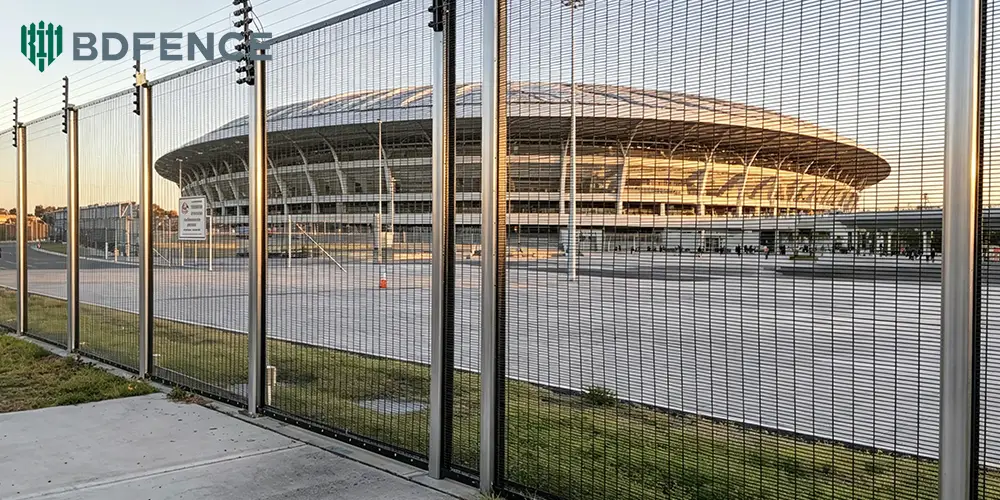
Ask a supplier for a Clear View fence and you may be offered more than one mesh opening. Wider arrangements around 76 × 50 mm are used for general boundaries. Intermediate openings around 76 × 25 mm appear in other commercial applications. The much narrower 358 configuration is commonly associated with applications requiring greater climbing deterrence.
These descriptions are useful for initial product selection, but they are not universal security certifications. A mesh marketed as “high security” has not necessarily passed a particular resistance test.
For a warehouse with a normal controlled perimeter, the project designer may specify a particular welded mesh arrangement based on the site’s security assessment. A data centre, restricted utility area or other sensitive facility may have more demanding requirements.
Would a dense 358 panel be appropriate in both cases? Possibly. But the decision belongs to the approved security design, not to a supplier’s marketing category.
There is another reason to be precise. If a contractor is extending an existing fence, a mesh that looks close enough in a small photograph can be noticeably different beside the installed panels. The dimensions, wire orientation, finish and fixing system all need to match.
Read the numbers behind 358 mesh
The traditional designation “358” comes from three inches by half an inch and approximately eight-gauge wire. In metric product descriptions, a common reference is 76.2 × 12.7 mm spacing with 4.0 mm wire.
One measurement detail can cause confusion: is the supplier describing wire-centre spacing or the clear opening between the wires?
Suppose the shorter 12.7 mm dimension is measured from one wire centre to the next. With a nominal 4.0 mm crossing wire, the clear space between the steel surfaces is approximately 8.7 mm before coating. If another supplier describes a 12.7 mm clear opening instead, the actual geometry is different.
That is why a dimensioned mesh drawing matters. The specification should identify both mesh directions, wire diameter, measurement convention and applicable tolerances. It is much more reliable than accepting “358 aperture” as the complete description.
For further technical background, see BDFENCE’s 358 mesh size and wire diameter guide.
Read the Panel Specification as a Complete Set of Dimensions
Start with wire diameter, then look at panel size
Imagine receiving two quotations for 2.4 m-high welded mesh panels. Both list the same nominal opening. The first specifies 4 mm steel wire, while the second uses a smaller diameter.
The offers are not equivalent. Even a modest change in wire diameter affects the amount of steel used. Because the cross-sectional area of round wire increases with the square of its diameter, moving from 3 mm to 4 mm represents a substantial increase in steel area per length of wire.
That doesn’t mean the thicker wire guarantees a particular security rating. Weld quality, steel properties, panel construction and the connections still matter. It does explain why apparently identical mesh panels can have noticeably different weights and prices.
Coating can complicate the comparison. Ask whether the quoted wire diameter refers to the steel core or the finished coated wire. A specification that simply says “4 mm coated wire” leaves an important question unanswered.
Match the panel width to the post connection
A buyer might see a 2.5 m panel width and divide a 200 m perimeter by 2.5 to estimate the order. That gives 80 nominal panel widths, but not necessarily 80 finished installation bays.
Gate openings need to be deducted. Corners and returns need posts. The connection system may also require an overlap or a particular spacing between post centres.
For this reason, the panel width shown in the product catalogue should be checked against the post-setting-out detail. Some systems use full-length clamp bars; others use brackets or specialized post profiles. Their dimensions are not interchangeable.
Higher panels also place different demands on the support system. A 3.0 m fence should not inherit the post dimensions and foundation detail of a shorter fence merely because the mesh opening is identical.
The responsible structural engineer needs to establish the post and foundation requirements for the project’s wind exposure, ground conditions, fence geometry and applicable rules. BDFENCE also provides a separate 358 fence post size guide for buyers comparing support arrangements.
Commercial and Industrial Sites Need Different Perimeter Decisions
A business park boundary is not the same as a restricted plant enclosure
Think about a commercial office development where visitors approach through landscaped grounds and parking areas. The fence may need to define a controlled boundary while allowing people inside the property to see the surrounding space.
At an industrial facility, the boundary could run behind loading yards, around valuable equipment or beside service roads. The security team may want clear sightlines, but the design must also account for vehicle access, maintenance work and areas where the fence meets other structures.
358 mesh is attractive in both settings because the closely spaced wires provide limited conventional handholds and footholds. Its open construction also allows visibility through the panels.
Yet mesh visibility should not be confused with a complete surveillance design. Camera placement, lighting, vegetation and the viewing angle still affect what security personnel can see. An unobstructed-looking panel cannot compensate for a blind corner behind a building.
For the buyer, the practical question is which parts of the perimeter have the same requirements. There may be no need to use identical panels at every location if the approved design specifies different boundary treatments. Any changes, however, should be deliberate and shown on the drawings.
Check the gate before the rest of the fence is finalized
The vehicle entrance is often where an otherwise straightforward fence order becomes complicated.
Is the stated gate width the clear opening for traffic or the overall manufactured width? Does the gate need to slide alongside the fence, or is there room for swing leaves? What happens to the mesh panel immediately beside the gate post?
These questions affect the supporting posts, concrete work and adjacent panel sizes. A gate frame using 358 mesh infill is not automatically equivalent to a gate designed for the same security requirements as the perimeter.
Where access control is specified, the mechanical gate and the electronic system should have coordinated interfaces and separate commissioning requirements. Emergency access and escape provisions also need to follow the approved design and applicable local requirements.
Ask for a gate schedule rather than relying on a line in the quotation that says “matching security gate.” The frame, infill, hinges or sliding equipment, locking hardware and support arrangement all need a defined scope.
Choose the Coating for the Site, Not Just the Colour
Johannesburg and Durban should not be treated as identical environments
A fence in an inland commercial development and one exposed to coastal air face different environmental conditions. For a site near Durban, Cape Town or another coastal location, salt exposure may be an important consideration. An inland industrial facility may instead have particular pollutants, drainage problems or other local exposure conditions.
There is no sensible single coating specification for every project in South Africa.
Buyers may encounter galvanized steel, powder-coated finishes or systems combining metallic and organic coatings. The suitability of each depends on the substrate preparation, coating process, specified performance and actual environment.
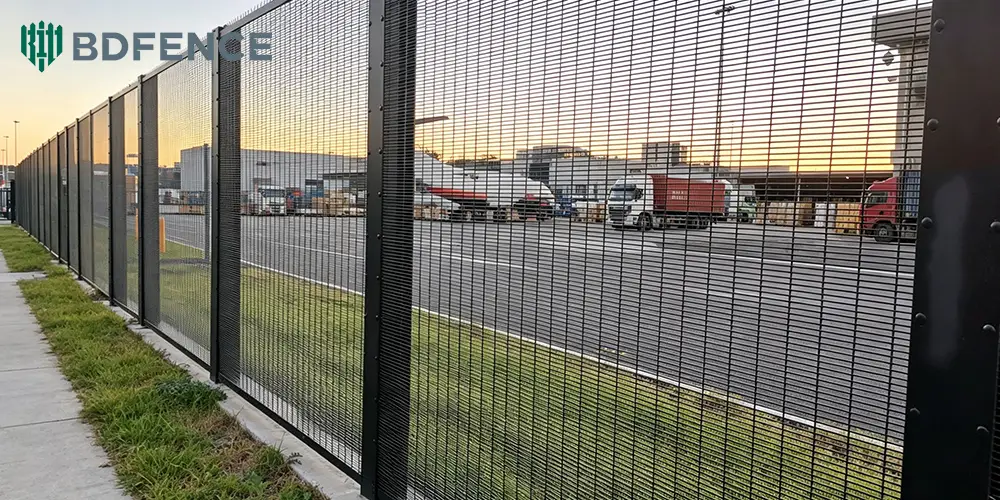
A supplier offering a black panel and another offering a black panel may have priced very different protective systems. The colour tells you little about the underlying corrosion protection.
Request the coating method, specified requirements and relevant inspection records. Where standards are referenced in the tender, the supplier’s offer needs to identify which components and processes those requirements cover.
Follow the finish through the whole fence
It is easy to concentrate on the panel and forget the hardware.
Will the brackets receive compatible corrosion protection? What about the bolts, gate hinges and cut edges? If the post has a welded base plate, how is that assembly protected?
These details become important when a shipment reaches site and the installer needs to drill, adjust or repair a component. A coat of matching paint is not automatically an acceptable repair to every coating system.
Any permitted field modification should follow the approved treatment method. Where cutting or drilling is not allowed, the installer needs an approved solution rather than altering the panel and treating the damage as a cosmetic issue.
The same care is worthwhile during delivery inspection. Record scratches, exposed metal or damaged components by bundle and item reference. Without that information, identifying which panels need attention becomes harder after the shipment has been distributed along the fence line.
Compare Quotations That Describe the Same Fence
Ask what is included in the price per metre
A South African contractor sourcing imported 358 mesh may receive quotations expressed per panel, per metre or for a complete project package. Those figures cannot be compared fairly until the quantities and included components are aligned.
One supplier might include mesh and ordinary posts. Another may offer panels with full-length security clamp bars, specified fasteners and a separate gate package. Even if their panel dimensions are identical, they are not pricing the same work.
Use a short technical comparison before evaluating the commercial terms:
| Check | What Must Be Clear |
|---|---|
| Mesh | Nominal spacing, wire orientation, steel diameter and tolerances |
| Panels | Height, overall width, edge detail and required finish |
| Posts | Profile, wall thickness, length and agreed installation arrangement |
| Connections | Clamp bars or brackets, fastener types and fixing positions |
| Gates | Clear openings, frames, supports, hardware and any separate equipment |
| Delivery | Packing, shipping terms, destination and excluded costs |
After the technical offers match, compare the delivered cost. An imported quotation may also involve freight, customs clearance, local handling and inland transport. The relevant costs depend on the agreed shipping terms and the buyer’s arrangements.
For a distributor holding stock, consistency between batches may matter as much as the price of the first shipment. For a contractor buying for one project, matching the approved BOQ and required delivery schedule may be more important.
Look for the missing drawing revision
Before the purchase order is released, ask one final question: are the supplier, consultant and installation contractor working from the same drawing revision?
A revised vehicle entrance can change panel quantities. An altered boundary alignment may introduce a special-width section. A higher fence at the rear of a facility may need different posts or more fixing points.
These are not just administrative changes. They affect the components that will be welded, coated, packed and shipped.
The final order documents should identify the approved drawings, panel schedule, gate requirements and relevant inspection deliverables. Any proposed substitution should be recorded and approved by the responsible party before manufacture.
Questions South African Buyers Commonly Ask
Q1. Is Clear View Fencing the same as 358 fencing?
Not always. “Clear View” is used for several welded mesh configurations in South Africa. A typical 358 specification uses narrow mesh spacing of about 76.2 × 12.7 mm with 4 mm wire. Ask for a dimensioned drawing rather than assuming that every Clear View panel has that geometry.
Q2. What 358 panel height is suitable for an industrial property?
There is no single correct height. Start with the project’s security and site requirements, then review the post system, foundations, gates and any approved top-security components. A taller panel alone does not establish the performance of the completed perimeter.
Q3. What should an overseas manufacturer receive before quoting?
Send the current fence layout, mesh specification, panel dimensions, post and connection details, gate schedule, coating requirements and bill of quantities. Include the delivery destination and any inspection or documentation requirements. If part of the design is still provisional, say so before the price is finalized.
Conclusion
The term Clear View Fencing is useful when searching for suppliers in South Africa, but it is not precise enough to approve a security fence order.
The mesh geometry must be defined. The posts and connections must suit the panels. Gates need their own details, and the coating should match the site’s actual exposure. A buyer who resolves those points can compare quotations on technical merit rather than on product names that happen to sound alike.
For commercial and industrial projects, that is the real value of a clear 358 mesh specification: the manufacturer knows what to produce, the contractor knows what to install, and the owner knows what the completed fence is supposed to meet.
Request 358 Clear View Fencing from BDFENCE
BDFENCE is a China-based manufacturer supplying metal fencing products to overseas contractors, distributors and project buyers. Our team has more than 30 years of experience in metal fence manufacturing.
For South African commercial and industrial enquiries, BDFENCE can review drawings and bills of quantities covering 358 mesh panels, steel posts, fixing systems, gates and the specified protective finish.
If you already have a tender specification, send it through Contact BDFENCE. If you are still comparing panel configurations, include the intended application, fence height, required mesh geometry and delivery location so the technical discussion starts with the right information.
Hebei Bendin Industrial Technology Co., Ltd. (BDFENCE)
Phone: +86 18703182863
WhatsApp: +86 18703287372
Email: info@bd-fence.com
Website: https://bd-fence.com/
Inquiry: Contact BDFENCE