


A 358 Security Fence panel may be the most visible part of the perimeter, but the posts carry much of the structural responsibility.
As fence height increases, the post system usually needs to change as well.
A 2.0m fence, a 2.4m fence, and a 3.0m fence should not automatically use the same post section, wall thickness, total length, fixing layout, or foundation design.
Therefore, the correct question is not:
“What post size is standard for 358 Fence?”
A better question is:
“What post specification matches this fence height, panel weight, fixing method, and project environment?”
Start with the Complete 358 Fence System
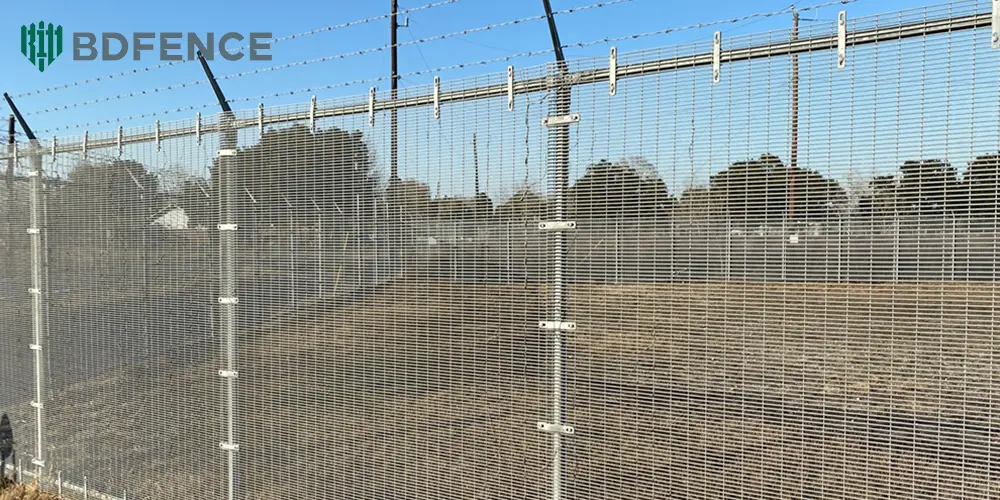
A 358 Fence system normally includes more than welded mesh panels.
The complete perimeter can include:
- 358 welded mesh panels
- Line posts
- Corner posts
- End or terminal posts
- Gate posts
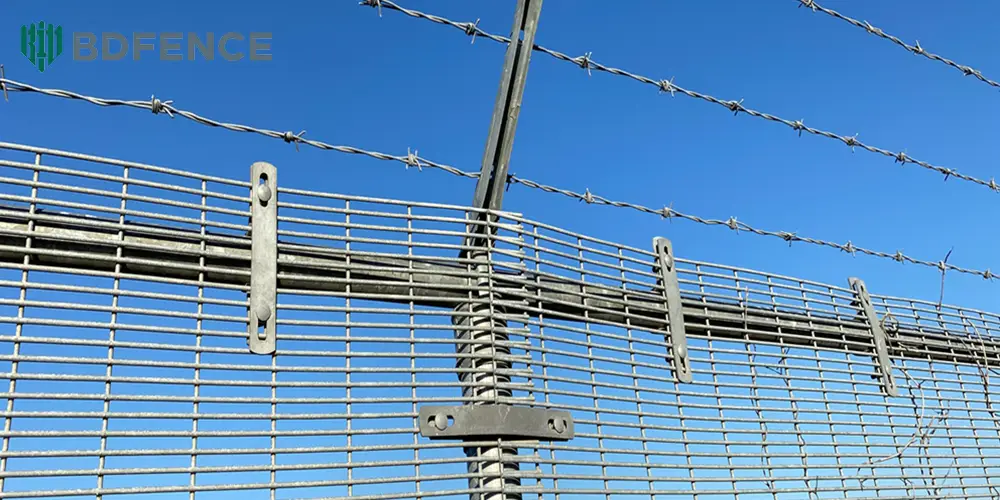
- Fixing bars or clamps
- Anti-tamper fasteners
- Pedestrian gates
- Vehicle gates
- Top security components where required
The posts must work with all of these elements.
Why Fence Height Changes the Post Requirement
As the fence becomes taller, more panel area is exposed above the ground.
That means the post system may need to deal with:
- Greater panel weight
- More wind exposure
- Higher bending demand
- More fixing points
- Longer post length
- Larger gate structures
- Additional top-security loads
Therefore, increasing fence height affects more than the panel itself.
2.0m, 2.4m and 3.0m 358 Fence Need Different Thinking
| Fence Height | Typical Project Direction | Post Consideration |
|---|---|---|
| About 2.0m | Commercial and controlled perimeter | Standard security post system may be suitable depending on project conditions |
| About 2.4m | Industrial, utility, data center and solar applications | Stronger post section and fixing review becomes more important |
| About 3.0m | High-security and restricted perimeter | Post size, wall thickness, fixing system, foundation and gate structure require closer review |
These are general selection directions only. Final post design should follow the actual project requirements.
Do Not Compare Post Size Without Wall Thickness
A post dimension alone does not fully describe the amount of steel in the post.
Two square or rectangular posts can have the same outside dimensions but different wall thicknesses.
That changes:
- Steel weight
- Rigidity
- Resistance to deformation
- Welding behavior
- Material cost
Therefore, a quotation that lists only “80 × 80 mm post” is incomplete if the wall thickness is not stated.
Post Length Is Not the Same as Fence Height
A 2.4m fence does not necessarily use a 2.4m post.
The total post length also depends on how the post is installed.
For embedded posts, the post needs additional length below the finished ground level.
For base-plated posts, the above-ground and fixing arrangement follow a different design.
Therefore, buyers should distinguish between:
- Finished fence height
- Panel height
- Total post length
- Embedment depth or base-plate design
Panel Width Also Affects the Post System
Fence height is not the only panel dimension that matters.
A wider 358 panel spans a greater distance between support points.
That can influence:
- Post spacing
- Panel rigidity
- Fixing layout
- Load transfer
Therefore, panel width and post spacing should be confirmed together.
Wire Diameter Changes Panel Weight
A 3mm, 4mm, or 5mm 358 panel does not place the same load on the support system.
When mesh geometry remains similar, thicker wire adds more steel to every panel.
That increases:
- Panel weight
- Handling weight
- Load on fixings
- Load on posts
- Gate infill weight
For this reason, post selection should consider wire diameter together with fence height.
Why 4mm 358 Fence Is Often Used as a Reference Point
A common metric 358 Fence configuration uses approximately 4.0 mm wire with a 76.2 × 12.7 mm mesh.
For many security projects, this becomes the reference configuration when selecting posts and fixings.
However, once the project moves to heavier wire or taller panels, the support system should be reviewed again rather than copied automatically.
Fixing Method Changes the Post Requirement
358 Fence panels can connect to posts in different ways.
Depending on the project, the system may use:
- Full-length clamp bars
- Steel fixing plates
- Security brackets
- Anti-tamper bolts
- Specialized nuts
The fixing method determines how loads are transferred from the panel into the post.
Therefore, post size and fixing design should be considered together.
Taller Panels Usually Need More Attention to Fixing Points
A tall 358 panel needs secure support from bottom to top.
If the fixing arrangement is too light or too widely spaced, the post may be strong while the connection between panel and post becomes the weak point.
This is why high-security perimeter design needs to review:
- Number of fixing points
- Fixing-bar length
- Bolt specification
- Anti-tamper hardware
- Post connection geometry
Corner Posts and End Posts May Need Different Specifications
Not every post in a 358 perimeter performs the same job.
Line posts support normal panel runs.
Corner posts deal with changes in fence direction.
End or terminal posts finish a fence run and may need additional structural attention depending on the design.
Therefore, buyers should not assume that every post should use the same section and wall thickness.
Gate Posts Need to Be Chosen from the Gate Backward
Gate posts should not simply copy the standard line-post specification.
A pedestrian gate and a wide vehicle gate place very different demands on the support structure.
Gate-post selection should consider:
- Gate width
- Gate height
- Gate frame weight
- 358 mesh infill
- Hinge arrangement
- Locking hardware
- Operating frequency
The larger the gate, the more important this becomes.
A 3m Fence with a Vehicle Gate Needs Special Attention
A 3m-high vehicle gate can become a heavy structure, especially when filled with 358 welded mesh.
The project may need to review:
- Gate frame section
- Frame wall thickness
- Gate post size
- Gate post wall thickness
- Hinge system
- Foundation design
- Opening method
For this reason, gate posts are often among the heaviest posts in the perimeter.
Top Security Changes the Post Design
Some 358 Fence projects include an additional security layer above the main panel.
Depending on the approved design, this may include:
- Post extensions
- Barbed wire
- Razor wire
- Other approved top-security systems
These components increase the total height and can add extra load to the post.
Therefore, top security should be included in the post specification before production begins.
Wind Exposure Matters More as the Fence Gets Taller
358 Fence is an open mesh system, but wind still acts on the wires, posts, gates, and top-security components.
Tall fences installed in exposed areas need greater attention to:
- Post section
- Wall thickness
- Post spacing
- Foundation design
- Gate structure
Coastal, desert, open industrial, and infrastructure sites may have different site conditions from sheltered commercial properties.
Post Spacing Should Match the Panel Design
Post spacing is usually connected to panel width.
A rigid welded 358 panel cannot be stretched or adjusted like woven Chain Link Mesh.
Therefore, accurate post positioning is critical.
If posts are installed with the wrong spacing, installers may face:
- Panel alignment problems
- Incorrect fixing positions
- Uneven gaps
- Gate-opening errors
This makes installation drawings especially valuable for large projects.
Foundation Design Is Part of Post Selection
A strong post still needs a suitable foundation.
Foundation design can depend on:
- Fence height
- Post size
- Post spacing
- Soil condition
- Wind exposure
- Gate loads
- Top security
- Local engineering requirements
For this reason, universal foundation dimensions should not be copied from another project without review.
Embedded Posts vs Base-Plated Posts
358 Fence can be installed using different post arrangements.
An embedded post extends into the foundation.
A base-plated post connects to a concrete structure or other approved base using anchors.
The correct option depends on the site and project design.
Buyers should identify the installation method in the RFQ because it affects:
- Total post length
- Base plate design
- Anchor requirements
- Factory fabrication
- Site installation
Surface Treatment Should Include the Posts
The mesh panel and post operate in the same outdoor environment.
Therefore, corrosion protection should be coordinated across the system.
Possible project directions may include:
- Galvanized posts
- Powder-coated posts
- Galvanized + powder-coated posts
The selected finish should match the project environment and approved specification.
What About Coastal Projects?
Coastal sites require more attention to exposed steel components.
The post system should be reviewed together with:
- Panels
- Fixing bars
- Bolts
- Gate posts
- Gate frames
- Post bases
A well-protected panel provides limited value if the posts or fixings use an unsuitable protection system.
A Practical Fence-Height and Post Review Guide
| 358 Fence Height | What Buyers Should Review |
|---|---|
| About 2.0m | Line-post section, wall thickness, panel width, fixing method and normal gate requirements |
| About 2.4m | Stronger post review, total post length, fixing points, foundations and vehicle gates |
| About 3.0m | Post section, wall thickness, foundation, wind exposure, heavy gates and top-security requirements |
| Above 3.0m | Project-specific high-security design and engineering review |
This table is intended as a purchasing guide, not a structural design substitute.
Why the Cheapest Post Can Increase Project Risk
When one supplier’s 358 Fence quotation is much lower than another, check the posts carefully.
The lower quotation may use:
- Smaller post section
- Thinner wall thickness
- Shorter total post length
- Lighter gate posts
- Different fixing hardware
- Different surface treatment
These changes can reduce the quotation even when the panel specification appears similar.
Therefore, panel price alone does not show the quality of the complete perimeter.
How to Compare 358 Fence Post Quotations
| Quotation Item | What to Confirm |
|---|---|
| Post Section | Square, rectangular or other specified size |
| Wall Thickness | Actual steel wall thickness |
| Total Post Length | Above-ground height plus installation requirement |
| Post Spacing | Matched to panel width and layout |
| Fixing Method | Clamp bars, brackets, plates or approved system |
| Gate Posts | Specified separately according to gate dimensions |
| Top Security | Included in the post design if required |
| Surface Treatment | Galvanized, powder coated or combined system |
| Installation Method | Embedded or base-plated |
A Better Way to Select 358 Fence Posts
For procurement, use this sequence:
- Confirm the security level
- Confirm fence height
- Confirm panel width
- Confirm mesh and wire diameter
- Select the fixing system
- Define line-post spacing
- Identify corners and end positions
- Design gate posts separately
- Include top security where required
- Review foundation and site conditions
This gives the supplier a much clearer basis for preparing a complete fence proposal.
What Should Be Included in a 358 Fence RFQ?
For a more accurate quotation, provide:
- Project country
- Project application
- Total perimeter length
- Fence height
- Panel width
- Mesh opening
- Wire diameter
- Preferred post size if already specified
- Post wall thickness
- Post spacing
- Embedded or base-plated installation
- Security fixing requirement
- Top security requirement
- Pedestrian gate dimensions and quantities
- Vehicle gate dimensions and quantities
- Surface treatment
- BOQ or perimeter drawings
- Destination port
If the post specification has not yet been finalized, BDFENCE can review the available project drawings and technical requirements before preparing the quotation.
How BDFENCE Supplies 358 Fence Post Systems
Hebei Bendin Industrial Technology Co., Ltd. (BDFENCE) manufactures 358 Security Fence systems for data centers, solar power plants, utilities, industrial sites, infrastructure projects, prisons, and other controlled-access facilities.
Our project supply can include:
- 358 welded security panels
- Different panel heights
- Different wire diameter options
- Customized line posts
- Corner and end posts
- Heavy-duty gate posts
- Fixing bars and security brackets
- Anti-tamper fasteners
- Pedestrian gates
- Vehicle gates
- Top-security supports
- Surface-treatment options
Project buyers can send BOQ documents, security layouts, perimeter drawings, and gate schedules directly to BDFENCE for review and quotation.
Final Answer: How Should Posts Match 358 Fence Height?
As 358 Fence height increases, the post system should be reviewed rather than copied from a lower fence.
Around 2.0m, the project may use a relatively standard security post arrangement depending on the site.
Around 2.4m, post section, wall thickness, fixing points, total length, foundations, and gate posts become more important.
Around 3.0m, the complete support system deserves closer attention, especially where the project includes heavy gates, strong wind exposure, or additional top security.
Most importantly, never compare 358 Fence posts by outside size alone.
Post section, wall thickness, total length, spacing, fixing method, installation type, gate loads, surface treatment, and foundation design all contribute to the final perimeter system.
Contact BDFENCE
Hebei Bendin Industrial Technology Co., Ltd. (BDFENCE)
Phone:
+86 18703182863
WhatsApp:
+86 18703287372
Email:
info@bd-fence.com
Website:
https://bd-fence.com/
FAQ
What size post should I use for 358 Fence?
There is no single post size for every 358 Fence. The correct specification depends on fence height, panel width, wire diameter, fixing method, post spacing, site conditions, gate loads, and foundation design.
Does 2.4m 358 Fence need larger posts than 2.0m fence?
A taller fence generally requires closer review of the support structure. Post size, wall thickness, total length, spacing, fixing points, and foundations may need to change.
What posts are needed for a 3m 358 Fence?
A 3m system should be reviewed as a complete high-security perimeter. Post section, wall thickness, gate posts, foundations, wind exposure, fixing system, and any top security should be considered together.
Should gate posts be larger than line posts?
They often need a different specification because gates place concentrated and moving loads on their supports. Final gate-post size should follow the actual gate dimensions and design.
Does thicker 358 Fence wire require stronger posts?
Heavier wire increases panel weight, so the support and fixing system should be reviewed when moving to a heavier mesh specification.
Can 358 Fence use base-plated posts?
Yes, where the project design allows it. Embedded and base-plated systems have different post lengths, fabrication details, anchors, and installation requirements.
Can BDFENCE customize 358 Fence post sizes?
Yes. BDFENCE can manufacture posts according to confirmed section size, wall thickness, total length, fixing method, finish, and project requirements.
Can I send a BOQ or fence drawing for post selection?
Yes. BDFENCE can review fence height, panel dimensions, wire specification, post schedule, gate requirements, security fixings, and project drawings before preparing a quotation.