



A data center can have excellent access control inside the building and still face a difficult question outside: where should the first controlled boundary begin?
The answer is not always the property line. A data center campus may contain server buildings, cooling equipment, electrical infrastructure, backup generators and service roads. Staff, contractors and delivery vehicles need access to different areas, but they should not all follow the same route.
For this illustrative U.S. data center project, the proposed solution uses 358 Mesh Fence to establish a defined external security perimeter. Dedicated pedestrian and vehicle gates provide controlled entry points, while the fence layout leaves room for security monitoring, maintenance and approved emergency access.
The main design challenge is not choosing a narrow mesh opening. It is coordinating the boundary with the site’s access-control strategy.
This article explains how such a project could approach perimeter planning, mesh specifications, gate locations, post connections and installation checks. It is an illustrative engineering scenario, not a record of a completed BDFENCE project in the United States.
Project Profile
| Project Item | Proposed Arrangement |
|---|---|
| Location | United States |
| Facility | Data Center Campus |
| Fence Type | 358 Welded Security Mesh Fence |
| Reference Mesh | 76.2 × 12.7 mm |
| Reference Wire Diameter | 4.0 mm |
| Panel Height | To be determined by the approved security design |
| Access Points | Controlled Pedestrian and Vehicle Entrances |
| Supporting Components | Steel Posts, Security Fixings and Gate Assemblies |
| Surface Treatment | Specified Galvanizing and Protective Coating |
| Project Status | Illustrative Application Scenario |
The mesh and wire dimensions above represent a commonly available 358 configuration. They are not a confirmed customer specification or an automatic security certification.
The Design Started with Access Routes, Not Fence Panels
Imagine a data center with a main administration entrance, a service yard and a separate route to electrical and cooling equipment. The building design is nearly complete, and the civil contractor now needs to establish the fence boundary.
One approach would be to draw a line around the property and add gates wherever a road crosses it. That might produce a workable boundary on paper. However, it does not explain which entrance staff will use, how visitors will be checked or where maintenance vehicles should go.
For this scenario, the security planner first identifies three types of movement:
- Authorized staff: Employees who enter through a designated pedestrian or controlled vehicle checkpoint.
- Visitors and contractors: People who require identity checks, authorization and access to approved areas.
- Service and delivery vehicles: Vehicles that need access to loading areas, generators, cooling equipment or other operational locations.
Once those routes appear on the site plan, the perimeter becomes easier to define. The fence separates uncontrolled exterior space from the campus, while the entrances manage the exceptions.
That order of work matters. Moving a gate after the fencing manufacturer has prepared the panel schedule may change the post locations, panel quantities, foundations and connection details.
Where Should the 358 Fence Run?
Keep the boundary continuous without blocking essential operations
The proposed 358 fence follows the approved security boundary rather than every change in the road layout. Along straight sections, standard mesh panels can provide a consistent fence line. Near access roads and building interfaces, the design may need shorter panels, different posts or special connections.
However, the site also contains infrastructure that needs maintenance.
Electrical equipment, cooling systems and emergency power installations may require access by specialist contractors. The fence should not create an obstruction that prevents authorized personnel from reaching those areas.
For example, if a maintenance route crosses the proposed perimeter, the designer needs to decide whether to include a controlled gate or revise the boundary. That decision belongs in the site security plan before manufacturing begins.
It is equally important to review emergency access. Fire and emergency service requirements vary by jurisdiction, so the project team should confirm the applicable local authority and fire department requirements.
Don’t forget changes in ground level
Data center campuses often contain concrete service roads, landscaped areas, drainage routes and equipment foundations. A fence running across those surfaces may encounter several ground levels.
The contractor needs to determine how the panels should follow the finished terrain.
On a gradual slope, the approved design may use a suitable stepped arrangement or another planned transition. Near retaining walls and concrete structures, special post or anchoring details may be necessary.
These areas deserve a separate drawing. A standard panel height does not determine the finished clearance beneath the fence.
Before ordering, the contractor should confirm that the fence layout, civil drawings and finished ground levels all use the same revision.
Why 358 Mesh Was Considered for This Application
A data center needs physical boundaries that work with its broader security arrangements. The fence provides a barrier and helps define controlled access points, but it does not replace surveillance, authentication or trained security personnel.
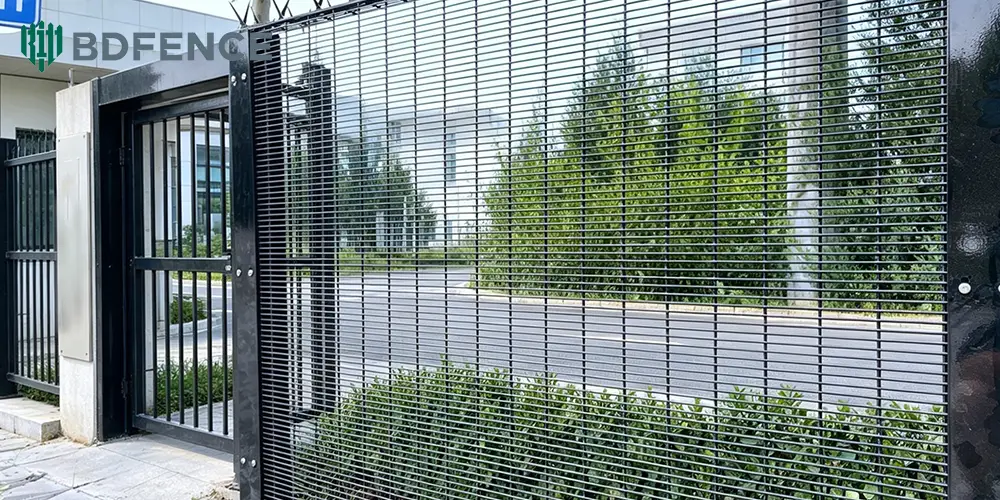
Conventional 358 mesh uses a narrow welded pattern, commonly specified at approximately 76.2 × 12.7 mm with 4 mm wire.
Compared with many larger-opening fence products, the narrow pattern offers fewer ordinary handholds and footholds. The welded construction also provides a relatively rigid panel when combined with suitable supports.
Another useful characteristic is visibility. Security officers and cameras can observe activity through the mesh rather than facing an opaque wall.
Even so, visibility depends on camera location, lighting, viewing angle and nearby objects. The mesh cannot guarantee a clear view from every position.
For this proposed campus, the 358 panel is one element of the perimeter. The final security performance depends on the specified posts, connections, gates, foundations and associated systems.
The Main Coordination Issue: Gates and Access Control
At a data center, the gate is more than an opening in the fence. It is the point where a person or vehicle moves from one security zone to another.
That means the gate schedule must satisfy both the fencing design and the access-control plan.
Pedestrian entrance: separate the gate hardware from electronic authorization
A pedestrian security gate may use a steel frame with matching 358 mesh infill. The manufacturer can supply the specified frame, hinges, posts, locking-related hardware and fixing components within the agreed scope.
However, an electronic access-control system is a separate part of the project.
Card readers, identity verification equipment, access permissions, alarm monitoring and event logging normally require coordination with the security systems integrator.
For this example, the project team would define the gate’s mechanical interface before selecting the electronic hardware.
The gate drawing should identify the opening dimensions, frame, hinge positions, lock provisions and relevant cabling interfaces. The security integrator can then confirm the approved access-control arrangement.
It is important not to assume that a fence manufacturer’s standard pedestrian gate includes a complete electronic access-control system.
Vehicle entrance: the gate must work with the checkpoint
Vehicles may enter through a staffed checkpoint, a controlled gate or another approved access arrangement. The selected operating method depends on the security plan and vehicle movements.
For the proposed data center, the gate location should allow vehicles to approach the checkpoint without obstructing public traffic or interfering with other site routes.
The gate schedule needs to identify the clear opening, gate type, movement space and structural requirements. If the design includes an automated gate, the system must also meet applicable operational safety requirements.
The gate frame can use matching 358 mesh infill for a consistent appearance. Still, its supporting posts and foundations may differ from those used along the ordinary fence line.
A vehicle gate supports moving loads. Therefore, the gate designer and responsible engineer must confirm the required frame, hardware and foundation arrangement.
Gate positions must match the surrounding panels
Consider a vehicle entrance located close to a corner. A standard-width mesh panel may not fit the short section between the gate post and the next line post.
The design team then needs a planned solution: a custom-width panel, a revised post position or another approved connection detail.
This is a small drawing issue with a practical manufacturing consequence.
If the supplier receives only the total fence length and a rough number of gates, it cannot reliably determine all the special panel dimensions. A gate schedule and dimensioned layout provide a much better starting point.
How the Fence Works with CCTV and Perimeter Monitoring
A data center may use security cameras, exterior lighting and intrusion monitoring around its property. The fence needs to coexist with those systems rather than interfere with them.
The proposed layout should therefore be reviewed with the security systems designer before finalizing the posts and gates.
At a corner, for instance, a post or nearby structure may affect a camera’s view. Beside a gate, the moving frame can temporarily change what the camera sees. Lighting fixtures and landscape features may also affect visibility.
These issues do not necessarily require a different fence product. They require coordination between the fence drawings and the approved surveillance layout.
If the perimeter design includes sensors or intrusion-detection equipment, the responsible specialist should specify how those components attach to, or operate alongside, the fence.
Likewise, any power and communications cables should follow the relevant electrical and security system drawings. The fencing manufacturer should not assume responsibility for the complete monitoring system simply because its posts provide possible mounting locations.
Reference Fence Specifications and Components
For procurement discussions, the following table shows how the proposed data center perimeter could be documented.
| Component | Reference Requirement |
|---|---|
| Mesh Construction | Welded 358 security mesh |
| Mesh Spacing | 76.2 × 12.7 mm nominal |
| Wire Diameter | 4.0 mm reference configuration |
| Panel Dimensions | To match the approved perimeter drawing |
| Line and Corner Posts | Specified steel profile, length and wall thickness |
| Fixing System | Compatible clamps, brackets and specified security fasteners |
| Pedestrian Gates | Specified frame, posts, hinges and locking interfaces |
| Vehicle Gates | Approved gate type, opening, frame and support system |
| Coating | Project-approved corrosion-protection system |
| Electronic Security | By the designated access-control and surveillance specialist |
The table is not a final construction specification. It gives the buyer and manufacturer a common basis for reviewing the expected supply package.
One particularly important detail is post spacing. A nominal panel width does not automatically equal the required distance between post centres. The connection system affects the final setting-out dimensions.
That is why the panel drawing, post schedule and fixing detail should be reviewed together.
What U.S. Security Requirements Should the Project Team Consider?
Data center security is usually designed through several layers of controls. Physical fencing forms part of that strategy, but the exact requirements depend on the operator, contractual obligations and facility risk assessment.
For technical context, NIST SP 800-53 Revision 5 identifies several relevant physical and environmental protection controls:
- PE-3 — Physical Access Control: Controlling authorized entry and exit at designated points.
- PE-6 — Monitoring Physical Access: Monitoring access to detect and respond to relevant security events.
- PE-8 — Visitor Access Records: Maintaining and reviewing visitor access information.
These controls help explain why a data center entrance needs more than a mechanical gate. However, NIST SP 800-53 does not establish a universal 358 mesh dimension or certify a particular fence product.
The facility’s security authority should identify which controls apply to the project and how they must be implemented.
For the reference guidance, see NIST SP 800-53 Revision 5.
The project also needs to consider applicable local building rules, gate safety requirements and emergency access provisions. Those matters require review by the responsible U.S. design and installation professionals.
What Was Reviewed Before the Proposed Order?
For a data center perimeter, approving the mesh panel alone would leave too many unanswered questions.
The proposed procurement review therefore focuses on four interfaces.
First: the mesh-to-post connection. The supplier needs approved post dimensions, wall thickness, panel widths, fixing positions and security fastener requirements.
Second: the post-to-foundation interface. The civil engineer must confirm how the fence supports connect to the foundations and whether the planned locations conflict with underground utilities.
Third: the fence-to-gate interface. Gate posts, closing panels and adjacent mesh connections should match the dimensioned entrance drawing.
Fourth: the mechanical-to-electronic interface. The gate supplier and security integrator should agree on the intended locking, monitoring and operating arrangements before the relevant components are manufactured or installed.
These reviews also help identify where responsibilities change between the fence manufacturer, civil contractor, gate installer and security systems integrator.
Factory Quality Checks and Export Packing
If the project proceeds to manufacturing, the factory should inspect the supplied components against the approved drawings and material schedule.
The inspection record would identify the relevant checks for the 358 panels, posts, fasteners and gates.
| Inspection Area | What to Verify |
|---|---|
| Welded Mesh | Wire diameter, mesh spacing and visible weld condition |
| Panel Dimensions | Height, width, flatness and agreed tolerances |
| Steel Posts | Profile, section dimensions, wall thickness and length |
| Fixing Components | Compatibility, dimensions, quantities and specified fasteners |
| Gate Frames | Opening dimensions, infill, hardware interfaces and overall geometry |
| Surface Treatment | Visible condition and required coating records |
| Export Packing | Component identification, protection and packing-list accuracy |
Packing deserves particular attention when several different panel heights or gate components form part of one order.
Standard panels may use one packing group, while custom-width closing panels need separate identification. Gate posts and hardware should also carry clear references to their intended locations.
That organisation helps the receiving contractor check the shipment before installation starts.
Installation and Handover: What Would Matter Most?
At installation, the first check should be whether the approved fence line still matches the finished site conditions.
Service roads, utility structures and drainage works may change during construction. If those changes affect a post or gate location, the contractor needs an approved revised detail before proceeding.
Once the line and gate posts are installed, the team can check the panel alignment, connection details and finished ground clearances.
However, the handover process must go beyond the fence itself.
For each controlled pedestrian or vehicle entrance, the responsible contractors should verify the mechanical operation, locking arrangement and any applicable access-control interfaces.
The security integrator should complete the relevant tests for readers, alarms, monitoring and system records. The fencing installer should confirm its own supplied and installed components against the approved specifications.
Any discrepancy should be recorded by location, with responsibility for correction assigned to the appropriate party.
This division of work helps the operator receive a coordinated perimeter rather than separate components that have never been tested together.
Related BDFENCE Data Center Project Experience
BDFENCE has published a separate 358 security fencing project for a data center in Germany.
According to that project reference, the supplied system used 76.2 × 12.7 mm welded mesh with 4.0 mm wire, together with steel posts, security fittings, pedestrian gates and vehicle gates.
The German project is a relevant example of how a fencing package can support controlled access around sensitive infrastructure. It is not the U.S. project described in this illustrative scenario.
Read the published project: 4mm Wire 358 Security Fence Project for a Data Center in Germany.
What This Application Demonstrates
For a data center, a perimeter fence should support the site security strategy rather than dictate it.
The first important decision is where people and vehicles should enter. The second is how the fence line connects those controlled points. Only then can the manufacturer prepare reliable panel, post and gate quantities.
358 welded mesh can provide a narrow-opening physical boundary with visibility through the fence. Yet its contribution depends on compatible posts, security fixings, properly designed gates and a coordinated installation.
The value of the proposed system lies in that coordination—not in treating one mesh dimension as a complete security solution.
Discuss Your Data Center Fence Requirements with BDFENCE
BDFENCE is a China-based metal fencing manufacturer serving overseas contractors, distributors and industrial project buyers.
For a data center perimeter enquiry, the purchasing team can provide the approved site layout, security fence specification, panel schedule, post details, gate drawings and bill of quantities.
BDFENCE can review the requested 358 welded mesh panels, steel posts, fixing systems and agreed gate components against those documents.
The project should separately identify responsibility for structural design, civil works, electronic access control, surveillance systems and any required certification or testing.
If you are preparing a data center security fence order, send your drawings or BOQ through Contact BDFENCE to request a factory quotation.
Frequently Asked Questions
Why is 358 mesh fencing considered for data centers?
Its narrow welded mesh provides fewer conventional climbing holds than many larger-opening fence products. It also allows visibility through the boundary. However, the complete security arrangement depends on posts, fixings, gates and the site’s wider security systems.
Can a 358 security gate connect to an electronic access-control system?
A suitable gate can include mechanical provisions for specified locking and access-control hardware. The electronic system, hardware compatibility and operating logic must be coordinated with the responsible security integrator.
Does NIST SP 800-53 require a particular 358 fence height?
No. NIST SP 800-53 identifies physical security controls but does not prescribe one universal 358 fence height for every data center. The height and complete perimeter design should follow the facility’s security assessment and applicable project requirements.
What information should a data center contractor send for a quotation?
Provide the fence layout, panel height, mesh and wire specifications, post system, fixing requirements, gate schedule, surface treatment, quantities and delivery destination. Identify any special interfaces with the access-control contractor.
Contact BDFENCE
Hebei Bendin Industrial Technology Co., Ltd. (BDFENCE)
Planning a 358 mesh security fence for a data center in the United States? Send your perimeter drawing, gate schedule or BOQ for a project-based quotation.
Phone: +86 18703182863
WhatsApp: +86 18703287372
Email: info@bd-fence.com
Website: https://bd-fence.com/
Inquiry: Contact BDFENCE