


A damaged section of 358 fencing does not always require a complete fence replacement. Sometimes the mesh panel is the only component that needs attention. In other cases, the damage extends to the supporting post, concrete foundation or fixing system.
This distinction appears in a 2026 Transnet National Ports Authority procurement document for fencing around the Port of Durban. The scope includes removing damaged 358 mesh panels, replacing damaged intermediate and corner posts, and supplying compatible comb clamps and anti-vandal bolts. The service covers installation and repairs on an as-and-when-required basis over 36 months.
The specified system includes 4 mm wire, 76.2 × 12.7 mm mesh openings, galvanized steel with Polymetic 6000 coating and 80 × 80 × 2.5 mm supporting posts. These details show how closely the panel, post and fixing specifications need to match when contractors replace damaged sections.
For South African industrial operators, maintenance contractors and fencing distributors, the important question is not simply where the fence is damaged. It is which components can remain in service and which ones need replacement. BDFENCE supplies Industrial Park 358 Fence panels and supporting components for projects that require coordinated specifications.
Start by Identifying What Actually Failed
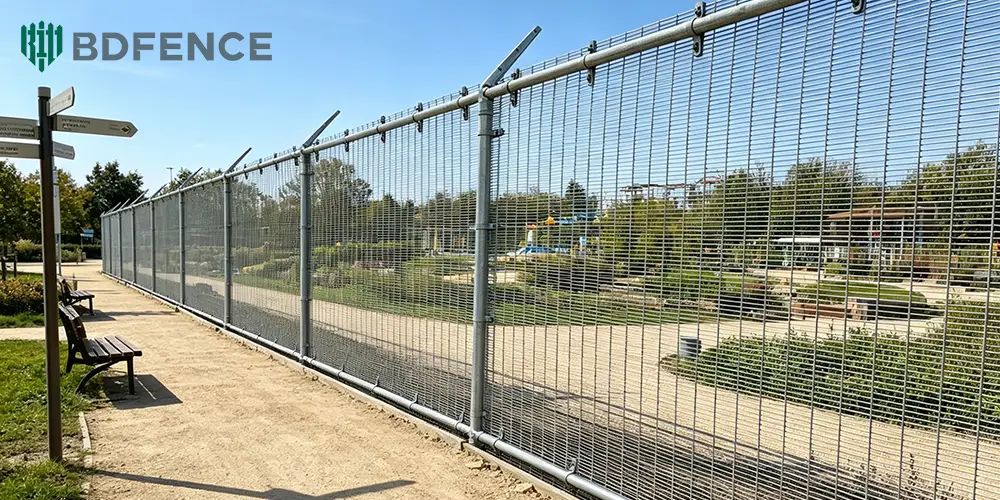
A 358 security fence is made up of several connected components. Damage to one part can affect the others, but it does not mean the entire fence needs replacing.
During an inspection, divide the affected area into four groups:
- Mesh panel: Check for cut wires, broken welds, bent sections and damaged panel edges.
- Posts: Look for bending, movement, corrosion and damage around the ground line.
- Fixing system: Inspect clamps, brackets, bolts and anti-tamper fasteners.
- Foundation: Check for cracks, movement, loose concrete and changes in post alignment.
These checks help the maintenance team decide whether a repair can restore the original arrangement or whether a larger section needs replacement.
For example, a panel with damaged mesh but firmly positioned posts may need a different repair scope from a panel attached to a post that has moved out of alignment.
When Is It Enough to Replace the 358 Mesh Panel?
Panel replacement may be suitable when the supporting structure remains in good condition.
Several types of damage can affect the welded mesh:
Cut or broken wires
Cut wires create openings in the narrow mesh pattern. They can also weaken nearby welded intersections.
A small damaged area may appear manageable, but the maintenance team should check the surrounding wires and welds before deciding how to proceed.
If the damage affects several wires or compromises the panel’s security function, replacing the complete panel is often more practical than attempting to reconstruct the original welded mesh on site.
Panel deformation
Impact from vehicles, machinery or other equipment can bend a panel out of its original shape.
The inspection should focus on the horizontal reinforcement, panel edges and fixing positions. A deformed panel may no longer fit correctly between its posts, even if the damage looks minor from a distance.
Do not force a badly bent panel back into position without checking its welds and structural condition. Doing so can create additional stress around the connections.
Damaged panel flanges and bends
Many 358 systems use formed horizontal bends or flanges to improve panel rigidity.
These features also affect how the panel fits its supporting posts and fixing hardware.
If an impact damages a formed section, check whether the panel can still maintain its intended shape and connection. A replacement should match the original panel dimensions and bend arrangement.
This matters particularly when an existing perimeter uses customized panels rather than a basic flat mesh configuration.
Post Damage: Why Replacing the Panel Alone May Not Work
A new mesh panel cannot correct a supporting post that has bent or moved.
In fact, attaching a replacement panel to an unstable post may create another problem after installation.
For 358 security fencing, inspect the following post conditions:
- Visible bending or twisting.
- Movement at the base of the post.
- Corrosion around exposed or ground-level areas.
- Damaged post caps or exposed openings.
- Cracks around the concrete foundation.
- Incorrect panel alignment caused by post movement.
A post that remains straight and securely fixed may be suitable for continued use, even if the attached panel needs replacement.
However, a damaged post should receive a separate assessment. The contractor may need to remove it, replace the foundation or install a new supporting post according to the approved design.
For larger 358 installations, post dimensions and wall thickness deserve particular attention. See the 358 Fence Post Size Guide for more information about matching post configurations with fence height and project conditions.
Fixing Hardware: Small Components That Can Affect the Entire Panel
Security clamps and bolts receive less attention than the mesh itself. Yet they determine how securely the panel connects to the posts.
Some high-security 358 systems use cover plates, comb clamps and anti-tamper bolts. Their arrangement can differ from one manufacturer or project specification to another.
The Port of Durban specification provides a useful South African example. Its 358 panel arrangement identifies:
- 8 double-bolt comb clamps.
- 8 single-bolt comb clamps.
- 24 anti-vandal bolts.
- Internal panel fixing positions.
These quantities belong to that particular tender specification. They should not be copied automatically into every 358 fence order.
When replacing damaged fixings, check the following:
| Component | Inspection Point |
|---|---|
| Comb Clamps | Deformation, cracks and compatibility with the panel |
| Anti-Vandal Bolts | Damaged heads, missing bolts and thread condition |
| Cover Plates | Alignment and secure contact with the post |
| Brackets | Position, corrosion and connection condition |
| Post Caps | Missing caps, loose fitting and exposed post openings |
Using ordinary replacement bolts in a system designed for anti-tamper hardware can change the original security arrangement. The replacement parts should match the approved fixing specification.
Coating Damage: Repair the Finish or Replace the Component?
South African industrial and port facilities need to pay attention to corrosion protection. Rain, moisture, industrial pollutants and coastal exposure can affect steel components over time.
A damaged coating does not always mean the entire panel needs replacing. The decision depends on the size of the damaged area, the condition of the underlying steel and the coating system.
Local coating damage
Small scratches or isolated coating defects may allow an approved repair process.
Before applying a repair coating, the maintenance team should identify the original surface treatment and follow a compatible preparation and repair method.
Applying an ordinary paint over a damaged polymer coating does not automatically restore the original protective system.
Widespread corrosion
If corrosion affects several wires, weld intersections or a large part of the panel, replacement may offer a more reliable solution.
The same applies to posts. Corrosion around the base can be particularly important because it affects a structural support rather than just the visible mesh.
For this reason, inspect the panel and post separately. Their coating condition may be different even when both components were originally supplied with the same finish.
Check the complete coating specification
The Port of Durban 358 specification provides an example of a multi-stage protective system. It identifies hot-dip galvanizing followed by Polymetic 6000 coating for the panels, posts and fixtures.
It also specifies UV-stabilized polymer post caps and matching surface treatment for the additional security components.
This is a project-specific specification, not a universal requirement for every South African 358 fence.
For replacement orders, the contractor should record the existing coating system before requesting new materials. Otherwise, the repaired section may have a different finish from the surrounding fence.
The Port of Durban Specification: What Makes Replacement More Complicated?
The Transnet National Ports Authority’s 2026 procurement document is particularly useful because it describes panel replacement and post replacement as separate work items.
Its 358 mesh specification includes the following details:
| Specification | Port of Durban Reference |
|---|---|
| Panel Dimensions | 2,515 × 3,300 mm |
| Mesh Opening | 76.2 × 12.7 mm, measured at wire centres |
| Wire Diameter | 4 mm |
| Horizontal Reinforcement | 4 recessed V-shaped formations, 50 mm deep |
| Side Flanges | Two 70° flanges |
| Top Flange | 90° |
| Bottom Flange | 30° |
| Post Section | 80 × 80 × 2.5 mm |
| Post Length | 4,200 mm |
| Post Cap | UV-stabilized polymer cap |
| Surface Treatment | Hot-dip galvanized + Polymetic 6000 |
| Foundation Reference | 400 × 400 × 900 mm, 30 MPa concrete |
The document also identifies internal security fixings and a 100 mm high steel shark-tooth spike at specified intervals.
These details explain why ordering a replacement panel based only on the familiar 358 mesh opening can lead to compatibility problems.
The mesh may have the correct aperture and wire diameter but still differ in its formed edges, reinforcement, fixing positions or overall dimensions.
For a replacement order, the original drawing is often more useful than a product photograph.
How to Decide Between Repairing and Replacing a Section
The maintenance team can use the following table as an initial inspection guide. Final decisions should follow the project specification and engineering assessment.
| Observed Condition | Possible Action |
|---|---|
| Small isolated coating scratch | Inspect steel and use an approved coating repair method |
| Missing or damaged fixing bolt | Replace with compatible approved hardware |
| Damaged clamp or cover plate | Replace the affected fixing component |
| Several cut wires or broken welds | Assess full panel replacement |
| Severely bent panel | Check panel replacement and fixing compatibility |
| Bent or unstable post | Assess post and foundation replacement |
| Cracked or moving foundation | Obtain structural assessment and repair the foundation |
| Damaged gate frame or hinge | Assess the gate assembly separately |
The key is to avoid treating every defect as a mesh problem. A damaged panel and a failed foundation require different work, different materials and different cost estimates.
What Should a 358 Fence Maintenance Inspection Record Include?
Large facilities benefit from keeping a record of damaged sections rather than relying on verbal reports from security staff or maintenance workers.
A simple inspection sheet can record:
- Fence location and section identification.
- Panel height and width.
- Type of mesh construction.
- Wire diameter and aperture.
- Condition of panel bends and welds.
- Post dimensions and visible condition.
- Fixing hardware and missing components.
- Foundation condition.
- Coating damage and corrosion.
- Photographs and recommended replacement quantities.
After inspection, the maintenance team can separate minor repairs from full component replacement.
This also makes procurement easier. Instead of requesting a general quantity of 358 mesh panels, the buyer can provide a list of specific replacement parts and their original dimensions.
Replacement Panels Must Match the Existing Fence
Compatibility is often the biggest issue when replacing only a small section of an older perimeter.
The existing fence may use a particular post system, panel width, bend arrangement and fixing method. A new panel with the same mesh opening may still fail to fit the original structure.
Before ordering, compare:
- Panel height and width.
- Horizontal and vertical wire diameters.
- Mesh aperture measurement method.
- Number and depth of reinforcing bends.
- Side, top and bottom flange details.
- Post profile and fixing position.
- Clamp and bolt specifications.
- Galvanizing and polymer coating.
For older installations, a physical sample or dimensioned drawing can help confirm the correct replacement configuration.
Where the original product has been discontinued, the contractor should obtain approval for an alternative before ordering or modifying the existing fence.
Planning Spare Parts for Long-Term Industrial Operations
Large industrial facilities do not always replace damaged fencing immediately. Some keep compatible panels, clamps, bolts and post components available for future maintenance.
The quantity of spare parts should reflect the site’s operational risk, repair history, replacement lead time and storage capacity.
For example, a port or warehouse with several kilometres of perimeter fencing may benefit from holding a small stock of matching fixing hardware. These parts take up less space than complete panels but can help resolve minor problems without waiting for a new shipment.
Full spare panels require more storage space and careful protection against handling damage. Their dimensions and coating should match the existing fence system.
For overseas projects, discuss spare-part quantities when placing the original order. Combining approved spare components with the main shipment may simplify future procurement.
What BDFENCE Can Supply for 358 Fence Replacement Orders
BDFENCE manufactures 358 welded security fence panels and related components for industrial facilities, warehouses, infrastructure sites and other controlled-access applications.
Its published Industrial Park 358 Fence range includes:
- Mesh openings of 76.2 × 12.7 mm and 75 × 12 mm.
- Wire combinations of 4.0 × 3.0 mm, 4.0 × 4.0 mm, 4.5 × 3.0 mm and 4.5 × 4.5 mm.
- Panel heights from 1,800 mm to 3,000 mm.
- Panel widths from 2,000 mm to 3,000 mm.
- Square, I-section and H-section post options.
- Different fixing and coating configurations.
These are published product options. They do not automatically match every existing 358 fence installation.
For replacement enquiries, provide photographs, original drawings, panel dimensions, post specifications and fixing details. BDFENCE can review the requested manufacturing scope and prepare a quotation for compatible replacement panels, posts and fittings.
For installation information, see the 358 Fence Installation Guide.
If the replacement involves a different post configuration, the 358 Fence Post Size Guide provides additional technical information.
To request a quotation, send your drawings or BOQ through Contact BDFENCE.
FAQ
Can I replace a damaged 358 fence panel without changing the posts?
Yes, if the existing posts remain straight, stable and compatible with the replacement panel. Check the post fixing positions, panel dimensions and clamp arrangement before ordering.
When should a 358 fence post be replaced?
A post may need replacement if it is badly bent, unstable, severely corroded or connected to a damaged foundation. The supporting structure should be assessed before installing a new panel.
Can I use a standard 358 panel to replace a customized security panel?
Not automatically. Customized panels may have different widths, reinforcing bends, flanges and fixing positions. Compare the original drawing and obtain approval for any alternative configuration.
How often should a 358 security fence be inspected?
Inspection frequency should follow the facility’s risk assessment, operating conditions and maintenance contract. Ports, warehouses and critical infrastructure sites may need more frequent checks after impacts, severe weather or reported security incidents.
Can damaged PVC or polymer coating be repaired?
Small isolated defects may allow an approved repair method. Extensive coating damage, exposed corrosion or deterioration around welded areas may justify replacing the affected component. Always use a repair system compatible with the original finish.
Does the Port of Durban specification apply to all South African 358 fences?
No. Its 2026 procurement document describes a particular port fencing system, including specific panel dimensions, coating, posts and fixings. Other South African projects may have different requirements.
Can BDFENCE supply replacement 358 panels and posts?
BDFENCE manufactures 358 mesh panels, posts and related fixing components. Buyers should provide the original dimensions and drawings so the requested replacement products can be checked for compatibility.
Contact BDFENCE
Hebei Bendin Industrial Technology Co., Ltd. (BDFENCE)
Need replacement 358 fence panels, posts or anti-tamper fixings for a South African industrial project? Send your existing fence specifications, photographs or BOQ for a manufacturing quotation.
WhatsApp: +86 18703287372
Email: info@bd-fence.com
Website: https://bd-fence.com/
Inquiry: Contact BDFENCE