


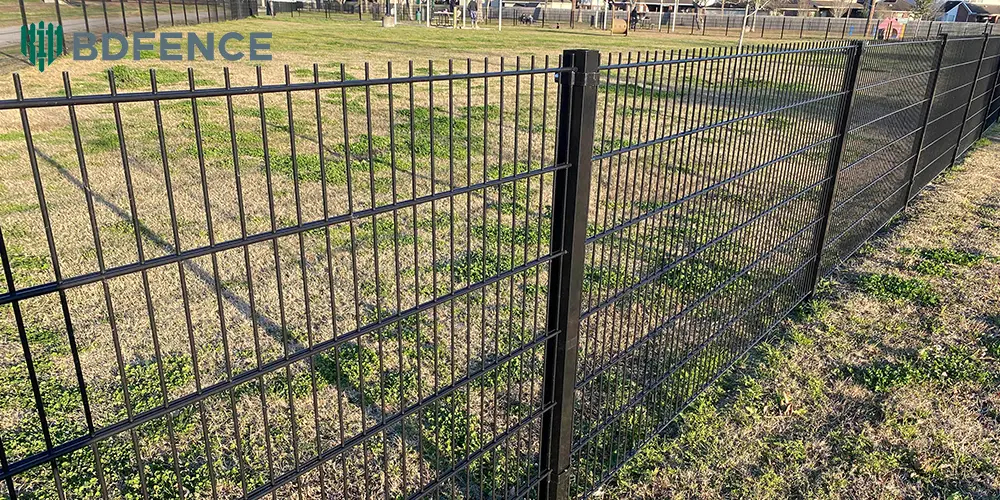
A 2D Fence is a rigid welded wire mesh fence designed with two horizontal wires and one vertical wire at each horizontal line.
This double-horizontal-wire structure is the main feature that separates 2D Fence from many standard single-wire welded mesh panels.
The extra horizontal wire increases panel rigidity and helps the fence maintain a flat, strong appearance over long perimeter runs.
For buyers, however, the term “2D Fence” is only the beginning of the specification.
Before ordering, you should also confirm:
- Horizontal wire diameter
- Vertical wire diameter
- Mesh opening
- Panel height
- Panel width
- Post size
- Fixing system
- Surface treatment
- Gate requirements
What Does “2D” Mean in 2D Fence?
The “2D” name refers to the panel construction.
At each horizontal mesh line, the vertical wire is reinforced by two horizontal wires.
This creates a structure similar to:
Horizontal wire + Vertical wire + Horizontal wire
The two horizontal wires run parallel to each other on opposite sides of the vertical wire.
This extra steel gives the panel greater rigidity than a typical single-horizontal-wire welded mesh panel.
Why Double Horizontal Wires Matter
The double-wire construction increases steel at the horizontal reinforcement points.
That can help improve:
- Panel stiffness
- Resistance to bending
- Long-term panel shape
- Impact resistance
- Overall visual rigidity
For commercial, industrial, school, sports, logistics, and public infrastructure projects, this can make 2D Fence attractive where buyers want a rigid welded panel system.
What Is the Typical Wire Arrangement?
2D Fence specifications are often written using three wire dimensions.
For example:
6/5/6 mm
This normally means:
- 6 mm horizontal wire
- 5 mm vertical wire
- 6 mm second horizontal wire
Another example could be:
8/6/8 mm
This indicates a heavier panel with thicker horizontal reinforcement and vertical wire.
6/5/6 vs 8/6/8 2D Fence
| Specification | Horizontal Wires | Vertical Wire | General Character |
|---|---|---|---|
| 6/5/6 mm | 6 mm + 6 mm | 5 mm | Commercial / general perimeter |
| 8/6/8 mm | 8 mm + 8 mm | 6 mm | Heavier-duty rigid panel |
The heavier option contains more steel and normally increases panel weight, rigidity, post requirements, shipping weight, and project cost.
Therefore, buyers should select the wire arrangement according to the actual application rather than automatically choosing the thickest panel.
What Mesh Size Does 2D Fence Use?
A common 2D welded mesh configuration uses rectangular openings.
The exact mesh size can vary by project and manufacturer.
Buyers should confirm:
- Horizontal mesh spacing
- Vertical mesh spacing
- Actual clear opening
Mesh size affects appearance, steel consumption, visibility, and the overall feel of the panel.
Why Mesh Opening Matters
A smaller mesh opening uses more wire across the same panel area.
That can increase:
- Panel weight
- Steel usage
- Fabrication cost
- Perimeter density
A larger mesh opening reduces steel usage but creates a more open panel.
The correct mesh should follow the required security level, visibility, and project specification.
What Panel Heights Are Available?
2D Fence can be manufactured in different heights according to the project.
Typical applications may require heights such as:
- 1.0 m
- 1.2 m
- 1.5 m
- 1.8 m
- 2.0 m
- 2.4 m
- Other customized heights
As panel height increases, buyers should also review:
- Post size
- Post wall thickness
- Fixing quantity
- Foundation design
- Gate height
Panel Width Also Affects the Fence System
2D Fence panels are rigid welded products.
Unlike woven Chain Link Fence, they cannot simply be stretched between posts.
Panel width therefore directly affects:
- Post spacing
- Panel quantity
- Bracket quantity
- Installation layout
For large projects, the panel width should be confirmed before the post layout is finalized.
Why 2D Fence Is So Rigid
The rigidity comes from three main factors:
- Welded wire intersections
- Double horizontal reinforcement
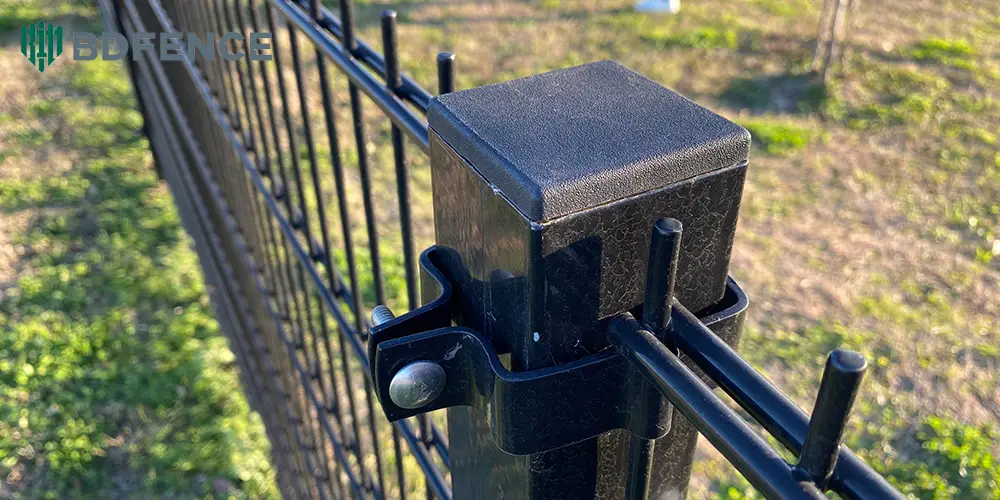
- Rigid panel-to-post fixing
Together, these create a fence that behaves more like a structural panel than a flexible mesh roll.
This is one reason 2D Fence is often used where a clean, straight perimeter line is important.
What Are the Main Applications of 2D Fence?
2D Fence can be used for:
- Commercial properties
- Industrial facilities
- Schools
- Sports facilities
- Warehouses
- Logistics centers
- Public infrastructure
- Residential developments
- Utility compounds
The correct wire thickness, panel height, post system, and finish should be selected according to the site.
Why Schools Often Use Rigid Welded Mesh Fence
School and public-area projects often value:
- Visibility
- Rigid construction
- Clean appearance
- Controlled pedestrian gates
- Low-maintenance welded panels
2D Fence can fit these applications when the mesh opening, height, gate design, and local safety requirements match the project specification.
Why Industrial Sites Use 2D Fence
Industrial buyers may prefer 2D Fence because the panels are rigid and visually organized.
The system can work around:
- Factories
- Warehouses
- Equipment compounds
- Service yards
- Parking areas
- Internal security zones
For heavier-duty areas, thicker wire options and stronger posts can be considered.
2D Fence vs 3D Fence
2D Fence and 3D Fence are both welded mesh systems, but the panel structures are different.
2D Fence relies on double horizontal wires for rigidity.
3D Fence normally uses V-shaped bends or reinforcement folds in the panel.
| Feature | 2D Fence | 3D Fence |
|---|---|---|
| Main Reinforcement | Double horizontal wire | V-bends / pressed folds |
| Panel Appearance | Flat | Profiled |
| Rigidity Method | More horizontal steel | Panel geometry |
| Typical Use | Rigid commercial and industrial perimeter | General welded mesh perimeter |
2D Fence vs 358 Fence
2D Fence and 358 Fence are also different products.
358 Fence uses a very narrow mesh opening designed primarily for anti-climb security.
2D Fence generally uses a larger welded mesh and focuses more on rigid panel construction.
| Feature | 2D Fence | 358 Fence |
|---|---|---|
| Panel Structure | Double horizontal welded wire | Narrow welded security mesh |
| Main Priority | Rigidity and perimeter control | Anti-climb security |
| Mesh Character | More open | Very narrow |
| Typical Application | Commercial, industrial, school, sports | High-security and restricted sites |
2D Fence vs Chain Link Fence
The construction principle is completely different.
2D Fence uses rigid welded panels.
Chain Link Fence uses flexible woven mesh supplied in rolls.
| Feature | 2D Fence | Chain Link Fence |
|---|---|---|
| Construction | Rigid welded panel | Flexible woven mesh |
| Installation | Panel-to-post fixing | Tensioned between posts |
| Appearance | Flat, structured panel | Traditional woven mesh |
| Uneven Ground | May require stepped layout | More flexible |
What Post System Does 2D Fence Need?
Post specification should match the panel height, wire weight, panel width, wind exposure, and site conditions.
A proper post specification should include:
- Post section
- Wall thickness
- Total length
- Post spacing
- Surface treatment
- Embedded or base-plated installation
Do not compare post prices using outside dimensions alone.
Post Wall Thickness Matters
Two posts can have the same outside section and different wall thicknesses.
That changes:
- Steel weight
- Rigidity
- Structural behavior
- Material cost
For project quotations, confirm both outside section and wall thickness.
How Are 2D Panels Fixed to Posts?
Different systems can use:
- Steel brackets
- Clamps
- Fixing plates
- Bolts and nuts
- Other project-specific connections
The fixing method should match the panel and post design.
For taller or heavier panels, fixing quantity and connection strength become more important.
Embedded Posts vs Base-Plated Posts
2D Fence can be installed using embedded posts or base-plated posts depending on the site.
Embedded posts extend below ground into a foundation.
Base-plated posts connect to an existing concrete structure using anchors.
The selected method affects:
- Total post length
- Base plate size
- Anchor requirements
- Installation cost
What Surface Treatments Are Available?
2D Fence can be supplied with different corrosion-protection systems.
Possible project options include:
- Galvanized finish
- Powder-coated finish
- Galvanized + powder-coated finish
The correct option depends on the environment and required appearance.
Why Powder Coating Is Popular for 2D Fence
Powder coating gives the rigid welded panels a consistent architectural color.
This can work well around:
- Schools
- Commercial properties
- Residential developments
- Sports facilities
- Public spaces
Common project colors may include green, black, gray, and other RAL colors.
When Should You Consider Galvanized + Powder Coated?
Projects in humid, coastal, industrial, or long-term outdoor environments may require stronger corrosion protection.
A galvanized base combined with a compatible powder-coated outer layer can provide:
- Base corrosion protection
- Architectural color
- Additional outer barrier
The final coating system should follow the project specification.
How Wire Thickness Affects Cost
Wire diameter is one of the largest cost drivers in 2D Fence.
Heavier specifications increase:
- Steel content
- Panel weight
- Post load
- Gate infill weight
- Shipping weight
Therefore, 8/6/8 mm panels will normally cost more than lighter 6/5/6 mm panels when the other dimensions remain similar.
Panel Height Also Changes the Price
A taller panel contains more wire and creates more coating area.
It may also require:
- Longer posts
- More fixing points
- Stronger gate frames
- Different foundations
This is why buyers should not compare 2D Fence quotations without confirming the exact panel height.
How Gates Should Match the 2D Fence
A complete project may include:
- Pedestrian gates
- Double swing gates
- Sliding vehicle gates
The gate infill can use matching welded mesh so the entrance remains visually consistent with the fence.
However, gate frames and gate posts need separate structural design.
Gate Posts Are Different from Line Posts
Line posts support fixed panels.
Gate posts support moving structures.
Gate-post selection should consider:
- Gate width
- Gate height
- Frame weight
- Mesh infill weight
- Hinge or sliding system
- Operating frequency
Wide vehicle gates may require much heavier posts than normal fence sections.
How to Calculate 2D Fence Quantity
The basic panel formula is:
Panel Quantity = Net Fence Length ÷ Panel Width
Before using this formula, deduct:
- Pedestrian gate openings
- Vehicle gate openings
- Unfenced sections
Then calculate line posts, corner posts, end posts, and gate posts separately.
What Should Be Included in a 2D Fence BOQ?
| BOQ Item | What to Confirm |
|---|---|
| Panels | Height, width, wire specification, mesh opening and quantity |
| Line Posts | Section, wall thickness, length and quantity |
| Corner / End Posts | Separate size and quantity |
| Fixings | Bracket, clamp, bolt and quantity |
| Pedestrian Gates | Opening, frame, infill and hardware |
| Vehicle Gates | Opening width, gate type and post specification |
| Surface Treatment | Galvanized, powder coated or combined finish |
| Color | RAL code if required |
Common Buying Mistake #1: Ordering “2D Fence” Without a Wire Specification
The product name alone is not enough.
A 6/5/6 mm panel and an 8/6/8 mm panel can have significantly different weight and price.
Always state the full wire combination in the RFQ.
Common Buying Mistake #2: Ignoring Post Wall Thickness
A heavy double-wire panel should not automatically be paired with the lightest available post.
Compare:
- Post section
- Wall thickness
- Total length
- Spacing
- Foundation method
Common Buying Mistake #3: Comparing Only Panel Price
A complete fence also includes:
- Posts
- Brackets
- Fasteners
- Gates
- Gate posts
- Surface treatment
- Packing
- Freight
The lowest panel price does not always produce the lowest complete project cost.
Common Buying Mistake #4: Using the Heaviest Wire Everywhere
Heavy wire adds rigidity, but it also adds cost and shipping weight.
A school boundary or commercial property may not need the same panel specification as a heavy industrial site.
The wire combination should match the application.
How to Compare Two 2D Fence Quotations
Make sure both suppliers are pricing the same:
- Horizontal wire diameter
- Vertical wire diameter
- Mesh opening
- Panel width
- Panel height
- Post size
- Post wall thickness
- Post spacing
- Fixing method
- Gate specification
- Surface treatment
If these details differ, the quotations are not directly comparable.
What Should You Send BDFENCE for a 2D Fence Quote?
For a more accurate quotation, provide:
- Project country
- Project application
- Total fence length
- Fence height
- Panel width
- Horizontal wire diameter
- Vertical wire diameter
- Mesh opening
- Post size and wall thickness
- Post spacing
- Embedded or base-plated installation
- Pedestrian gate dimensions and quantities
- Vehicle gate dimensions and quantities
- Surface treatment
- RAL color if required
- Site drawing or BOQ
- Destination port
If the final wire or post specification has not yet been selected, BDFENCE can review the available project information before preparing the quotation.
How BDFENCE Supplies 2D Fence Systems
Hebei Bendin Industrial Technology Co., Ltd. (BDFENCE) manufactures welded mesh fence systems for commercial, industrial, school, sports, residential, logistics, utility, and infrastructure projects.
Our 2D Fence project supply can include:
- Double horizontal wire mesh panels
- Different wire combinations
- Customized panel heights
- Customized panel widths
- Steel fence posts
- Corner and end posts
- Brackets and clamps
- Pedestrian gates
- Vehicle gates
- Gate posts
- Galvanized finishes
- Powder-coated finishes
- Galvanized + powder-coated systems
Project buyers can send BOQ documents, fence drawings, gate schedules, and technical specifications directly to BDFENCE for review and quotation.
Final Answer: What Is a 2D Fence?
A 2D Fence is a rigid welded wire mesh panel reinforced with two horizontal wires around each vertical wire line.
Specifications such as 6/5/6 mm or 8/6/8 mm describe the horizontal, vertical, and second horizontal wire diameters.
The double-horizontal-wire design gives the panel strong rigidity without relying on V-shaped reinforcement bends.
Before buying, confirm the wire combination, mesh opening, panel dimensions, post size, wall thickness, fixing system, gates, and surface treatment.
The correct 2D Fence is not simply the heaviest panel available. It is the specification that matches the actual security, appearance, durability, and budget requirements of the project.
Contact BDFENCE
Hebei Bendin Industrial Technology Co., Ltd. (BDFENCE)
Phone:
+86 18703182863
WhatsApp:
+86 18703287372
Email:
info@bd-fence.com
Website:
https://bd-fence.com/
FAQ
What does 2D mean in 2D Fence?
It refers to the double horizontal wire construction. Two horizontal wires reinforce each horizontal mesh line around the vertical wire.
What does 6/5/6 mm mean?
It generally means two 6mm horizontal wires with a 5mm vertical wire between them.
What does 8/6/8 mm mean?
It generally means two 8mm horizontal wires with a 6mm vertical wire. This is a heavier panel than a 6/5/6 mm configuration.
Is 2D Fence stronger than 3D Fence?
The two systems achieve rigidity differently. 2D Fence uses double horizontal wires, while 3D Fence typically uses formed V-bends. The appropriate system depends on the project specification.
Is 2D Fence the same as 358 Fence?
No. 358 Fence uses a much narrower mesh mainly for anti-climb security, while 2D Fence uses double horizontal reinforcement for panel rigidity.
Can 2D Fence be powder coated?
Yes. Galvanized, powder-coated, and galvanized + powder-coated systems can be supplied according to project requirements.
Can 2D Fence be used for schools?
Yes, where the approved height, mesh opening, gate design, and local safety requirements suit the project.
Can BDFENCE customize 2D Fence specifications?
Yes. Wire diameter, mesh opening, panel height, panel width, post size, fixing method, surface treatment, and gate requirements can be customized according to confirmed project specifications.