


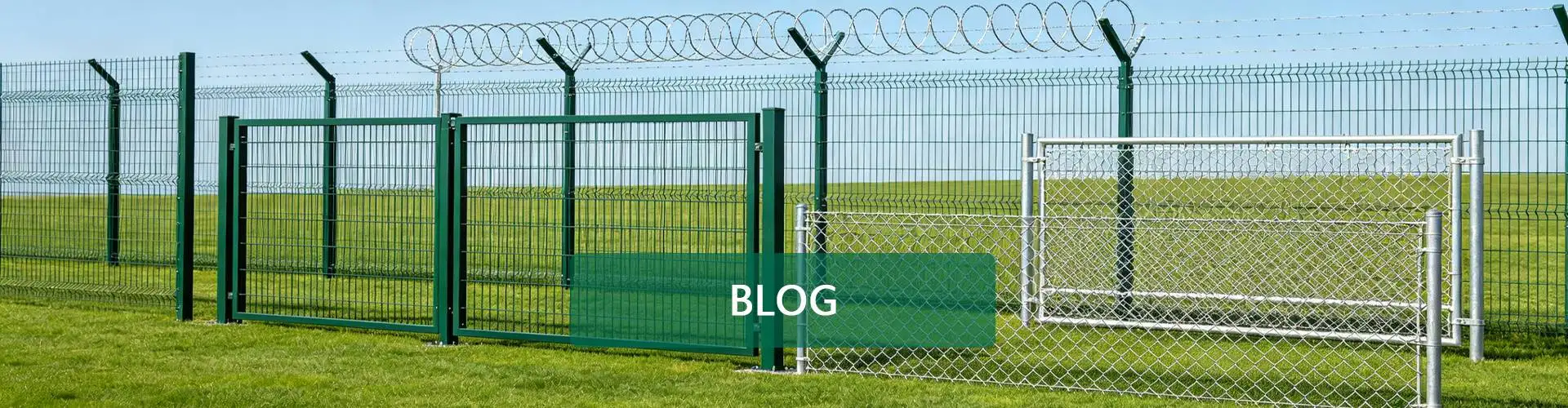
When a project requires several hundred or several thousand meters of perimeter fencing, choosing between Steel Tubular Fence and Chain Link Fence is not simply a question of which product is stronger or cheaper.
The real decision usually comes down to how the site will be used.
A corporate entrance, warehouse boundary, truck yard, university campus, and utility area may all belong to the same project, but they do not necessarily need the same fencing system.
Steel Tubular Fence is usually selected where appearance, rigid construction, and entrance presentation matter more. Chain Link Fence is often preferred where long-distance coverage, flexible installation, and budget control are more important.
For many large developments, the best answer is not choosing one and rejecting the other. It is using each fence where it creates the most value.
This guide explains how project buyers can make that decision more practically.
Start with the Site, Not the Fence
A common procurement mistake is choosing a fence before dividing the project into functional areas.
Instead, first separate the site into zones such as:
- Main entrance
- Public-facing boundary
- Office area
- Warehouse area
- Truck yard
- Service road
- Sports area
- Utility zone
- Rear perimeter
Once these areas are identified, the choice between Tubular Fence and Chain Link Fence becomes much easier.
Where Steel Tubular Fence Usually Makes More Sense
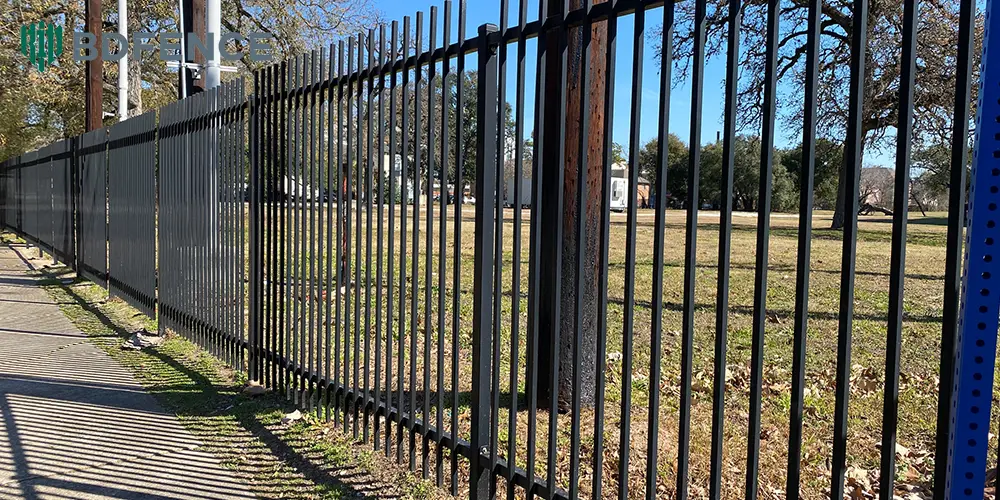
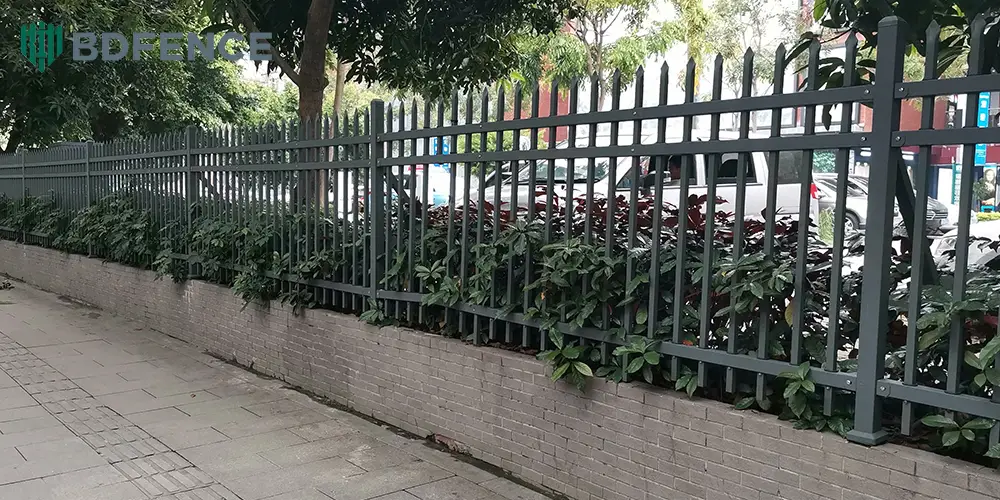
Steel Tubular Fence is built from vertical steel pickets connected by horizontal rails. The result is a rigid fence panel with a clean and structured appearance.
It is usually a stronger candidate for areas where the fence becomes part of the visual design of the project.
Typical examples include:
- Corporate entrances
- Commercial campuses
- Residential communities
- Universities
- Public buildings
- Office areas inside industrial parks
In these locations, the buyer is not only purchasing a boundary. The fence also contributes to the appearance of the development.
Where Chain Link Fence Usually Makes More Sense
Chain Link Fence uses woven steel wire rather than rigid fabricated panels.
Its main advantage is efficiency across long or irregular boundaries.
It is commonly considered for:
- Warehouse perimeters
- Logistics yards
- Industrial land boundaries
- Railway and utility corridors
- Sports facilities
- Equipment storage areas
- Remote or secondary project zones
When appearance is not the main concern, Chain Link Fence can provide practical perimeter protection without adding unnecessary structural cost.
What Is the Real Difference?
| Decision Factor | Steel Tubular Fence | Chain Link Fence |
|---|---|---|
| Visual Effect | Clean, architectural and structured | Functional and industrial |
| Fence Structure | Rigid fabricated panels | Flexible woven mesh |
| Best Use | Visible and high-profile areas | Long functional boundaries |
| Terrain Adaptability | Requires more planning | More flexible on slopes |
| Typical Cost Position | Higher | Usually lower |
| Gate Appearance | Very easy to match architecturally | Functional and practical |
| Project Role | Security + appearance | Coverage + economy |
Do Not Compare Only Price Per Meter
Price per meter is useful, but it can also be misleading.
A complete fencing package can include much more than the visible fence section.
For Steel Tubular Fence, buyers should compare:
- Picket dimensions
- Picket wall thickness
- Picket spacing
- Horizontal rail size
- Post dimensions
- Post wall thickness
- Surface treatment
- Fence fittings
- Gate specifications
For Chain Link Fence, buyers should compare:
- Wire diameter
- Mesh opening
- Fence height
- Post dimensions
- Post spacing
- Galvanizing or PVC coating
- Tension system
- Fence fittings
- Gate specifications
A cheaper quotation can simply contain less steel, a lighter post system, fewer accessories, or a different coating specification.
Which Fence Is Better for a Long Perimeter?
For a project with several kilometers of boundary, Chain Link Fence usually becomes more attractive.
The reason is not only the mesh price.
Its woven structure can simplify long-distance installation and can adapt more easily to gradual changes in ground level.
This makes it particularly useful for:
- Industrial parks
- Logistics centers
- Railway facilities
- Water infrastructure
- Large storage yards
Using Steel Tubular Fence around the entire perimeter of these sites may create unnecessary cost if most sections are not visible to customers or the public.
Which Fence Is Better at the Main Entrance?
At the main entrance, the decision often changes.
This is where Steel Tubular Fence usually provides more value.
The straight vertical pickets, matching gates, powder-coated finish, and rigid structure can create a more professional appearance.
For a business park, university, residential project, or factory entrance, the fence becomes part of the first impression of the site.
In these areas, appearance may justify the higher initial material cost.
How Terrain Changes the Decision
Ground conditions are often overlooked during early procurement.
Steel Tubular Fence uses rigid panels, which means sloping ground may require stepped installation or customized sections.
Chain Link Fence is more flexible and can follow gradual changes in terrain more naturally.
For a flat commercial entrance, this difference may not matter.
For a long infrastructure boundary with frequent elevation changes, it can have a major impact on installation efficiency.
What About Security?
Neither fence should be judged only by its product name.
Security performance depends on the complete configuration.
For Steel Tubular Fence, important factors include picket spacing, fence height, post strength, gate design, and fence fittings.
For Chain Link Fence, buyers should evaluate wire diameter, mesh opening, post system, tensioning, gate configuration, and overall fence height.
Both systems can provide reliable commercial and industrial perimeter control when correctly specified.
If the project requires specialized anti-climb or high-security protection, buyers should evaluate purpose-designed security fencing such as 358 Fence rather than expecting a standard general-purpose fence to perform the same role.
A Better Way to Use the Project Budget
For large developments, one of the most effective strategies is to divide the fence budget according to visibility and function.
For example, an industrial facility could use:
- Steel Tubular Fence around the main entrance
- Steel Tubular Fence around administrative buildings
- Chain Link Fence around storage yards
- Chain Link Fence around utility areas
- Chain Link Fence along long rear boundaries
This approach avoids paying for premium architectural fencing in areas where it creates little additional value.
Typical Selection by Project Type
| Project Area | More Practical Choice |
|---|---|
| Commercial Main Entrance | Steel Tubular Fence |
| Corporate Campus | Steel Tubular Fence |
| Residential Development | Steel Tubular Fence |
| University Public Boundary | Steel Tubular Fence |
| Factory Rear Boundary | Chain Link Fence |
| Warehouse Perimeter | Chain Link Fence |
| Truck Yard | Chain Link Fence |
| Sports Facility | Chain Link Fence |
| Infrastructure Corridor | Chain Link Fence |
| Mixed-Use Industrial Project | Combination of Both |
What Should Buyers Confirm Before Ordering?
Before requesting final quotations, prepare a clear scope of supply.
For Steel Tubular Fence, confirm:
- Total length
- Fence height
- Panel width
- Picket size
- Wall thickness
- Picket spacing
- Post specification
- Surface treatment
- RAL color
- Gate schedule
- Fence fittings
For Chain Link Fence, confirm:
- Total length
- Fence height
- Mesh opening
- Wire diameter
- Post specification
- Post spacing
- Galvanized or PVC-coated finish
- Tension system
- Gate schedule
- Fence fittings
Why Complete Fence System Supply Matters
Panels or mesh represent only part of the final installed fence.
A complete project may also require:
- Posts
- Brackets or tension components
- Fasteners
- Post caps
- Pedestrian gates
- Vehicle gates
- Gate hardware
- Other fence fittings
When these components are purchased from unrelated suppliers, dimensional and connection mismatches can occur.
For project buyers, coordinated supply can reduce site adjustments and simplify material management.
How BDFENCE Supports Both Fence Systems
Hebei Bendin Industrial Technology Co., Ltd. (BDFENCE) manufactures both Steel Tubular Fence and Chain Link Fence for international project buyers.
Depending on the project, BDFENCE can supply:
- Steel Tubular Fence panels
- Galvanized Chain Link Fence
- PVC-Coated Chain Link Fence
- Steel posts
- Pedestrian gates
- Vehicle gates
- Fence fittings
- Installation accessories
Project drawings, BOQ documents, gate schedules, and technical specifications can be reviewed before quotation and production.
Final Recommendation
Steel Tubular Fence and Chain Link Fence solve different project problems.
Choose Steel Tubular Fence when the perimeter needs to look clean, structured, and integrated with the architecture.
Choose Chain Link Fence when the project needs efficient coverage across long, functional, or uneven boundaries.
For many large projects, the most practical solution is to use both systems in different areas.
Instead of asking which fence is universally better, ask:
Which fence creates the most value in each part of this project?
That question usually leads to a better technical decision and a more efficient project budget.
Contact BDFENCE for Your Fence Project
Hebei Bendin Industrial Technology Co., Ltd. (BDFENCE)
Website: https://bd-fence.com/
Phone: +86 18703182863
WhatsApp: +86 18703287372
Email: info@bd-fence.com
FAQ
Which is cheaper, Tubular Fence or Chain Link Fence?
Chain Link Fence is usually more economical for long general-purpose boundaries. Steel Tubular Fence generally costs more because of its fabricated pickets, rails, posts, and architectural finish.
Which fence is better for commercial entrances?
Steel Tubular Fence is usually the stronger choice for commercial entrances because it provides a cleaner architectural appearance and can be coordinated with matching pedestrian and vehicle gates.
Which fence is better for factories?
Many factories can use both. Steel Tubular Fence can be used around offices and main entrances, while Chain Link Fence can cover warehouses, storage yards, utility areas, and long secondary boundaries.
Can Chain Link Fence handle uneven terrain?
Yes. Its woven structure generally adapts more easily to gradual slopes than rigid panel fencing.
Can BDFENCE supply both fence types for one project?
Yes. BDFENCE can provide Steel Tubular Fence and Chain Link Fence together with posts, gates, fence fittings, and other required project components.