



The difficult part of extending a warehouse fence is not always installing the new mesh. Sometimes it is deciding when the old fence can come down.
A logistics warehouse cannot simply stop receiving trucks while contractors rebuild its boundary. Loading bays still need access. Drivers follow familiar routes, and warehouse staff need a clear separation between vehicle movements and construction work.
This application study considers a warehouse expansion in Thailand where a new chain link fence system would connect to an existing perimeter. The proposed work involves an extended boundary, a relocated vehicle entrance and several sections that cannot be opened to the outside at the same time.
The fencing itself is relatively conventional. The installation sequence is not.
The New Boundary Does Not Follow the Old One
Consider a warehouse that has acquired additional land beside its existing loading yard. The site operator wants to move the perimeter outward and make room for more outdoor storage.
On the drawing, the new fence forms a longer boundary around the enlarged property.
The contractor could estimate the mesh from that line, add posts and prepare a preliminary price. But the drawing leaves an awkward question unanswered.
What protects the warehouse while the existing fence is being removed?
If the contractor demolishes the old boundary first, part of the operating yard may remain exposed until the replacement is complete.
The better construction sequence may be to install most of the new external fence before removing the internal section of the old boundary.
That would allow the warehouse to retain its existing perimeter for much of the work.
It sounds simple. Yet the proposed vehicle entrance complicates the sequence, particularly if the new access road overlaps the old fence line.
The final plan needs to show not just where the new fence belongs, but which sections must remain closed during each construction stage.
Three Fence Sections, Three Different Jobs
For planning purposes, divide the proposed boundary into three working sections.
Section A — The New External Boundary
This section runs along the expanded property line. Contractors can install it while the original warehouse fence remains in place.
The material package includes the specified mesh, posts, rails and fittings. The civil contractor must first confirm the boundary position, ground conditions and any underground services.
Section B — The Vehicle Entrance
The new entrance needs separate coordination with the driveway works.
Gate-post positions, clear opening dimensions and finished pavement levels must agree before the foundations go in.
If the gate supplier and fencing contractor use different drawings, the entrance can become the first serious installation problem.
Section C — The Connection to the Existing Fence
This is the part that needs the closest attention.
The original mesh may be removed only after the new perimeter and entrance provide the required boundary control.
Where the new mesh joins an existing post, the contractor must check whether that post can carry the proposed fabric tension. An old line post should not automatically become a terminal post merely because the fence now ends there.
The designer may need a new supported terminal assembly instead.
A Temporary End Is Still an End
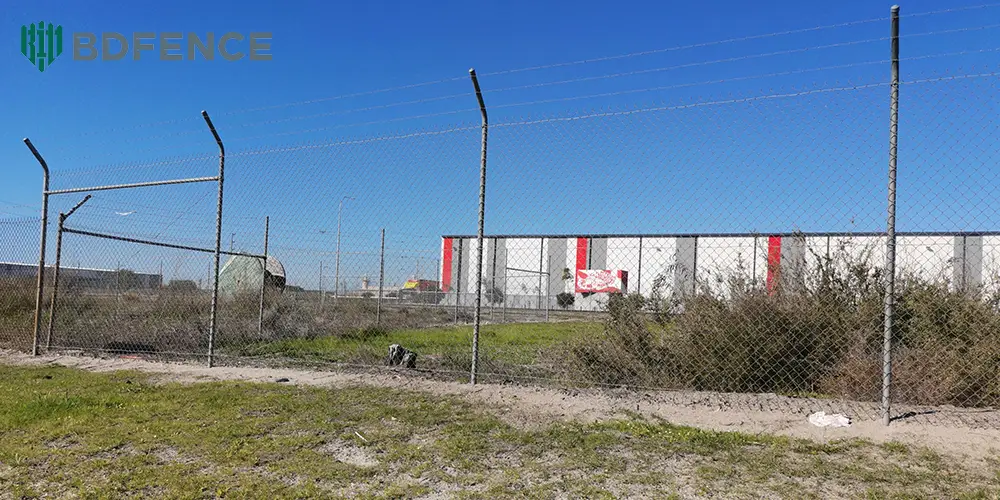
During staged construction, a chain link fence run may stop at a temporary termination point.
It is tempting to treat that as a minor site detail. After all, the contractor plans to continue the fence later.
But the fabric still needs a proper tensioning arrangement while that temporary end remains in service.
If the mesh is stretched against an inadequately supported post, the tension can pull the post out of alignment.
The contractor should identify temporary termination points on the phasing drawing and agree on their support arrangements.
There is also a practical choice to make. Should the contractor use a permanent terminal assembly at a position that will remain in the finished fence, or install a temporary arrangement that can be removed later?
The answer depends on the final layout and the expected construction sequence.
What does not work is leaving the decision until the mesh is already unrolled.
Choosing the Mesh Specification
For this warehouse application, the preliminary purchasing schedule could consider galvanized chain link mesh with a 50 × 50 mm opening and 3.0 mm wire.
A nominal fence height of 2.0 m could also provide a starting point for discussion.
These are illustrative specifications, not confirmed dimensions from an actual Thai warehouse order.
The final selection must follow the customer’s perimeter requirements, exposure conditions and approved design.
BDFENCE offers several wire diameters, mesh openings and roll dimensions through its Chain Link Fence product range.
For a project that involves installation in stages, the contractor should decide whether the supplier will deliver the entire order together or separate the materials according to the construction programme.
A single shipment may simplify overseas procurement. Separate deliveries or clearly identified bundles may make storage and handling easier on site.
Those decisions involve the contractor’s storage capacity and shipping arrangements as well as manufacturing.
The Gate Should Not Decide Its Own Location
Moving a vehicle entrance is rarely a fencing-only decision.
The new gate must suit truck movements, driveway levels and the warehouse’s operating procedures.
A wide opening may appear generous on the site plan, but a turning truck can still require additional space near the posts.
For a sliding gate, the designer must also allow sufficient room beside the entrance for the leaf to travel. A swing gate requires a different clearance assessment.
The gate contractor needs the finished roadway level, clear opening and operating requirements before manufacturing the frame.
There is another detail worth checking.
The chain link mesh on either side of the entrance terminates at supported posts. Those posts may also interact with the gate structure.
The structural designer must consider the fence tension and gate loads together, rather than simply reusing an ordinary line-post specification.
One Material List Is Not Enough for a Staged Job
A conventional material schedule identifies the total quantity of mesh, posts and fittings.
This project needs that information, but it also needs to show where the components belong.
A practical procurement schedule might use the following arrangement:
| Work Area | Materials to Identify | Site Information Required |
|---|---|---|
| New external boundary | Mesh rolls, line posts, terminal posts, rails and ties | Released boundary line and post locations |
| New vehicle entrance | Gate assembly, gate posts and associated fittings | Clear opening, finished levels and vehicle access requirements |
| Boundary connection | Terminal components, tension bars and fixing hardware | Condition and position of existing fencing |
| Temporary construction stages | Temporary termination and restraint components | Approved installation and security sequence |
This schedule does not replace a BOQ. It helps the contractor connect the BOQ to the installation plan.
The supplier should also distinguish between materials that belong permanently in the fence and components required only during construction.
Otherwise, the purchasing team may discover that the final fencing quantities are correct but the staged installation materials are incomplete.
A Drawing Review Before the Order Leaves the Office
Before issuing the purchase order, place the new perimeter drawing beside the existing site layout.
Mark the old fence in one colour and the proposed fence in another.
Then follow a truck from the public road into the loading yard during each construction stage.
Can it still reach the loading bay? Is the entrance wide enough? Does the planned fence work block a turning area?
Next, trace the boundary itself.
At what point does the old fence come down? What closes the perimeter before the final connection is complete? Which posts carry fabric tension during the intermediate stages?
Finally, compare these locations with the material schedule.
If the plan shows a temporary fence termination but the quotation contains no appropriate terminal or bracing components, something is missing.
This review will not resolve every construction issue. It should, however, expose some expensive omissions before the mesh, posts and fittings leave the factory.
What BDFENCE Would Need to Prepare the Supply Package
For this type of warehouse expansion, a product name and total perimeter length would not provide enough information for a complete quotation.
BDFENCE can discuss galvanized or PVC-coated chain link fencing, mesh dimensions, posts, top rails and compatible installation accessories.
To review a project-specific material requirement, the useful documents would include the new boundary layout, the existing fence positions, gate details and the proposed installation stages.
If the project uses different fencing products for separate areas, buyers can also review our complete metal fencing range.
The aim is to supply materials against an agreed schedule, with the termination points, posts and fittings identified before production.
Planning a Warehouse Fence Extension?
A warehouse expansion should not turn into an access problem simply because the fencing sequence was left until installation.
Settle the boundary arrangement, gate positions and temporary termination points first. Then prepare the mesh and component schedule around the approved construction plan.
If your company is sourcing chain link fencing for a logistics, warehouse or industrial project, BDFENCE can review your drawings and requested specifications.
Send us the fence layout, mesh requirements, estimated quantities and destination port. Where installation will take place in stages, include the phasing drawing as well.
BDFENCE — Hebei Bendin Industrial Technology Co., Ltd.
Website: bd-fence.com
WhatsApp: +86 18703287372
Email: info@bd-fence.com