


A 2.0m × 2.5m Temporary Fence panel and a 2.0m × 3.0m panel may appear to solve the same problem: closing a temporary perimeter.
For a buyer, however, those extra 500mm affect much more than panel size.
They change how many panels are needed, how many connections the site uses, how workers handle each section, how the fence turns around corners, and how the complete order is packed for transport.
This is why BDFENCE does not recommend selecting Temporary Fence from a dimension table alone.
A better approach is to start with the site and work backward to the panel.
Start with the Job the Fence Has to Do
Imagine three buyers asking for Temporary Fence.
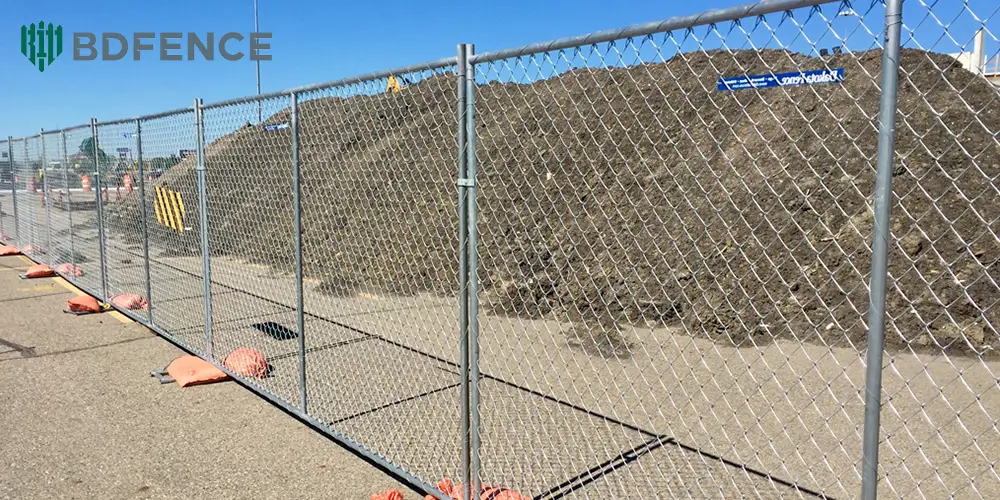
The first manages a construction site with a long, mostly straight perimeter.
The second supplies temporary fencing for events and regularly installs, removes, stores, and transports the panels.
The third is a distributor replacing stock that must remain compatible with an existing local fence system.
All three buyers may request a similar height. Yet the best panel configuration may not be the same.
| Buyer | Main Question |
|---|---|
| Construction Contractor | How efficiently can we close the required site perimeter? |
| Rental / Event Company | How practical is the system to handle, move, store, and reuse? |
| Distributor | Will the new panels work with the dimensions and accessories already used in our market? |
Therefore, “What is your standard size?” should usually be followed by another question: “Where and how will the fence be used?”
Think in Perimeter Coverage, Not Individual Panels
Project buyers ultimately need to close a certain number of meters.
Panel width determines how that perimeter is divided.
For example, consider a 300m temporary boundary.
| Nominal Panel Width | Approximate Panel Positions for 300m |
|---|---|
| 2.0 m | 150 |
| 2.5 m | 120 |
| 3.0 m | 100 |
| 3.5 m | About 86 |
This simple comparison explains why width matters commercially.
A wider panel can reduce the number of individual fence sections along a long straight boundary. It can also reduce the number of panel-to-panel connection points.
However, that does not automatically make the widest option the best choice.
Why a Narrower Panel Can Make Sense
Real construction sites are rarely perfect rectangles.
A perimeter may pass around temporary buildings, storage zones, corners, access roads, equipment areas, or irregular property lines.
In those situations, a shorter panel can give the installer more flexibility when changing direction.
Handling is another consideration. The panel needs to move through the complete cycle:
factory → container → warehouse → truck → site → installation → removal → storage → reuse.
Therefore, panel width is also a logistics decision.
Height Changes the Character of the System
Temporary Fence buyers commonly discuss heights in the region of 1.8m, 2.0m, 2.1m, or 2.4m, depending on the destination market and project.
These should be treated as common purchasing references rather than one worldwide standard.
The important point is what happens when height increases.
A taller panel has a larger exposed surface. It may also weigh more, depending on the mesh and frame specification.
As a result, the buyer should look beyond the panel and review the complete temporary fence arrangement.
A 2.4m Panel Is Not Simply a Taller 1.8m Panel
Suppose a buyer changes the required height from 1.8m to 2.4m.
The purchasing conversation should not end with changing one number on the drawing.
The project may also need to review:
- Panel frame construction
- Mesh specification
- Panel weight
- Base or foot system
- Connections between panels
- Additional stabilization
- Gate arrangement
- Site exposure
This becomes particularly important when the temporary perimeter is installed in an exposed location.
Adding Privacy Screen Changes the Question Again
Some projects attach shade cloth, branding, banners, dust-control fabric, or privacy screening to temporary fencing.
From a purchasing perspective, this is not merely a visual modification.
A relatively open welded mesh panel allows air to pass through much of its surface. Adding screening changes that condition and can substantially increase wind action on the fence system.
Therefore, buyers planning to add screening should disclose this before the temporary fence arrangement is finalized.
The appropriate stabilization should follow the site conditions, temporary works design, and applicable local requirements.
Now Look Inside the Panel
Once the project has established a useful height and width, the next question is what is actually inside those outside dimensions.
This is where two apparently identical Temporary Fence panels can become very different products.
The outside rectangle does not tell you:
- How much wire is used
- How large the mesh openings are
- How thick the wire is
- What tube forms the frame
- How thick the tube wall is
- Whether reinforcement is included
For an importer, these details are essential because they affect product weight, manufacturing cost, and compatibility.
Use Panel Weight as a Question, Not a Specification
Buyers sometimes ask for “a heavy panel” or request a target panel weight.
Weight can be useful as a cross-check, but it does not explain where the steel is located.
Two panels with similar total weight could distribute their steel differently between the welded mesh and tubular frame.
Therefore, instead of purchasing by weight alone, define the components that create that weight.
Ask for the actual wire diameter, mesh opening, frame tube section, and tube wall thickness.
Mesh Opening Changes the Steel Distribution
A Temporary Fence panel contains repeated welded wires across a large area.
Changing the spacing between those wires changes the mesh construction.
This is why “welded mesh Temporary Fence” is not a complete buying specification.
A distributor replacing existing inventory should pay particular attention to mesh configuration because customers may expect new stock to look and perform consistently with panels they already own.
Actual Wire Diameter Is Better Than “Heavy Duty”
Terms such as “strong,” “premium,” and “heavy duty” are difficult to compare between suppliers.
Millimeters are easier.
If the wire diameter matters to the purchase, put the actual required diameter on the RFQ and purchase specification.
This makes it much easier to compare quotations from different factories.
The Frame Is Where Many Price Comparisons Go Wrong
Imagine two quotations with the same panel dimensions and similar welded mesh.
One may still be cheaper because the surrounding tubular frame uses a different steel specification.
A useful frame description should identify both:
tube outside dimension + tube wall thickness.
Knowing only the outside diameter is not enough.
This principle also applies to any additional reinforcement tubes included in the panel design.
Do New Panels Need to Fit Fence You Already Own?
This question is especially important for rental businesses and distributors.
If the buyer already owns hundreds or thousands of temporary fence panels, new stock may need to work with the existing system.
Compatibility can involve:
- Panel height
- Panel width
- Frame tube dimensions
- Base arrangement
- Clamp dimensions
- Connection positions
- Gate system
In this situation, a “better” panel on paper can actually create an operational problem if it cannot mix with existing inventory.
Sending BDFENCE an existing drawing or measured sample specification can reduce this risk.
Do Not Buy the Panel Without Buying the Standing System
A Temporary Fence panel does not stand by itself.
This sounds obvious, but many RFQs describe the panel in detail and give only one line to the base: “with feet.”
The standing system deserves its own specification.
Depending on the product design and destination market, the fence may use different types of removable feet or bases.
Buyers should confirm what is supplied and how it connects with the panel.
One Missing Clamp Can Make Two Good Panels Useless
Temporary fencing works as a continuous line because adjacent sections connect to each other.
That makes clamps, couplers, bolts, and related hardware operational components rather than optional extras.
For a bulk order, calculate these components from the layout and system design instead of ordering an arbitrary box of accessories.
Also check that the clamp dimensions match the frame tubes.
Gates Break the Normal Panel Rhythm
A 500m perimeter is not necessarily 500m of standard fence panels.
The site may need:
- Worker entrances
- Material delivery access
- Vehicle entrances
- Emergency access
These openings should be marked before the final panel quantity is calculated.
Otherwise, the buyer may order too many standard panels while forgetting the components needed at access points.
Calculate the Site by Sections
For larger projects, BDFENCE recommends dividing the perimeter into sections rather than using one total length.
For example:
| Site Section | Purchasing Consideration |
|---|---|
| Long Straight Boundary | Efficient panel coverage |
| Main Entrance | Vehicle gate requirement |
| Worker Access | Pedestrian gate |
| Frequent Corners | Panel layout flexibility |
| Exposed Boundary | Stability review |
| Screened Area | Wind-related temporary works review |
This produces a more realistic BOQ than dividing the entire site length by one panel width.
The Destination Market Should Be on the RFQ
A Temporary Fence supplier serving multiple countries should not assume that every buyer wants the same panel.
Local rental fleets, contractor preferences, connection systems, project specifications, and common panel dimensions can differ.
Therefore, tell the manufacturer where the products will be used.
For an importer or distributor, the destination market can be just as important as the total quantity.
For Distributors, Standardization Can Matter More Than Customization
Factories often promote customization as an advantage.
However, a distributor does not always need a unique product.
Sometimes the more valuable solution is a repeatable specification that customers can continue buying year after year.
That means keeping records for:
- Panel dimensions
- Mesh
- Wire
- Frame
- Feet
- Clamps
- Finish
- Gate configuration
When the next container is ordered, the buyer can reproduce the approved specification instead of starting again from a photograph.
For Rental Companies, Think About the Entire Reuse Cycle
Rental fencing has a different commercial life from fencing purchased for one construction project.
Panels may be handled repeatedly.
They leave the yard, travel on a truck, go through installation, return from the site, enter storage, and then repeat the cycle.
Therefore, rental buyers should consider dimensions together with:
- Manual handling
- Transport efficiency
- Stacking
- Existing inventory
- Accessory compatibility
- Repair and replacement strategy
The lowest factory price per panel may not represent the lowest operating cost for a rental fleet.
For Importers, Panel Dimensions Also Become Shipping Dimensions
Once the order leaves the factory, every millimeter becomes part of a logistics problem.
Panels are large, flat products. Feet may be dense and heavy. Clamps are small. Gates can have different dimensions from standard panels.
Therefore, a container should be planned around the complete Temporary Fence system rather than panels alone.
The final loading calculation depends on the confirmed specification, quantities, packing arrangement, and cargo weight.
A Better Way to Compare Temporary Fence Quotes
Instead of asking which supplier has the lowest panel price, create one comparison sheet.
| Question | Supplier A | Supplier B |
|---|---|---|
| Panel H × W | ||
| Mesh Opening | ||
| Wire Diameter | ||
| Frame Tube | ||
| Tube Wall Thickness | ||
| Base / Foot | ||
| Coupler | ||
| Gate | ||
| Surface Treatment | ||
| Packing |
If these rows are different, the two prices are not yet directly comparable.
What Should You Send BDFENCE for a Temporary Fence Quote?
You do not need a perfect technical drawing to start an inquiry.
For an initial review, send:
- Destination country
- Construction, event, rental, distribution, or other application
- Required perimeter or panel quantity
- Preferred height
- Preferred width
- Existing specification if matching current stock
- Required gates
- Whether screening will be attached
- Destination port for shipping quotations
If you already have a detailed specification, also include the mesh opening, wire diameter, frame tube, wall thickness, feet, couplers, finish, and packing requirements.
Temporary Fence Supply from BDFENCE
Hebei Bendin Industrial Technology Co., Ltd. (BDFENCE) supplies metal fencing for overseas importers, distributors, contractors, rental businesses, and project buyers.
Temporary Fence orders can be configured around the required destination market and application, including:
- Welded mesh Temporary Fence panels
- Custom panel dimensions
- Different mesh and wire specifications
- Tubular steel frames
- Fence feet and bases
- Clamps and couplers
- Bracing components
- Pedestrian access
- Vehicle access
- Bulk export packing
- Container-loading support
BDFENCE has more than 30 years of metal fence manufacturing experience. Our manufacturing operation includes a 15,000㎡ factory, 190+ employees, and more than 80 machines.
BDFENCE products have been exported to more than 70 countries.
So, What Temporary Fence Panel Size Should You Buy?
Do not begin with a catalogue number.
Begin with the perimeter.
Ask how long the boundary is, how often it changes direction, where people and vehicles enter, whether the panels will be reused, whether they need to match existing inventory, and whether screening will be attached.
Then choose the height and width.
After that, define the mesh, wire, frame, feet, connections, gates, and packing that turn those dimensions into a complete Temporary Fence system.
This method gives buyers something more useful than a “standard panel size.” It gives them a specification that fits the way the fence will actually be purchased, transported, installed, and used.
Contact BDFENCE
Hebei Bendin Industrial Technology Co., Ltd. (BDFENCE)
Phone:
+86 18703182863
WhatsApp:
+86 18703287372
Email:
info@bd-fence.com
Website:
https://bd-fence.com/
FAQ
Is there one standard Temporary Fence panel size?
No single panel dimension is standard worldwide. Common sizes vary between markets, suppliers, rental systems, and applications. Buyers should confirm the dimensions used in their destination market or project specification.
Are 1.8m and 2.0m common Temporary Fence heights?
Yes, buyers commonly encounter heights around 1.8m and 2.0m, as well as other heights such as 2.1m and 2.4m. Availability and suitability depend on the market and application.
Should I choose a wider Temporary Fence panel?
A wider panel can cover a long straight perimeter with fewer individual sections. A narrower panel may offer more flexibility around corners and irregular layouts. Handling, transport, and compatibility should also influence the decision.
Why do two Temporary Fence panels of the same size have different prices?
The mesh opening, wire diameter, frame tube, tube wall thickness, reinforcement, surface treatment, feet, couplers, and packing may be different. Outside dimensions alone do not define the product.
Can new Temporary Fence panels match my existing rental stock?
They can be manufactured according to a confirmed specification. Provide the existing panel dimensions, frame tube, base system, coupler details, and other relevant measurements so compatibility can be reviewed before production.
Does adding privacy mesh affect Temporary Fence selection?
It can. Screening reduces the openness of the fence and can increase wind action. The complete temporary fence and stabilization arrangement should therefore be reviewed for the actual site and applicable temporary works requirements.
What information should I send for a bulk Temporary Fence quotation?
Send the destination market, application, panel dimensions or perimeter, quantity, mesh and frame specifications if known, base and coupler requirements, gates, packing requirements, and destination port.