



A commercial development needs perimeter control long before the permanent fence, landscaping, and final entrances are completed.
During construction, contractors, delivery vehicles, equipment, materials, and visitors may all move through different parts of the site. At the same time, the project boundary can change as work progresses.
For a commercial development project in Canada, BDFENCE supplied a Temporary Construction Fence system designed for this changing stage of the project.
The supply included welded mesh temporary fence panels together with the matching bases, panel connections, and access components required to create a practical temporary perimeter.
Project Profile
| Project Item | Details |
|---|---|
| Country | Canada |
| Project Type | Commercial Development |
| Product | Temporary Construction Fence |
| Application | Temporary Site Perimeter and Construction Zone Separation |
| System | Welded Mesh Panels with Bases and Connections |
| Supply Type | Bulk Project Supply |
| Main Requirement | Flexible Site Boundary, Access Planning and Reusable Components |
The Fence Had to Work Before the Site Was Finished
A permanent fence is normally designed around a completed site.
A Temporary Construction Fence works in a very different environment.
On an active commercial development, the site can change from one construction phase to another. Material storage may move. Vehicle access can change. New work zones may open while completed areas become available for other activities.
Therefore, the temporary perimeter needed to support change rather than prevent it.
This was one reason a modular panel system made sense for the project.
The Site Was Considered as Several Working Zones
Instead of treating the complete boundary as one continuous line, the project could be understood as several functional areas.
| Site Area | Temporary Fence Function |
|---|---|
| External Boundary | Separate the active construction site from surrounding areas |
| Material Storage | Create a defined temporary storage zone |
| Vehicle Entrance | Maintain controlled access for deliveries and construction traffic |
| Worker Access | Provide a defined pedestrian route |
| Active Work Zone | Separate selected construction activities where required |
| Changing Construction Area | Allow the temporary layout to be repositioned as work progresses |
This zone-based approach also helped explain why panel quantity alone was not enough to define the order.
Why a Modular Temporary Fence Was Useful
The commercial development did not need a permanent foundation for every temporary boundary position.
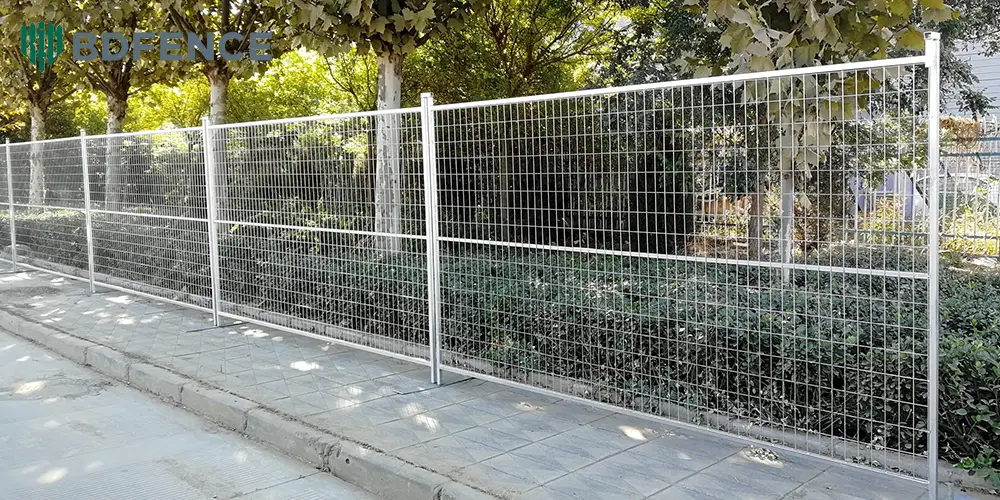
Instead, individual fence panels could form sections of perimeter using removable support and connection components.
This gave the construction team more flexibility when the site layout changed.
Panels could be used to create a long external boundary in one stage and then be repositioned where the project required them later, subject to the site’s temporary works requirements.
For contractors, that reusability is an important difference between temporary and permanent fencing.
Panel Dimensions Were Selected as Part of the Site Layout
Panel size affects much more than the appearance of Temporary Fence.
Width influences how many sections are needed across the perimeter, while height affects the overall fence arrangement and exposed area.
For this reason, the panel dimensions were considered together with:
- Required boundary layout
- Handling
- Site access
- Connection quantity
- Storage
- Transport
- Future reuse
The objective was to create a repeatable panel format that could work across the project rather than manufacture a different panel for every section.
The Panel Specification Went Beyond Height and Width
Two temporary panels with identical outside dimensions can contain different amounts of steel.
Therefore, the confirmed product specification also considered the construction of the panel itself.
Key items included:
- Panel height
- Panel width
- Welded mesh configuration
- Wire diameter
- Frame tube dimensions
- Frame tube wall thickness
- Surface treatment
Defining these items before bulk production helped maintain consistency across the project order.
The Base Was Treated as Part of the Fence
A freestanding Temporary Construction Fence needs more than a panel.
The base or foot is part of the working system because it supports the panel without requiring the same permanent installation method as a fixed fence post.
For project purchasing, the base specification should therefore be confirmed together with the panel.
This avoids a common procurement problem: receiving suitable panels but support components that do not match the intended fence arrangement.
Panel Connections Were Small Components with a Big Job
Each panel works as part of a longer temporary boundary.
The connection between adjacent panels helps turn individual sections into a continuous fence line.
For that reason, the order also considered the required clamps, couplers, bolts, or other matching connection components according to the confirmed system.
Quantity control matters here.
A missing panel may reduce the available perimeter by one section. A shortage of connection hardware can prevent several otherwise complete panels from being installed correctly.
Vehicle Access Was Planned Separately from the Fence Line
A commercial construction site needs deliveries.
Trucks, construction vehicles, equipment, and materials may need to enter and leave regularly.
Therefore, vehicle access cannot be treated as an interruption discovered after the panel quantity has already been calculated.
The entrance should be identified in the temporary perimeter layout from the beginning.
This helps the project team calculate the surrounding fence sections and required access components more accurately.
Pedestrian Movement Needed Its Own Access Point
Worker and visitor movement may follow a different route from construction vehicles.
Where the site plan requires separate pedestrian access, the temporary fencing layout should account for that opening as well.
This allows the buyer to distinguish between:
- Standard temporary panels
- Pedestrian access
- Vehicle access
- Special boundary sections
As a result, the BOQ reflects how the construction site will actually operate.
The Fence Layout Could Change with the Construction Program
This was one of the most useful characteristics of the temporary system.
During early construction, a large area may need to remain inside the controlled perimeter.
Later, the work may move toward another section of the development.
Because the fence used modular panels and removable components, the contractor could reorganize sections according to the changing site plan, provided the revised arrangement met the applicable project requirements.
That flexibility gives temporary fencing value beyond its first installation position.
Screening Would Change the Temporary Fence Conditions
Commercial construction projects sometimes attach branding, privacy mesh, dust-control fabric, or other screening to the fence.
However, adding material to an open mesh panel changes how the fence interacts with wind.
Therefore, screening should not be treated only as a graphic or privacy accessory.
If screening is required, the temporary fence arrangement, bases, bracing, exposure, and other relevant factors should be reviewed according to the project conditions and applicable temporary works design.
Production Focused on Repeatability
A commercial project may use many temporary fence panels side by side.
Consistency therefore matters.
Production checks focused on the characteristics that needed to repeat across the order:
| Component | Production Focus |
|---|---|
| Panel | Overall dimensions and geometry |
| Welded Mesh | Mesh configuration and wire specification |
| Frame | Tube dimensions and fabrication |
| Welded Connections | General fabrication condition |
| Surface | Visible finish condition |
| Accessories | Type and quantity |
The goal was not to inspect one attractive sample and assume the rest would match. Bulk supply requires repeatable production across the order.
Temporary Fence Has a Different Logistics Profile from Permanent Fence
Temporary fencing is designed to be handled.
Before reaching the project, the panels move through several stages:
factory → packing → container → port → local transport → project site.
After use, they may continue through:
site removal → storage → transport → another installation.
This makes handling and packing particularly relevant for contractors and rental-oriented buyers.
Panels, Bases and Connections Were Packed as Different Product Groups
A complete Temporary Fence order contains components with very different shapes.
Large welded mesh panels are relatively flat.
Bases can be compact and comparatively dense.
Clamps and fasteners are small but numerous.
Access components may have different dimensions from standard panels.
Therefore, BDFENCE considered the shipment by component group rather than treating everything as one type of cargo.
Package Identification Helps at a Busy Construction Site
A commercial development may receive many categories of building materials.
Clear identification of fence packages can make receiving easier.
It can also help site personnel separate:
- Standard panels
- Support components
- Panel connections
- Access components
- Other fence accessories
This is particularly useful when the fencing will be installed in several stages.
The Order Was Checked as a System Before Shipment
Before export, the useful question was not simply, “Are all the panels finished?”
The better question was, “Can the supplied components form the temporary fence system described in the order?”
That meant checking the relationship between panels and accessories as well as individual product dimensions.
Typical pre-shipment checks can include:
- Panel dimensions
- Mesh configuration
- Wire diameter
- Frame tube specification
- Base quantity
- Connection quantity
- Access components
- Visible surface condition
- Package quantities
What Made This a Commercial Development Fence Project?
The answer was not a special panel shape.
It was the way the fence had to support an active construction site.
The system needed to create a boundary today without assuming that the same boundary would remain unchanged throughout the entire development.
It also needed to accommodate access, different working zones, transportation, storage, and potential reuse.
That is why Temporary Construction Fence should be purchased around the site’s operating plan rather than by panel price alone.
What Contractors Can Learn from This Canada Project
Before requesting Temporary Fence for a commercial development, divide the site into functions.
Identify the external boundary first. Then mark vehicle access, pedestrian access, storage areas, changing work zones, and any sections that may require screening.
After that, calculate the panel layout.
This order of work usually produces a more useful BOQ than simply dividing the total perimeter by one panel width.
Information to Send for a Temporary Construction Fence Quote
For a project quotation, buyers can send BDFENCE:
- Project country
- Construction site type
- Site drawing or perimeter layout
- Approximate fence length
- Required panel height
- Preferred panel width
- Mesh specification if defined
- Frame specification if defined
- Required bases
- Connection requirements
- Vehicle access requirements
- Pedestrian access requirements
- Screening plans if applicable
- Quantity of spare panels if required
- Destination port
If the technical specification has not yet been finalized, the site layout, destination market, required height, and approximate quantity are useful starting points.
BDFENCE Temporary Fence Project Supply
Hebei Bendin Industrial Technology Co., Ltd. (BDFENCE) supplies metal fencing for overseas contractors, developers, distributors, importers, and project buyers.
Temporary Construction Fence supply can include:
- Welded mesh temporary panels
- Different panel dimensions
- Different mesh and wire specifications
- Steel tubular frames
- Temporary fence bases
- Panel clamps and couplers
- Bracing components where specified
- Pedestrian access components
- Vehicle access components
- Bulk export packing
- Container-loading support
BDFENCE has more than 30 years of metal fence manufacturing experience, with a 15,000㎡ factory, 190+ employees, and more than 80 machines.
Our products have been exported to more than 70 countries.
Project Takeaway
This Canadian commercial development shows why Temporary Fence is better understood as a changing site system than a row of identical mesh panels.
The panels established the physical boundary, but bases, connections, access points, layout planning, packing, and reusability made the system practical for construction.
For contractors and developers, the most useful purchasing question is therefore not only “How many panels do we need?”
It is “How does the temporary perimeter need to work during each stage of the project?”
If you are planning a commercial, residential, infrastructure, or construction project, send BDFENCE your site layout, Temporary Fence specification, BOQ, or approximate perimeter for quotation.
Contact BDFENCE
Hebei Bendin Industrial Technology Co., Ltd. (BDFENCE)
Phone:
+86 18703182863
WhatsApp:
+86 18703287372
Email:
info@bd-fence.com
Website:
https://bd-fence.com/
FAQ
Why use Temporary Fence for a commercial construction site?
A modular Temporary Fence can create a defined construction perimeter without using the same permanent installation method as a fixed fence. Sections can also be reorganized as the site layout changes, subject to project requirements.
Can Temporary Fence be used for internal construction zones?
Yes. Depending on the site plan and project requirements, temporary panels can also be used to separate selected work, storage, or access areas inside the main construction perimeter.
Can Temporary Fence include pedestrian and vehicle access?
Yes. Access requirements should be identified during the site layout stage so the appropriate components can be included in the BOQ instead of treating the complete perimeter as standard panels.
Can Temporary Fence panels be reused?
Temporary panels are designed as removable components and may be reused where their condition and the next site’s requirements allow. Handling, storage, transport, and compatibility are important considerations for repeated use.
Can privacy screen or banners be attached to Temporary Fence?
Projects may use screening, but it can change wind action on the fence. The complete temporary works arrangement should be reviewed for the actual site conditions before screening is added.
What should a Canadian contractor send for a Temporary Fence quotation?
Provide the site layout or approximate perimeter, required panel dimensions, quantity, access requirements, destination, and any defined mesh, frame, base, connection, or screening requirements.
Can BDFENCE supply Temporary Fence in bulk for overseas construction projects?
Yes. BDFENCE can supply temporary panels and matching components in bulk according to the confirmed project specification, packing requirements, and shipment plan.