


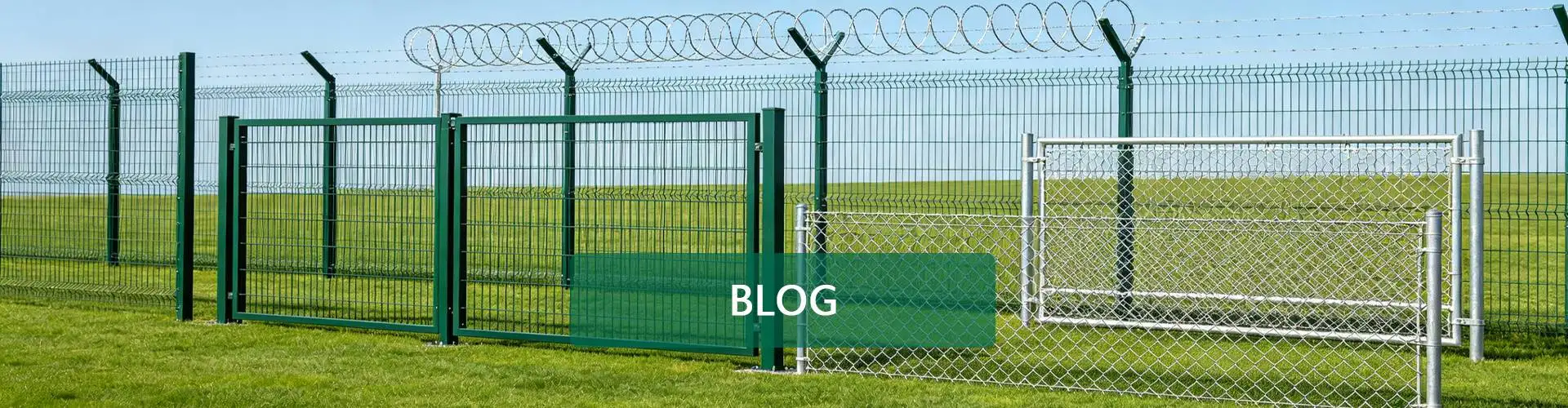
A commercial property does not always need one fence type around the entire site.
The front entrance may face customers every day. The loading yard may only be seen by drivers and warehouse staff. A parking boundary, utility area, office frontage, and rear service road can all have different priorities.
That is why the choice between Steel Tubular Fence and Chain Link Fence becomes easier when you stop asking which product is better overall.
Instead, ask:
Where on the property is each fence worth using?
For many commercial projects, Steel Tubular Fence makes more sense where appearance and rigid construction matter. Chain Link Fence can make more sense where the project needs economical coverage across long or less-visible boundaries.
Quick Answer for Commercial Buyers
| Area of the Property | Fence to Consider First | Main Reason |
|---|---|---|
| Main Entrance | Steel Tubular Fence | Professional appearance and matching gates |
| Office Frontage | Steel Tubular Fence | Architectural presentation |
| Visitor Parking | Steel Tubular Fence | Clean appearance with open visibility |
| Warehouse Rear Boundary | Chain Link Fence | Efficient long-distance perimeter coverage |
| Truck Yard | Chain Link Fence | Functional security and visibility |
| Utility Area | Chain Link Fence | Practical enclosure where appearance matters less |
| Public-Facing Landscape | Steel Tubular Fence | Better integration with architecture |
| Remote Property Boundary | Chain Link Fence | Better use of perimeter budget |
This does not mean every project should follow the table exactly.
However, it provides a useful starting point before requesting quotations.
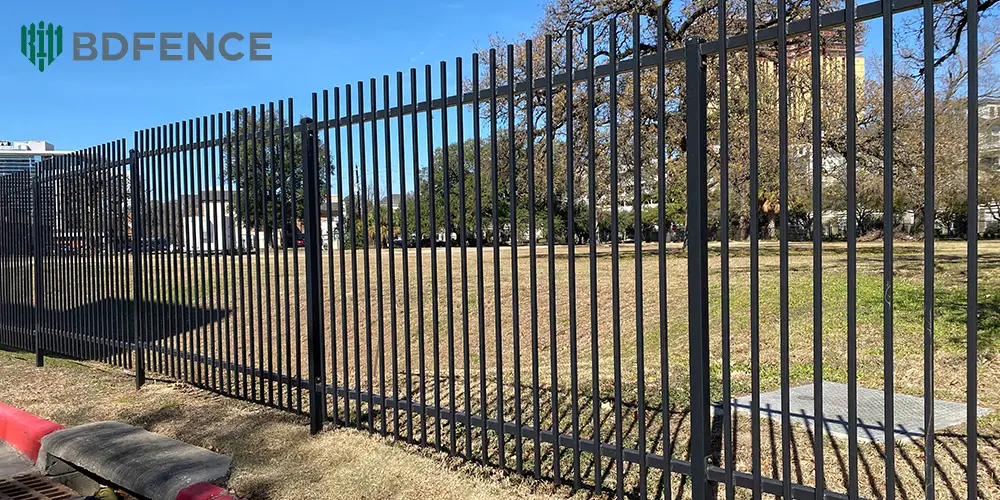
The Expensive Mistake: Specifying One Fence for the Whole Property
Imagine a commercial development with 1,500 meters of perimeter.
Only 250 meters face the main road and customer entrance. The remaining boundary surrounds warehouses, loading areas, service roads, and utility space.
If the buyer specifies architectural Steel Tubular Fence for all 1,500 meters, a large part of the budget may be spent where visitors rarely see the fence.
The opposite can also happen.
Using standard Chain Link Fence around the entire property may save money, but the main entrance can look much more industrial than the building behind it.
A better commercial fencing strategy is often to spend differently in different zones.
Think of the Property as Front-of-House and Back-of-House
Commercial buildings already use this idea internally.
Customer-facing areas receive different finishes from loading docks and technical rooms.
The perimeter can follow the same logic.
Front-of-House Fence
These are areas customers, visitors, tenants, or the public regularly see.
Examples include:
- Main entrances
- Office frontage
- Visitor parking
- Landscaped boundaries
- Road-facing sections
- Pedestrian entrances
In these locations, Steel Tubular Fence often creates more value because the fence becomes part of the property’s visual presentation.
Back-of-House Fence
These areas are more operational.
Examples include:
- Loading yards
- Warehouse rear boundaries
- Truck parking
- Utility zones
- Service roads
- Equipment storage
Here, Chain Link Fence can provide practical perimeter control without paying for architectural detailing that creates little additional value.
Why Steel Tubular Fence Works at the Main Entrance
The entrance is often where the fence becomes part of the building design.
Steel Tubular Fence gives buyers control over details such as:
- Picket size
- Picket spacing
- Fence height
- Rail position
- Top profile
- RAL color
- Pedestrian gate design
- Vehicle gate design
These options allow the fence to coordinate with the architecture rather than simply surround it.
For a hotel, office complex, retail property, business park, or commercial campus, that difference can be valuable.
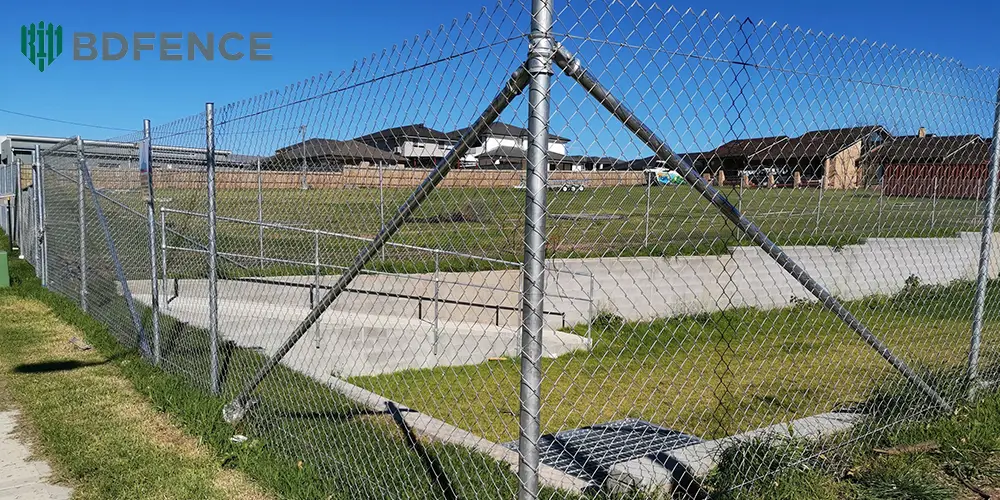
Why Chain Link Fence Works Behind the Warehouse
The rear boundary often has a very different job.
It may need to:
- Define the property
- Control access
- Protect outdoor inventory
- Keep visibility open
- Cover a long distance
- Connect with service gates
Chain Link Fence handles these functions without requiring every meter of the perimeter to use fabricated tubular panels.
For long warehouse and logistics boundaries, this can change the economics of the whole project.
Compare the Cost Where It Actually Matters
Buyers often ask:
Which is cheaper per meter?
That is useful, but it is not the best commercial question.
A better question is:
Where is the additional cost of Steel Tubular Fence actually creating additional value?
Consider a simple example.
| Fence Zone | Length | Possible Strategy |
|---|---|---|
| Main Road Frontage | 200 m | Steel Tubular Fence |
| Entrance and Visitor Area | 100 m | Steel Tubular Fence |
| Warehouse Sides | 400 m | Chain Link Fence |
| Rear Logistics Yard | 600 m | Chain Link Fence |
| Utility Compound | 200 m | Chain Link Fence |
In this example, only 300 meters need the more architectural fence.
The remaining 1,200 meters can prioritize functional perimeter coverage.
This type of zoning can be more useful than trying to declare one product the winner.
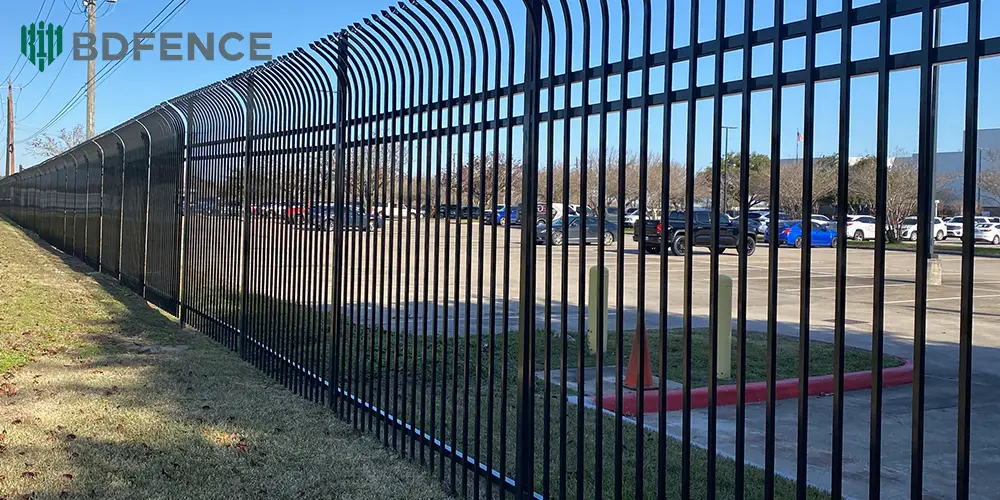
What About Security?
Do not compare security from product names alone.
A lightweight Steel Tubular Fence is not automatically more secure than a correctly specified commercial Chain Link Fence.
Likewise, a basic low Chain Link Fence should not be compared with a heavy-duty tubular steel perimeter.
For Steel Tubular Fence, security depends on:
- Fence height
- Picket spacing
- Picket section and wall thickness
- Rail arrangement
- Post specification
- Gate design
For Chain Link Fence, review:
- Fence height
- Actual wire diameter
- Mesh opening
- Line and terminal posts
- Post spacing
- Tension system
- Gate specification
- Top security where required
The comparison becomes meaningful only after these details are defined.
Which Fence Works Better with CCTV?
Both products can maintain good visibility.
That is one reason both are widely considered for commercial sites.
Steel Tubular Fence creates larger vertical openings between pickets.
Chain Link Fence creates many smaller diamond-shaped openings.
For CCTV planning, the project should look at the actual viewing angle, fence position, wire or picket dimensions, and camera locations rather than assuming one system always provides better visibility.
Parking Areas Need a Different Decision from Loading Yards
A visitor parking lot contributes to the first impression of a commercial property.
For that reason, black or another architectural-color Steel Tubular Fence may fit well around parking areas close to the main building.
A truck staging area behind a warehouse is different.
There, the priorities may be:
- Long fence runs
- Wide vehicle gates
- Visibility
- Easy perimeter inspection
- Cost control
Chain Link Fence can make more commercial sense in that zone.
Gate Cost Can Change the Decision
Do not select the fence without reviewing the gate schedule.
A commercial property may require:
- Pedestrian gates
- Double swing gates
- Sliding gates
- Large truck entrances
- Emergency access
Steel Tubular Fence can create an attractive entrance because the same picket design can continue across the gate.
Chain Link Fence gates can provide a simpler functional solution for service and logistics entrances.
On properties with several large vehicle gates, gate construction can represent a significant part of the fencing budget.
Do Not Forget the Gate Posts
Gate posts should not simply copy the normal fence posts.
A wide sliding or swing gate places concentrated loads on its support system.
Therefore, compare:
- Gate opening
- Gate frame section
- Gate frame wall thickness
- Gate post size
- Gate post wall thickness
- Hardware
- Foundation requirements
This applies to both Steel Tubular Fence and Chain Link Fence systems.
Uneven Land Can Favor a Different Fence Type
Commercial land is not always perfectly level.
Chain Link Mesh is flexible, so it can often follow changing terrain more naturally.
Rigid Steel Tubular Fence panels need another approach.
The installer may need to:
- Step the panels
- Customize panel dimensions
- Adjust post positions
- Fabricate special sections
Therefore, site topography can influence both the installation method and project cost.
Which System Is Easier to Repair?
The answer depends on the type of damage.
With Chain Link Fence, damaged mesh sections, ties, or fittings may be repaired or replaced without changing a complete rigid panel.
With Steel Tubular Fence, impact damage may affect individual pickets, rails, a complete welded panel, or the surface finish.
Commercial properties with frequent forklift, truck, or maintenance activity should consider where impact is most likely before choosing the system.
How the Finish Changes the Commercial Appearance
Steel Tubular Fence often uses powder coating because color is part of the visual design.
Black and dark gray are common directions for modern commercial properties.
Chain Link Fence may use:
- Galvanized wire
- Green PVC coating
- Black PVC coating
A black or green coated Chain Link Fence can look more finished than standard galvanized mesh.
However, it still has the visual character of woven fencing rather than a rigid architectural picket system.
Do You Really Need the Same Finish Everywhere?
Not necessarily.
A mixed commercial perimeter could use:
- Black powder-coated Steel Tubular Fence at the entrance
- Black or green PVC-coated Chain Link Fence beside landscaped secondary areas
- Galvanized Chain Link Fence around remote service areas
The exact approach should follow the architectural and technical specification.
However, the principle is useful: spend on appearance where appearance creates value.
Steel Tubular Fence vs Chain Link Fence for Different Commercial Properties
| Property Type | Steel Tubular Fence | Chain Link Fence |
|---|---|---|
| Retail Center | Strong option for visible boundaries | Useful for service and utility zones |
| Office Park | Good fit for entrance and road frontage | Possible for remote boundaries |
| Warehouse | Useful at main entrance | Strong fit for long rear perimeter |
| Logistics Center | Useful around office/visitor area | Practical for truck yards and long boundaries |
| Commercial Campus | Useful around public-facing sections | Useful around service areas |
| Utility Area | Possible where appearance matters | Often a practical functional solution |
When Steel Tubular Fence Is Worth the Extra Budget
Consider Steel Tubular Fence when the fence is part of the property’s public image.
The additional fabrication cost may make sense where buyers need:
- Architectural presentation
- Custom picket spacing
- Specific RAL colors
- Matching decorative gates
- A rigid panel appearance
- Consistent road frontage
In these areas, evaluating the fence only by price per meter misses part of its purpose.
When Chain Link Fence Protects the Budget Better
Chain Link Fence can make more sense when the perimeter is long and primarily functional.
Examples include:
- Warehouse rear boundaries
- Trailer yards
- Utility areas
- Outdoor storage
- Service roads
- Remote property lines
In these areas, the project can concentrate its budget on fence height, wire diameter, posts, gates, and access control rather than architectural fabrication.
A Better Buying Strategy: Price the Property by Zone
Instead of requesting one quotation for one fence type, consider dividing the BOQ into perimeter zones.
For example:
| Zone | Information to Provide |
|---|---|
| Zone A – Main Entrance | Architectural fence, pedestrian gates and main vehicle gate |
| Zone B – Office Frontage | Steel Tubular Fence with specified finish |
| Zone C – Warehouse Boundary | Commercial Chain Link Fence |
| Zone D – Truck Yard | Chain Link Fence with vehicle access |
| Zone E – Utility Area | Functional perimeter according to required security level |
This gives procurement teams a clearer view of where the fence budget is being spent.
What Should You Compare in the Quotations?
For Steel Tubular Fence, compare:
- Picket size
- Picket wall thickness
- Picket spacing
- Rail specification
- Post size and wall thickness
- Panel width
- Surface treatment
- Gate specifications
For Chain Link Fence, compare:
- Actual wire diameter
- Mesh opening
- Fence height
- Line-post specification
- Terminal and corner posts
- Post spacing
- Tension system
- Surface treatment
- Gate specifications
If these details differ, the quotations are not directly comparable.
What Information Should You Send BDFENCE?
For a commercial property, the most useful starting point is the site plan.
Send BDFENCE:
- Project country
- Property type
- Site perimeter drawing
- Total fence length by zone
- Required fence heights
- Main entrance location
- Warehouse and service areas
- Pedestrian gate schedule
- Vehicle gate schedule
- Security requirements
- Required finish or RAL color
- BOQ if available
- Destination port
BDFENCE can then review where Steel Tubular Fence, Chain Link Fence, or a combination of both may fit the project requirements.
How BDFENCE Supports Mixed Commercial Fence Projects
Hebei Bendin Industrial Technology Co., Ltd. (BDFENCE) manufactures both Steel Tubular Fence and Chain Link Fence for commercial, industrial, logistics, residential, infrastructure, and utility projects.
Our supply can include:
- Steel Tubular Fence panels
- Steel Picket Fence systems
- Galvanized Chain Link Fence
- PVC-coated Chain Link Fence
- Customized steel posts
- Pedestrian gates
- Swing gates
- Sliding gates
- Fence fittings
- Surface-treatment options
Instead of forcing one fence product around an entire development, project buyers can send the site layout and fence schedule for a zone-by-zone quotation.
Final Answer: Which Fence Should a Commercial Property Use?
Do not start by choosing one fence for the whole property.
Start by separating the site into customer-facing and operational areas.
Steel Tubular Fence often makes more sense around entrances, office frontage, visitor parking, and landscaped boundaries where the fence contributes to the appearance of the property.
Chain Link Fence often makes more sense around warehouses, logistics yards, utility areas, outdoor storage, and long remote boundaries where practical perimeter coverage matters more.
For many commercial developments, the most efficient specification is not Steel Tubular Fence or Chain Link Fence.
It is using each system where its advantages are worth paying for.
Contact BDFENCE
Hebei Bendin Industrial Technology Co., Ltd. (BDFENCE)
Phone:
+86 18703182863
WhatsApp:
+86 18703287372
Email:
info@bd-fence.com
Website:
https://bd-fence.com/
FAQ
Is Steel Tubular Fence or Chain Link Fence better for a commercial property?
It depends on where the fence is installed. Steel Tubular Fence often fits customer-facing areas where appearance matters, while Chain Link Fence can be more practical for long warehouse, logistics, service, or utility boundaries.
Can I use both Steel Tubular Fence and Chain Link Fence on the same project?
Yes. A commercial property can use different fence systems in different zones when the project design allows it. This can help balance appearance, security, and total perimeter cost.
Which fence is better for the front of a business?
Steel Tubular Fence is often considered for commercial frontage because picket spacing, tube dimensions, top design, gate style, and color can be customized to match the property.
Which fence is better behind a warehouse?
Chain Link Fence can be practical for rear warehouse boundaries because it provides open visibility and efficient coverage across long functional perimeter sections.
Is Chain Link Fence always cheaper than Steel Tubular Fence?
Not in every specification, but Chain Link Fence can often provide lower-cost coverage across long perimeter runs. Final price depends on height, wire diameter, mesh opening, posts, gates, finish, and accessories.
Which system is better for large vehicle gates?
Both can support vehicle gates. Gate frame design, opening width, support posts, hardware, operation method, and required appearance should determine the final system.
Which fence is easier to install on uneven ground?
Flexible Chain Link Mesh can often adapt more easily to changing terrain. Rigid Steel Tubular Fence may require stepped panels or customized sections.
Can BDFENCE quote two fence types from one site plan?
Yes. Buyers can mark different perimeter zones on the drawing, and BDFENCE can review Steel Tubular Fence and Chain Link Fence requirements together with gates, posts, finishes, and accessories.