


Talk to any property developer or HOA board member, and they’ll tell you perimeter fencing is one of those investments that’s easy to under-specify — until you’re dealing with trespassing complaints, rising maintenance bills or declining curb appeal. For modern residential communities, Steel Tubular Fence strikes a workable balance between reliable security, clean visual design and reasonable long-term upkeep. Below we break down how it performs across each of these three critical areas, and what specs actually matter when you’re putting together a project BOQ.
Security Performance for Residential Perimeter Protection
Security isn’t just about stopping intentional break-ins. For multi-unit communities, it’s about reducing casual trespassing, package theft around parking areas, and keeping unauthorized visitors away from pool zones and playgrounds. Steel tubular fence systems are built to address these day-to-day risks while still meeting standard structural benchmarks for ornamental steel fencing.
- Solid impact and wind resistance: Rigid steel tubing with reinforced rail connections holds up better than wood, vinyl or aluminum against low-speed vehicle bumps, forced entry attempts and heavy seasonal winds. Thicker wall tubing is worth specifying for front perimeter sections and main vehicle access points where stress loads are highest.
- Practical anti-climb spacing: Standard picket gaps of 100–125mm eliminate easy foot holds, and you can step up security further with spear top or tapered rail options for rear property lines or isolated fence sections. This is a much cleaner solution than barbed wire or chain link extensions for residential settings.
- Unified access control: The system works with matching pedestrian swing gates, sliding vehicle gates and standard access control hardware, so you don’t end up with mismatched products that break the security perimeter at every entry point.
- Clear property demarcation: Consistent fence lines put a clean boundary between community property and public sidewalks, cutting down on boundary disputes and making it easier to manage pedestrian flow near busy road frontages.
Aesthetic Design for Modern Residential Developments
Fencing makes up a huge portion of a community’s street-level first impression, and the wrong system can drag down perceived property values across the whole development. Steel tubular fencing works here because it doesn’t force you to choose between “secure” and “attractive”.
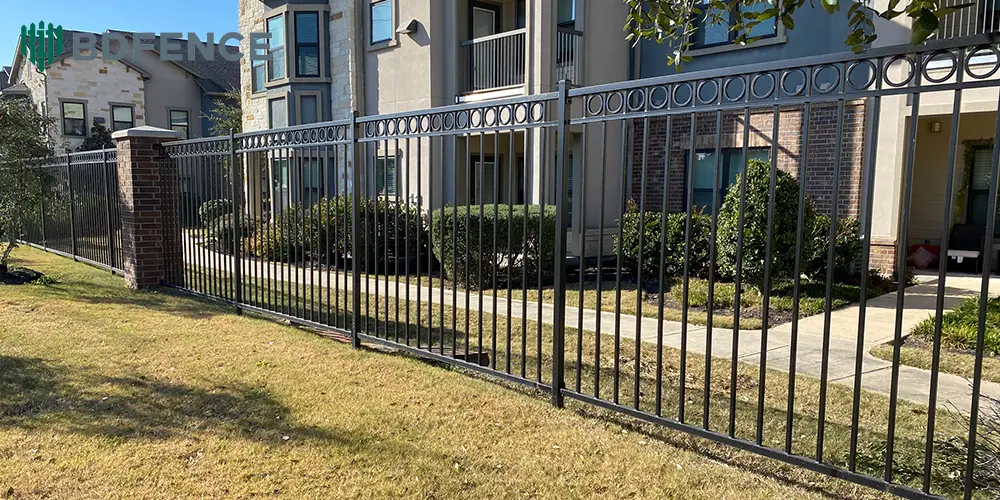
You can pick top profiles to match your overall architectural direction: flat top for minimalist townhouse projects, ring top for more traditional single-family subdivisions, and spear top for perimeter sections that need a visible security presence. With full RAL color matching available through powder coating, you can align the fence with community brand colors, building trim or existing landscape elements without settling for a generic black or silver finish.
Compared to Chain Link Fence or heavy industrial barrier systems, tubular steel has slim, consistent lines that look intentional rather than institutional. It reads as a well-planned design feature, not an afterthought — and that difference shows up in resident satisfaction and perceived neighborhood quality over time.
Durability and Real-World Maintenance Requirements
For HOAs and property management teams, the real cost of fencing isn’t the upfront purchase — it’s years of repainting, repairs and component replacement. Steel tubular fencing keeps these lifecycle costs predictable and low.
Quality systems use a two-layer protective approach: hot-dip galvanization underneath, plus a polyester powder coat finish on top. Working together, these coatings provide strong corrosion resistance for suburban environments. In most temperate climates, the base galvanized protection lasts for decades, and the powder coat finish retains its color and surface integrity for 10–20 years before any touch-up work becomes necessary.
Day-to-day upkeep is minimal. A periodic rinse with plain water removes dust and surface dirt, and an annual visual check of fasteners and coating condition is usually all that’s needed. There’s no staining, sealing or rotting component replacement as with wood, and no UV brittleness or warping issues common with vinyl fencing. For large community properties, that adds up to less staff time spent on repairs and fewer resident complaints about neglected common areas.
What to Confirm During Procurement
Not all steel tubular fence is built to the same standard, and cutting corners on key specs will show up in a few years’ time. When requesting quotes for a residential community project, make sure you clarify these points with every supplier:
- Actual tube gauge and size: Nominal sizes can be misleading. Confirm the actual steel wall thickness and tubing dimensions, especially for main perimeter runs and gate posts that carry higher structural loads.
- Coating specifications: Ask for galvanization thickness and powder coat quality standards, particularly if your project is in a coastal area or high-humidity climate where corrosion risk is elevated.
- Post spacing and foundation details: Standard 1200mm on-center spacing works for most sites, but you’ll need adjustments for taller fence heights, high wind zones or softer ground conditions.
- Gate and hardware compatibility: Make sure hinges, latches and gate frames are from the same system line. Mismatched hardware is one of the most common causes of early failure and visual inconsistency.
Every residential site has its own set of constraints, from topography to HOA design guidelines. Working with a supplier that understands these variables will get you a system that fits your project, not a one-size-fits-all catalog solution.
If you’re working through plans for a new community installation or a full perimeter replacement, share your site drawings, BOQ or design requirements with the BDFENCE team for a detailed, project-specific quote.
FAQ
What is the standard height range for steel tubular fence in residential communities?
For most residential community applications, steel tubular fencing is commonly specified between 1.2m and 2.4m in height. Street-facing front perimeters typically use 1.5m–1.8m for balanced visibility and curb appeal, while rear property lines, pool enclosures and parking lot perimeters often use 1.8m–2.4m for increased security and trespass deterrence. Final heights should always be aligned with local building codes and HOA design guidelines.
How long does steel tubular fencing last in residential environments?
With a proper duplex coating system (hot-dip galvanized base + polyester powder coat top) and basic annual maintenance, the exterior finish maintains its appearance and integrity for 10–20 years in temperate suburban climates. The underlying galvanized steel core provides corrosion protection for several decades beyond that. Service life will vary based on coastal proximity, local climate and regularity of surface cleaning and inspection.
Can we color-match steel tubular fence to our community design standards?
Yes. Powder coated steel tubular fencing is available in a full range of standard RAL colors, allowing precise matching to community brand colors, building trim, landscape features or existing site elements. Custom color matching is also available for larger volume projects to ensure visual consistency across the entire development.
Does steel tubular fence installation require on-site welding?
No. Quality steel tubular fence systems are engineered as fully modular, pre-welded panels that install with bolt-on brackets and standard fasteners. This eliminates on-site welding entirely, reduces installation labor costs and timelines, and avoids damage to protective coatings that can lead to premature corrosion. It also simplifies future panel replacement if localized damage occurs.
Does this type of fencing meet typical HOA and municipal building code requirements?
Steel tubular fencing is widely accepted by most HOAs and municipal building codes for residential use, thanks to its clean, finished appearance and consistent structural performance. That said, HOA rules can be more restrictive than local code, with specific limits on height, color and top style. Always review local zoning rules and HOA architectural guidelines before finalizing specifications, and confirm with your supplier that the system can be adjusted to meet those requirements.
What is the typical lead time for a residential community fence order?
Lead times vary based on order volume and customization level. Standard catalog specifications generally have shorter production windows, while custom colors, special top designs or large project volumes will extend timelines accordingly. It’s best to share your project schedule early with suppliers so they can align production and delivery with your construction timeline.
Every residential site has its own set of constraints, from topography to HOA design guidelines. Working with a supplier that understands these variables will get you a system that fits your project, not a one-size-fits-all catalog solution.
If you’re working through plans for a new community installation or a full perimeter replacement, share your site drawings, BOQ or design requirements with the BDFENCE team for a detailed, project-specific quote.
Hebei Bendin Industrial Technology Co., Ltd. (BDFENCE)
Have a residential community fence layout, BOQ or technical specification? Share it with our team for a quotation based on your project requirements.
Phone: +86 18703182863
WhatsApp: +86 18703287372
Email: info@bd-fence.com
Website: https://bd-fence.com/
Inquiry: Contact BDFENCE