


A contractor is replacing an old steel fence around a commercial property. The concrete pavement is already finished, the entrance roads are in use and the customer wants the new tubular panels installed without major ground excavation.
The first question is not which fence panel to buy. It is how the posts will be fixed.
There are two common approaches: embedding the posts into concrete foundations or fixing them to an existing concrete surface with base plates and anchor bolts. Both can work, but they are not interchangeable.
For buyers sourcing Steel Tubular Fence from overseas manufacturers, this decision affects more than installation. It also changes the post design, fabrication requirements, hardware list and information needed for the quotation.
The Existing Concrete Slab Changes the Decision
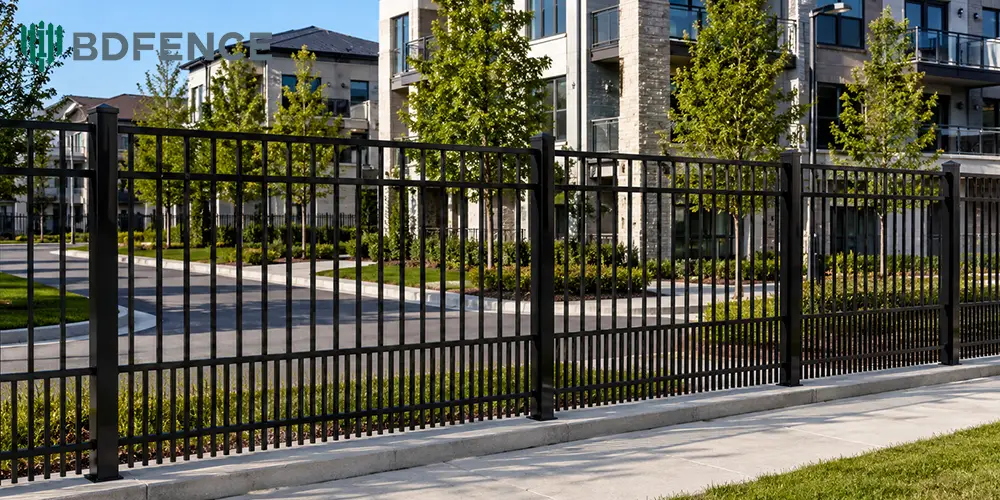
Base-plated posts are often considered when a project already has a suitable concrete surface.
The post is welded or connected to a steel base plate. Installers then secure the plate to the concrete using an approved anchor arrangement.
This can reduce excavation and make installation easier in areas where the finished pavement needs to remain intact.
However, an existing slab is not automatically suitable for fence installation.
Before specifying base plates, the contractor should establish:
- Concrete thickness
- Concrete strength, where known
- Distance from the slab edge
- Existing reinforcement and embedded services
- Proposed anchor positions
- Condition of the concrete around the fixing points
The edge distance deserves particular attention.
A fence post installed close to the edge of a concrete slab may create a different anchoring problem from one positioned near the centre. Anchor capacity also depends on the selected fastener, concrete condition and loads acting on the fence.
If the slab is cracked, too thin or unsuitable for the proposed anchors, the installation may need a different foundation arrangement.
Simply increasing the base plate size does not resolve every concrete problem.
Embedded Posts May Be the Better Option on an Unfinished Site
An embedded post follows a different installation sequence.
The contractor prepares the foundation location, positions the post and secures it within concrete. Once the foundation reaches the required condition, the fence panel can be connected.
This arrangement is commonly considered for new developments, open ground and locations where the design calls for individual post foundations.
It also avoids relying on an existing slab for anchor resistance.
There is a trade-off, though.
Excavation, concrete placement, curing and accurate post positioning all need to fit the construction schedule. If the fence line contains many posts, even small setting-out errors can create alignment problems along the finished boundary.
The contractor must also coordinate underground utilities before digging.
For a new commercial development, embedded posts may be straightforward. For a warehouse where concrete paving and vehicle routes are already operating, the same method could create unnecessary disruption.
The Post Specification Cannot Stay the Same
This is where the purchasing team needs to pay attention.
A base-plated post and an embedded post do not necessarily use the same overall dimensions.
The base-plated version needs a plate with suitable dimensions, thickness, weld connections and anchor holes. The embedded version needs an appropriate post length and foundation embedment arrangement.
Both still require a structural design that accounts for the fence height, panel configuration, wind exposure and site conditions.
For example, a supplier quoting 2.4 m high tubular fence panels may need additional information before calculating the posts.
Is 2.4 m the visible fence height above ground?
Or does the project measure the total post length, including the embedded portion?
Those are different measurements.
The same question applies to base-plated posts. The buyer should clarify whether the specified height includes the base plate and how the panel sits relative to the finished pavement.
A quotation that leaves these points open can lead to unnecessary changes later.
What Should the Base Plate Drawing Show?
A base plate is a small component compared with the full fence panel, but it carries an important connection.
The fabrication drawing should identify its dimensions, thickness, position and connection to the post.
It should also show the proposed anchor-hole arrangement.
Don’t accept a drawing that simply labels the component “standard base plate” without dimensions.
The contractor or structural designer needs enough information to check the connection against the actual site conditions.
The following details are worth including:
| Drawing Detail | Why It Matters |
|---|---|
| Plate length and width | Determines the available fixing footprint |
| Plate thickness | Forms part of the connection design |
| Anchor-hole positions | Must match the approved anchor layout |
| Post connection | Shows the weld or other connection arrangement |
| Finished fence height | Prevents confusion over measurement |
| Surface treatment | Defines protection for the complete assembly |
Anchor bolts should be selected according to the approved design and concrete conditions. Their diameter alone does not establish the capacity of the connection.
There Is Another Detail: Water Around the Base Plate
Outdoor steel fencing is exposed to rain, washing and surface water.
With base-plated posts, water can collect around the plate if the pavement slopes toward the post or the installation creates a pocket.
That can make inspection and maintenance more difficult.
The contractor should review the paving fall and drainage arrangement before fixing the posts. The plate should not obstruct an existing drainage route, and the connection should allow the specified protective finish to remain effective.
Embedded posts have their own exposure conditions, particularly where soil or water remains around the post at ground level.
Neither method eliminates corrosion risk. The finish needs to suit the installation environment.
For projects in coastal Australia or humid Southeast Asian locations, buyers should confirm the required corrosion protection for posts, panels, plates and fasteners.
A powder-coated black finish does not, by itself, tell the purchaser what corrosion protection sits beneath it.
Don’t Order the Fence Panels Before Settling the Post Positions
There is a practical reason to finalize the installation arrangement early.
Steel tubular fence panels have fixed dimensions. Once the posts are installed, the distance between them determines which panels will fit.
If the post positions change after the panels have been manufactured, the contractor may need special-width sections or additional fabrication.
For a project with repeated standard bays, this may be easy to manage. For a property with several short sections, it can become a costly exercise.
Before approving production, the contractor should compare three things:
- The site layout showing the fence line.
- The post schedule showing each fixing position.
- The panel schedule showing the required panel widths.
The three documents should describe the same installation.
If the project uses base-plated posts, include the anchor layout. If it uses embedded posts, show the proposed foundation positions and required post lengths.
This is also a good time to identify any sections where the contractor cannot drill or excavate.
A Quick Comparison for Project Buyers
| Project Condition | Base-Plated Posts | Embedded Posts |
|---|---|---|
| Existing suitable concrete | Often worth considering | May require excavation |
| New development on open ground | Possible where designed | Commonly considered |
| Minimal disruption to finished paving | Potential advantage | Usually less convenient |
| Underground service restrictions | Depends on anchor locations | Excavation may be restricted |
| Foundation requirements | Existing concrete must be suitable | Individual foundations required |
| Procurement requirements | Plates and anchor details | Post length and foundation details |
This table is a purchasing guide, not a structural design recommendation.
The final method should be approved for the actual ground conditions, fence design and project loads.
What B2B Buyers Should Include in the RFQ
If you are importing steel tubular fencing, don’t send only the panel dimensions and total quantity.
The manufacturer needs to know how the fence will be installed.
For a base-plated system, include the required plate dimensions, post connection and approved anchor arrangement.
For an embedded system, provide the required post length and foundation information.
The rest of the RFQ should cover:
- Panel height and width
- Rail and picket dimensions
- Tube wall thickness
- Post spacing
- Base plate or embedded post arrangement
- Surface treatment
- Brackets and fixing accessories
- Quantity and delivery destination
If the installation method has not been finalized, state that clearly. The manufacturer can then discuss the available configurations before preparing a final quotation.
Steel Tubular Fence Supply from BDFENCE
BDFENCE supplies steel tubular fencing for overseas importers, wholesalers, commercial contractors and project procurement teams.
Our Steel Tubular Fence product range includes different panel configurations, post options and surface finishes.
For projects using base-plated posts, share the required plate and fixing details. For embedded installations, provide the proposed post dimensions and foundation requirements.
A site drawing is particularly useful when the fence connects to existing concrete, retaining walls or other structures.
We can review the requested manufacturing specifications and discuss the available panel and post configurations.
You can also explore our other metal fencing products for different commercial and industrial applications.
Have a Steel Tubular Fence Project to Quote?
Send us the panel schedule, installation method and post requirements.
If you are replacing an existing fence, include photographs or drawings of the current concrete surface. If this is a new development, provide the site layout and proposed foundation details.
That gives our team a clearer basis for reviewing your order.
BDFENCE — Hebei Bendin Industrial Technology Co., Ltd.
Website: bd-fence.com
WhatsApp: +86 18703287372
Email: info@bd-fence.com