



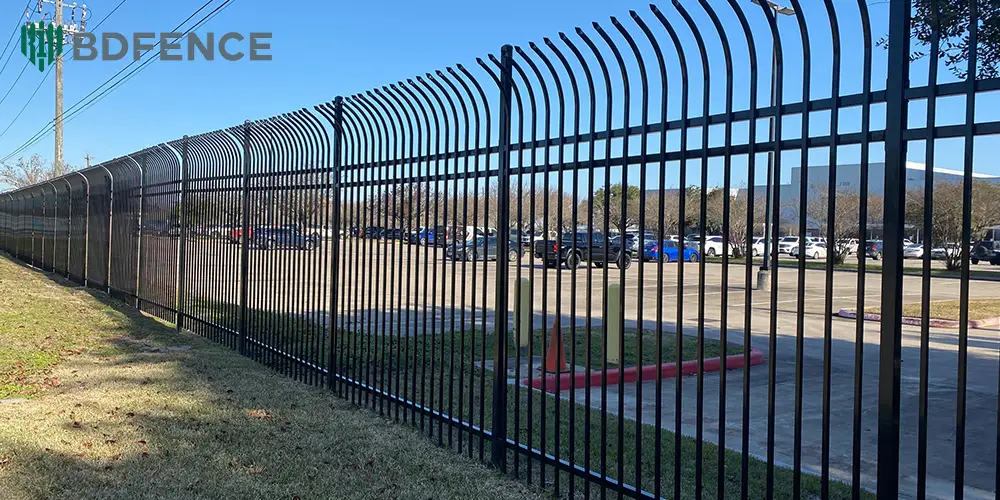
A government administrative building in Texas needed a steel perimeter that could do two jobs at the same time.
It had to define the property clearly, especially around staff and vehicle access areas. But the front of the building was also open to daily public use, so the fence could not look like a temporary industrial barrier.
Steel Picket Fence was selected for the perimeter concept.
The project used the same general fence style around the property, while the actual components changed at the main frontage, pedestrian entrance, vehicle access and end sections.
For BDFENCE, this was not simply a matter of producing identical panels. The important work was making those different sections fit together as one fence system.
Project Location: Texas, USA
Texas conditions were relevant to the fence specification from the beginning.
Outdoor steel fencing can face strong sun, rain and changing weather conditions. At the same time, an administrative building has a different visual requirement from a factory yard or construction site.
The fence needed a clean, permanent appearance.
That made the surface treatment, panel alignment and gate appearance part of the discussion rather than details to consider after fabrication.
The Main Frontage Set the Look for the Project
The first section people would notice was the fence facing the public side of the property.
This became the visual reference for the rest of the order.
The vertical tubular pickets created an open boundary, while the repeated panel design kept the frontage orderly. From one bay to the next, the picket arrangement and rail positions needed to remain consistent.
That consistency becomes more important on a government or commercial building because the fence sits close to the architecture and entrance landscaping.
A small difference in one panel may not look serious inside the factory. Across a long finished frontage, it can be obvious.
The Side Perimeter Was More Practical
Move away from the front entrance and the fence has a slightly different job.
Along the side of the property, the priority shifts toward maintaining a continuous boundary around staff and service areas.
There was no need to invent another fence design for this section.
Keeping the same basic Steel Picket Fence style made the property look consistent. At the same time, posts, connections and special sections could be coordinated with the actual layout of that part of the site.
This approach also avoids unnecessary customization. Use the repeating panel wherever it fits; change the component only where the site gives a reason to change it.
Picket Layout Needed a Clear Definition
One detail we pay attention to on Steel Tubular Fence orders is the word “spacing.”
It can be surprisingly unclear.
A drawing may show a spacing dimension without saying whether it means the distance from picket center to picket center or the clear opening between two pickets.
For factory production, those are different measurements.
We prefer the project specification to identify the picket section and the clear opening separately. This makes the panel layout easier to check and gives the buyer a clearer basis for comparing quotations.
It also affects material use. If the clear opening becomes narrower, the same panel width may require more pickets, more steel and more welded joints.
The Pedestrian Entrance Had to Belong to the Fence
Visitors and staff approaching on foot would see the pedestrian gate next to the fixed panels.
It could not look like an unrelated steel door.
The visible gate design therefore followed the language of the surrounding fence. Picket profile, arrangement, finished height and coating could be coordinated with the adjacent panels.
Behind that appearance, however, the gate remained a separate fabricated component.
A fixed fence panel does not move. A gate does.
Its frame, hinges, supporting post and other hardware therefore need to suit the gate opening and project requirements instead of simply copying the construction of a normal fence bay.
Vehicle Access Was Treated Separately
The vehicle entrance introduced a wider opening into the perimeter.
Here, simply making a normal panel wider would not solve the problem.
The gate assembly needs its own frame and supporting arrangement. This becomes increasingly important as the opening gets wider and the gate becomes heavier.
At the same time, the entrance still forms part of the same building perimeter.
So there were two questions to answer:
How should the gate work?
And how should it look beside the fence?
Keeping those questions separate helps avoid the common mistake of treating a vehicle gate as an oversized fence panel.
The Fence Did Not End on a Perfect Panel Module
Real building perimeters rarely divide perfectly by one panel width.
A wall, gate post, corner or existing structure eventually interrupts the sequence.
That happened here too.
Where the remaining opening did not suit the main panel, the better solution was to identify a closing section rather than expect the installer to cut a regular panel on site.
A short panel still needs some thought.
If its pickets are positioned without checking the remaining width, the final gap at one edge may look awkward. For a public-facing property, that detail matters.
So special-width panels were treated as their own pieces rather than shortened copies made without reviewing the internal layout.
Posts Had to Follow the Fence Layout
Panels usually get most of the attention in product photos. On site, the posts are doing essential work.
For this Texas project scenario, post selection could not be separated from fence height, panel arrangement, connections, gate positions and site requirements.
The same applies to foundations.
BDFENCE does not assume that one universal post or foundation specification is suitable for every project simply because the fence height is the same.
Where structural or civil requirements are available, they should be reviewed together with the fence drawings.
Black Is a Color, Not a Complete Coating Specification
For an architectural steel fence, buyers often begin with the color they want.
“Black Steel Picket Fence” is easy to understand.
The factory still needs the surface treatment specification.
Depending on project requirements, steel fencing can use galvanizing, powder coating or a specified coating system. A galvanized base combined with powder coating can provide a zinc layer beneath the outer barrier and color finish.
However, we do not attach a universal service-life claim to a coating name.
Exposure, coating specification, installation damage and future maintenance all affect corrosion performance.
The Factory Order Looked Different from the Site Drawing
On the original site plan, the fence could be represented by a line around the building.
By the time it reached production, that line had become several groups of components.
| Component | Role in the Texas Project |
|---|---|
| Main picket panels | Repeated along the regular perimeter |
| Steel posts | Supported the fixed panel sections |
| Closing panels | Finished irregular openings at selected locations |
| Pedestrian gate | Provided staff and visitor access |
| Vehicle gate | Created the wider controlled entrance |
| Connections and accessories | Completed the specified fence assemblies |
This is why we prefer receiving the complete fence layout when possible.
A panel specification tells us how to make a panel. A site layout tells us where that panel has to work.
Production Checks Focused on Repeatability
For the regular panels, consistency was important.
Relevant dimensions, picket arrangement, rail position and tubular specifications needed to follow the confirmed production information.
The special sections were checked against their own requirements instead of being treated as normal panels.
Gate components also followed their respective drawings.
Surface finish formed another part of the order inspection.
The objective was straightforward: when regular and special components reached Texas, each should correspond to the part of the fence system for which it had been manufactured.
Special Pieces Needed to Stay Special During Packing
A closing panel is useful only if the site team can distinguish it from the regular panels.
The same applies to different posts and gate components.
For export preparation, the order therefore needs more organization than simply stacking steel into bundles.
Panels, posts and other components can be grouped according to the confirmed packing plan, while special items can be identified where required.
This becomes increasingly valuable as a fence project gains more gates, corners and non-standard sections.
Why Steel Picket Fence Suited This Government Building
The strongest reason was not one particular panel dimension.
It was the ability to keep one recognizable fence style while adapting the system to different parts of the property.
The public frontage could remain clean and architectural.
The side perimeter could continue the same visual design.
Pedestrian and vehicle gates could match the fence without pretending that their frames had the same structural job as fixed panels.
And where the regular module stopped working, purpose-made closing sections could finish the run.
For a government administrative building, that combination gave the perimeter a more coordinated result than treating panels, posts and gates as unrelated purchases.
Ordering Steel Picket Fence for a U.S. Project
If you are sourcing Steel Picket Fence for a government property, office complex, school, commercial development or similar project in the United States, the existing project documents are usually the best place to start.
Send BDFENCE the fence drawing, elevation, BOQ or fence schedule if available.
For an initial quotation, useful information includes:
- total perimeter or required quantity;
- finished fence height;
- panel width or post layout;
- picket section and clear opening;
- rail specification;
- post requirements;
- pedestrian gate openings;
- vehicle gate openings;
- surface treatment and color;
- delivery destination in the United States.
If the project has not finalized every dimension, mark the undecided items instead of guessing them.
We can start with the information already available.
About BDFENCE
Hebei Bendin Industrial Technology Co., Ltd. (BDFENCE) manufactures metal fencing for international distributors, contractors and project buyers.
BDFENCE was established in 2021, while our team has more than 30 years of metal fence manufacturing experience. The factory covers approximately 15,000㎡, with more than 190 employees and 80+ machines.
Our product range includes Steel Tubular Fence, 358 Fence, Chain Link Fence, 2D Fence, 3D Fence and other metal fencing systems. BDFENCE products have been exported to more than 70 countries.
For a U.S. Steel Picket Fence project, send us your existing drawing or BOQ. We can review the fence panels, posts, gates and special sections together for quotation.
FAQ
Can Steel Picket Fence be used for government buildings in the USA?
Steel picket fencing can be specified for government, institutional and commercial properties where an open steel perimeter suits the architectural and security requirements. The final system should follow the applicable project specifications and local requirements.
Can BDFENCE customize Steel Picket Fence panels for a Texas project?
Yes. Panel dimensions, tubular members, picket arrangement, posts, gates and other details can be manufactured according to the confirmed project specification.
Can a vehicle gate use the same design as the fence?
The visible picket pattern and finish can be coordinated with the fixed fence. The gate frame, supporting posts and hardware should be designed for the gate opening and operating requirements.
Can you manufacture short panels beside a building or gate?
Yes. Once the required opening is confirmed, special-width closing panels can be included instead of relying on site cutting of regular panels.
What surface treatment is available for an outdoor Steel Picket Fence?
Options can include galvanizing, powder coating or a specified combined system, depending on the project. Buyers should confirm the required coating specification and color rather than specifying color alone.
What information should a U.S. buyer send for quotation?
A fence drawing or BOQ is the best starting point. Otherwise, send the perimeter length, fence height, panel and picket details, gate openings, required finish, quantity and U.S. delivery destination.
Contact BDFENCE
Hebei Bendin Industrial Technology Co., Ltd. (BDFENCE)
Phone:
+86 18703182863
WhatsApp:
+86 18703287372
Email:
info@bd-fence.com
Website:
https://bd-fence.com/