


Picket spacing can completely change the way a Steel Tubular Fence looks, feels, and performs.
Two fences can use the same height, the same picket tube, and the same finish, but if the gaps between the pickets are different, the final result may be very different.
Closer spacing creates a denser fence and uses more steel. Wider spacing creates a more open appearance and can reduce material cost.
Therefore, the right picket spacing is not simply the smallest gap available.
The better choice depends on security, visibility, appearance, project type, and budget.
What Does Picket Spacing Mean?
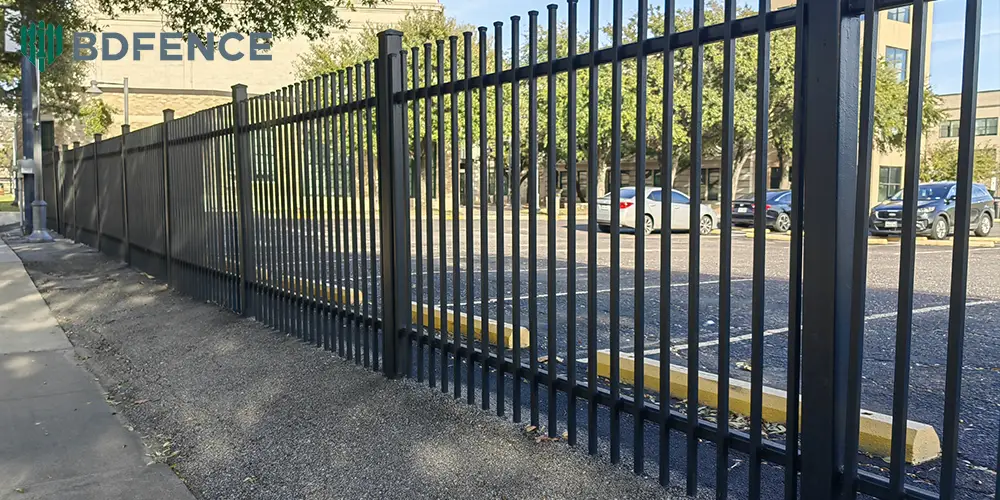
Picket spacing normally refers to the clear gap between adjacent vertical pickets.
However, buyers should confirm how the supplier defines spacing because some drawings may show:
- Clear opening between pickets
- Center-to-center distance
- Number of pickets per panel
These are not the same measurement.
For accurate quotation and production, the drawing should clearly identify the actual clear gap or the center spacing.
Why Picket Spacing Matters
Spacing affects several parts of the fence at the same time.
It changes:
- Number of pickets per panel
- Total steel weight
- Panel rigidity
- Visibility
- Climbing opportunity
- Overall appearance
- Production cost
Because of this, spacing should be treated as a design and purchasing decision rather than only a visual preference.
Closer Spacing Means More Steel
If the panel width remains the same, reducing the clear gap means adding more vertical pickets.
More pickets increase:
- Steel consumption
- Welding points
- Panel weight
- Surface treatment area
- Production time
- Final fence cost
This is why two visually similar Steel Picket Fence quotations can have different prices even when the tube size is the same.
Wider Spacing Creates a More Open Fence
Increasing the gap between pickets reduces the number of vertical members in each panel.
That can make the fence look lighter and more open.
This may be useful for:
- Landscape boundaries
- Residential communities
- Low-risk commercial areas
- Decorative frontage
However, wider spacing should still meet the project safety and security requirements.
Typical Picket Spacing Directions
There is no single spacing that works for every Steel Tubular Fence project.
Common project directions may include:
| Clear Gap | General Character | Possible Application Direction |
|---|---|---|
| 50–70 mm | Dense and security-focused | Higher-control commercial or industrial areas |
| 70–100 mm | Balanced spacing | Residential, commercial and general perimeter use |
| 100–120 mm | More open visual effect | Landscape and decorative boundaries |
| Above 120 mm | Very open fence | Only where project requirements allow |
These are general design directions only. Final spacing should follow the approved drawing, local code, and project requirements.
Which Spacing Is Better for Residential Projects?
Residential projects usually need a balance between security and appearance.
The fence should define the property boundary without creating an overly industrial look.
For this reason, moderate spacing is often selected.
Residential buyers may consider:
- Visibility through the fence
- Child safety requirements
- Landscape design
- Fence height
- Top style
- Gate appearance
A tighter spacing can provide a more substantial boundary, while a wider spacing can create a lighter architectural effect.
Which Spacing Is Better for Commercial Projects?
Commercial projects vary widely.
A business park entrance may prioritize appearance, while a warehouse boundary may need a more security-focused fence.
Therefore, the correct spacing depends on the area of the site.
For example:
| Commercial Zone | Possible Spacing Direction |
|---|---|
| Main Entrance | Balanced spacing for appearance |
| Office Frontage | Moderate spacing |
| Warehouse Boundary | Tighter spacing may be preferred |
| Service Yard | Security-focused spacing |
One commercial project can therefore use different fence designs in different zones if the approved design allows it.
Which Spacing Is Better for Industrial Facilities?
Industrial sites often place more emphasis on perimeter control and structural durability.
A tighter picket gap may be useful where the fence separates:
- Production areas
- Storage yards
- Utility zones
- Vehicle service areas
- Restricted compounds
However, the fence height, post system, picket size, and gate design should still be reviewed together.
Tight spacing alone does not create a complete security system.
Does Smaller Spacing Make the Fence Harder to Climb?
It can reduce the amount of open space between vertical pickets.
However, anti-climb performance depends on more than the clear gap.
Buyers should also consider:
- Fence height
- Horizontal rail position
- Picket top design
- Post arrangement
- Gate construction
For example, horizontal rails can sometimes create useful footholds depending on their position.
Therefore, security should be considered across the full panel design.
Rail Position Changes the Climbing Behavior
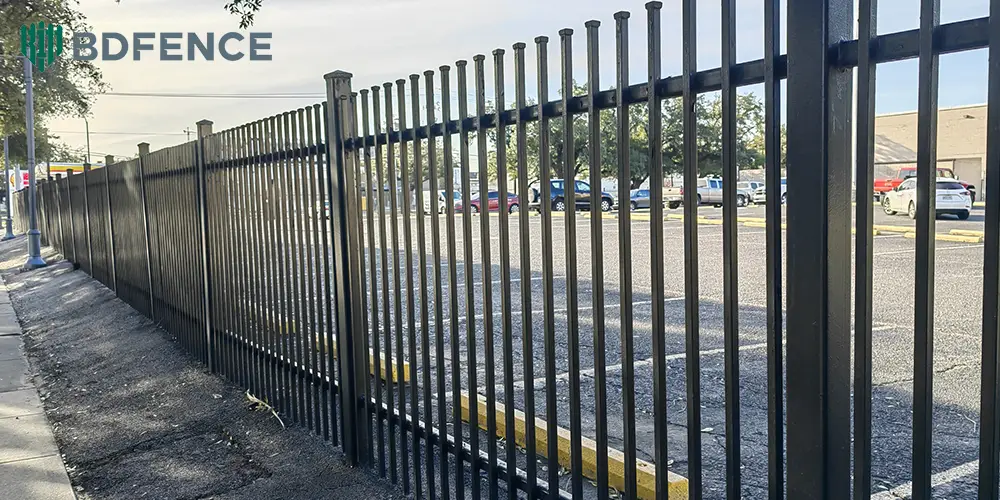
Steel Picket Fence is usually built with vertical pickets and horizontal rails.
Those rails are necessary for panel structure, but their location can influence how the fence is climbed.
For more security-focused designs, the project may place rails in positions that reduce easy access from the outside.
Therefore, picket spacing should not be discussed without also looking at rail layout.
How Picket Size Changes the Spacing Decision
A 25 × 25 mm picket and a larger rectangular or square picket create different visual proportions.
If the clear gap stays the same but the picket becomes wider, the panel contains more steel and appears denser.
Therefore, the visual rhythm of the fence depends on both:
- Picket width
- Clear spacing
This is especially important for architectural and residential projects.
How to Calculate the Number of Pickets in a Panel
The number of pickets depends on:
- Panel width
- Picket width
- Clear spacing
- Edge spacing at both sides
For example, if the spacing becomes smaller, the same panel may need one or more additional pickets.
That small design change can increase steel weight across every panel in the project.
Why Panel Width Matters
Picket spacing should always be checked against the actual panel width.
A 2.0-meter-wide panel and a 2.5-meter-wide panel may not use the same number of pickets even when the clear gap is identical.
Therefore, suppliers should prepare the picket layout according to the confirmed panel dimensions.
Do Gates Need the Same Picket Spacing?
Usually, matching the gate spacing with the fence creates a more consistent appearance.
This applies to:
- Pedestrian gates
- Swing vehicle gates
- Sliding gates
However, gate frames have different structural requirements from fixed panels.
Therefore, the gate frame size may change even when the picket spacing remains the same.
Picket Spacing Can Change Gate Weight
A tighter spacing adds more vertical pickets to a gate frame.
This increases gate weight.
For large vehicle gates, that additional weight can affect:
- Gate frame size
- Gate post strength
- Hinges
- Sliding hardware
- Automation system
Therefore, spacing should be reviewed carefully on wide gates rather than copied directly from a small pedestrian panel without checking the total weight.
How Picket Spacing Affects Price
The main reason is simple: closer spacing means more steel.
For a large project, adding only one extra picket per panel can become significant.
Imagine a project with 2,000 fence panels.
One additional picket per panel means 2,000 additional steel tubes, plus extra welding and coating.
Therefore, spacing has a direct commercial effect.
Why the Cheapest Fence May Simply Have Wider Gaps
When one quotation is much lower than another, buyers should check the picket layout.
The lower-price supplier may be using:
- Wider picket spacing
- Smaller picket tubes
- Thinner wall thickness
- Fewer rails
- Lighter posts
This does not automatically mean the fence is unsuitable.
However, it means the quotations are not technically equivalent.
Visibility vs Security: Find the Balance
Very tight spacing creates a denser visual barrier.
Very wide spacing creates a more open perimeter.
The best result depends on what the project values more.
| Project Priority | Spacing Direction |
|---|---|
| More Open Appearance | Wider spacing |
| Denser Perimeter | Closer spacing |
| Lower Steel Weight | Wider spacing |
| More Vertical Members | Closer spacing |
| Architectural Balance | Moderate spacing |
Do Local Codes Affect Picket Spacing?
Yes, they can.
Some projects may have specific requirements for openings, especially around:
- Schools
- Playgrounds
- Pool areas
- Residential developments
- Public facilities
Therefore, buyers should confirm local regulations and project specifications before finalizing the gap.
A manufacturer should not replace local code review with a generic spacing recommendation.
Do Not Copy Spacing from a Product Photo
A fence may look good in an online image, but the picture does not show the complete project conditions.
The original fence may have a different:
- Height
- Picket tube size
- Panel width
- Security requirement
- Local code
Therefore, use photos for design inspiration, not as the final technical specification.
A Better Way to Select Picket Spacing
Use the following sequence:
- Confirm the project application
- Check local opening requirements
- Confirm fence height
- Select picket tube size
- Choose the required clear gap
- Calculate pickets per panel
- Review panel weight
- Check rails and posts
- Apply the same design logic to gates
- Compare the complete fence cost
This creates a more balanced system than selecting the gap by appearance alone.
What Should Be Written in an RFQ?
If possible, avoid writing only “standard picket spacing.”
A better RFQ should identify:
- Fence height
- Panel width
- Picket tube size
- Picket wall thickness
- Clear gap between pickets
- Rail size and quantity
- Post size and wall thickness
- Post spacing
- Top design
- Gate sizes
- Surface treatment
- RAL color
- Project drawings or BOQ
This allows suppliers to quote the same fence rather than making different assumptions.
What Information Should You Send BDFENCE?
If you are not sure what picket spacing to use, send BDFENCE the available project information.
Useful details include:
- Project country
- Project type
- Total fence length
- Fence height
- Panel width
- Preferred picket tube size
- Security requirement
- Gate dimensions
- Surface treatment
- Site drawings or BOQ
- Destination port
BDFENCE can review the picket spacing together with the tube sizes, rails, posts, and gates rather than treating the gap as an isolated dimension.
How BDFENCE Supplies Steel Picket Fence
Hebei Bendin Industrial Technology Co., Ltd. (BDFENCE) manufactures Steel Tubular Fence and Steel Picket Fence systems for residential, commercial, industrial, educational, logistics, and infrastructure projects.
Our project supply can include:
- Customized picket spacing
- Different picket tube sizes
- Different wall thickness options
- Horizontal rails
- Customized steel posts
- Pedestrian gates
- Swing vehicle gates
- Sliding gates
- Galvanized and powder-coated finishes
- Brackets and installation accessories
Project buyers can send fence drawings, BOQ documents, panel designs, and gate schedules directly to BDFENCE for review and quotation.
Final Answer: How Much Space Should Be Between Steel Pickets?
There is no single spacing that works for every Steel Picket Fence.
Closer gaps create a denser panel, use more steel, and can support a more security-focused design.
Wider gaps create a more open appearance and can reduce panel weight and cost.
For many residential and commercial projects, moderate spacing can provide a good balance between visibility, appearance, steel use, and perimeter control.
However, the final clear gap should always be selected together with fence height, picket size, rails, posts, gates, local regulations, and project security requirements.
Contact BDFENCE
Hebei Bendin Industrial Technology Co., Ltd. (BDFENCE)
Phone:
+86 18703182863
WhatsApp:
+86 18703287372
Email:
info@bd-fence.com
Website:
https://bd-fence.com/
FAQ
What is the standard spacing for Steel Picket Fence?
There is no universal standard gap for every project. The required spacing depends on the application, fence height, picket size, local requirements, and desired security level.
Is smaller picket spacing more secure?
Closer spacing reduces the open gap between vertical members, but complete fence security also depends on height, rail position, top design, posts, gates, and other system details.
Does closer spacing make Steel Picket Fence more expensive?
Usually, yes. Closer spacing requires more pickets per panel, which increases steel consumption, welding, coating area, and panel weight.
What spacing is best for residential fencing?
Residential projects often use moderate spacing to balance security, visibility, appearance, and cost. Final spacing should also follow local safety requirements.
Should the gate use the same picket spacing as the fence?
Using the same spacing usually creates a more consistent appearance. However, the gate frame and supporting posts still need to be designed for the actual gate size and weight.
Can BDFENCE customize picket spacing?
Yes. BDFENCE can manufacture Steel Picket Fence with customized picket spacing, tube sizes, wall thickness, rails, posts, gates, finishes, and colors according to project requirements.
Can BDFENCE review my fence drawing?
Yes. Buyers can send project drawings, BOQ documents, panel dimensions, picket specifications, and gate schedules for review and quotation.