


A 358 fence quotation can look complete and still leave several important questions unanswered. The mesh may be listed as 76.2 × 12.7 mm, the wire as 4 mm, and the finish as galvanized. But what about the panel construction, weld strength, post section, fixing arrangement and coating mass?
These are not minor details in the South African market. A published City of Cape Town perimeter fencing tender, No. 49Q/2025/26, specifies a 2,400 mm high 358 Dublo system with 3,050 mm-wide panels, 4 mm horizontal and vertical wires, specified tensile and weld strengths, Zincalu Super coating and IPE steel posts.
The document goes further. It also describes concrete foundations, panel connections, vehicle gates and pedestrian gates. In other words, the requested product is a complete perimeter system rather than a collection of welded mesh panels.
For South African fencing contractors, importers and project procurement teams, this is a useful example of how detailed a 358 fence specification can become. Before requesting a factory price, it is worth understanding what each requirement actually means.
1. A 358 Fence Is More Than 76.2 × 12.7 mm Mesh
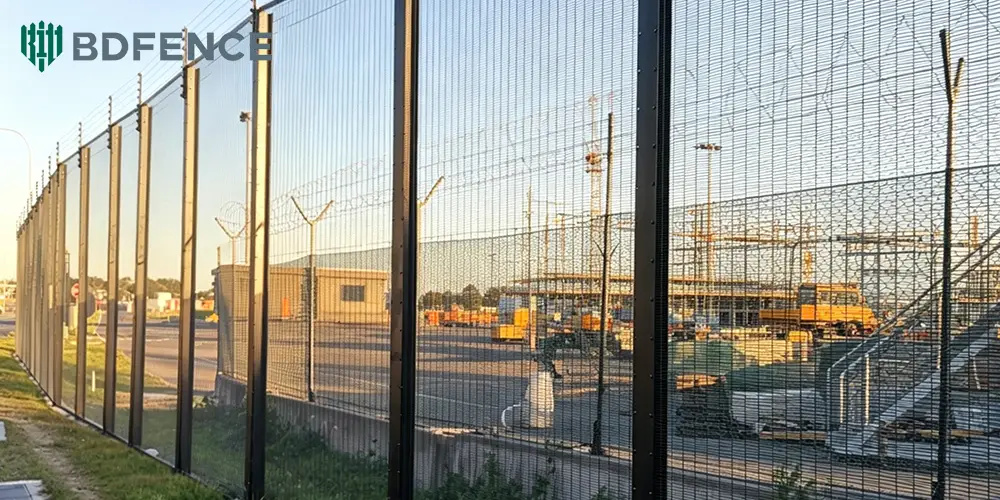
The familiar 358 designation identifies a narrow welded mesh configuration. It originates from the imperial description of 3 inches by half an inch, with an 8-gauge wire reference.
Its commonly quoted metric dimensions are 76.2 × 12.7 mm, with approximately 4 mm steel wire.
However, a mesh opening does not tell the buyer how the complete panel is constructed.
One important distinction appears in the Cape Town tender mentioned above. Its specification calls for 358 Dublo panels, describing vertical double wires welded on either side of the horizontal wires.
This is different from simply describing a panel as conventional single-skin 358 mesh.
When reviewing a quotation, ask the manufacturer to identify:
- Whether the panel uses single or double vertical wires.
- Horizontal wire diameter.
- Vertical wire diameter.
- Mesh opening dimensions.
- Panel width and height.
- Any reinforcing bends or formed sections.
- Required tensile strength and weld strength.
If a tender specifically requests a double-wire construction, a supplier should not silently substitute a single-skin panel just because both products use the same nominal mesh opening.
2. Read the Mesh Dimensions Carefully
South African technical documents sometimes list both the nominal mesh aperture and the inner aperture. These measurements should not be confused.
The City of Cape Town 358 Dublo specification provides a useful example:
| Mesh Measurement | Specified Dimension |
|---|---|
| Nominal Aperture | 76.2 × 12.7 mm |
| Inner Aperture | 72.2 × 8.7 mm |
| Horizontal Wire | 4 mm |
| Vertical Wire | 4 mm |
The distinction matters because the nominal spacing and the clear opening between steel wires are not necessarily the same measurement.
For procurement, ask the manufacturer to show the measurement points on the mesh drawing. This is particularly useful when the buyer compares quotations from suppliers using different drawing conventions.
Do not rely on a catalogue photograph to establish the actual aperture. A dimensioned drawing provides a much better basis for checking the product.
3. Wire Diameter, Tensile Strength and Weld Quality
A 4 mm wire specification does not describe every mechanical property of a 358 panel.
The City of Cape Town tender also identifies a tensile strength range of 600–900 N/mm² and a weld strength requirement of 60–80% for its specified panel.
These requirements provide another level of information beyond the wire diameter.
Tensile strength describes the stress a steel wire can withstand before breaking under a tensile test. It helps identify the specified material performance.
Weld strength relates to the strength of the welded intersection compared with the specified reference strength. It matters because the panel depends on welded connections between horizontal and vertical wires.
For a bulk order, the buyer should establish whether the manufacturer can provide the required test information or inspection records.
There is also a practical issue with mixed wire configurations. Some manufacturers offer different horizontal and vertical diameters rather than using the same size in both directions.
BDFENCE’s published Industrial Park 358 Fence range includes:
- 4.0 × 3.0 mm
- 4.0 × 4.0 mm
- 4.5 × 3.0 mm
- 4.5 × 4.5 mm
These are available product configurations, not automatic equivalents to every South African tender requirement. The buyer should compare each direction separately and confirm the required mechanical properties.
4. Panel Width and the Post-to-Post Dimension
The Cape Town tender specifies a nominal panel width of 3,050 mm.
However, panel width and the distance between post centres are two different measurements. The actual installation spacing depends on the post profile, fixing arrangement and manufacturer’s panel details.
The tender also refers to a maximum panel-to-panel step of 150 mm. This is a project-specific requirement that needs to be considered when preparing the installation layout.
For a perimeter with changes in ground level, the contractor should confirm:
- Finished ground levels along the fence route.
- Post centre positions.
- Panel termination details.
- Maximum permitted changes in level.
- Bottom clearance beneath the mesh.
- Special sections near corners and gates.
A standard panel may not fit every section of the site. Short closing panels and special connections should appear in the material schedule before production.
5. Zincalu, Galvanizing and Powder Coating
Surface treatment is one of the most important parts of an outdoor security fence specification.
In the Cape Town tender, the specified 358 Dublo system uses Zincalu Super wire coating with a composition of 95% zinc and 5% aluminium. The document specifies a minimum coating mass of 275 g/m² under SANS 10244-2:2003.
This is more specific than simply requesting a galvanized fence.
Why does it matter?
Different protective coatings have different compositions and specified coating requirements. A supplier who only states “hot-dip galvanized” has not necessarily demonstrated that the product meets the requested Zincalu specification.
For South African buyers, the quotation should identify:
- Metallic coating type.
- Specified zinc or zinc-aluminium composition.
- Minimum coating mass.
- Whether the requirement applies to the mesh wire, posts and other steel components.
- Any additional polymer or powder-coated finish.
- Required inspection or coating documentation.
The same tender also describes anthracite PVC-coated components for certain gate assemblies. This illustrates why buyers should review the finish requirements component by component rather than assume that every part of the fence has an identical coating schedule.
For coastal and industrial locations, the project designer should also consider the environmental exposure when establishing the required corrosion-protection system.
6. Posts and Foundations Are Part of the 358 Fence Specification
The mesh panel receives most of the attention in a product quotation. Yet the post system and its foundation determine how the panels connect to the site.
The Cape Town tender provides a detailed example of the supporting structure.
| Component | Tender Reference |
|---|---|
| Fence Post | IPE 100 × 55 mm steel section |
| Post Length | 3,000 mm |
| Footing Reference | 300 mm |
| Foundation Dimensions | 450 × 450 × 800 mm |
| Concrete Reference | 15 MPa, 19 mm stone |
| Post Finish | Galvanized and anthracite coated |
The document also states that ground conditions may require additional concrete.
This is an important point for contractors. A foundation dimension listed in a tender should not automatically be treated as suitable for every site. Soil conditions, fence height, wind exposure and the engineer’s design may require adjustments.
Other details in the specification include special corner post arrangements and an earth-lug provision on the posts.
These details may seem unrelated to the mesh panel, but they can affect the manufacturing drawings and installation scope.
For a factory quotation, the buyer should therefore identify the required post profile, steel thickness, length, connection method and foundation responsibilities separately.
7. The Gate Specification Can Change the Entire Supply Package
A high-security fence without a properly specified gate leaves an important part of the perimeter unresolved.
The Cape Town document includes separate provisions for vehicle and pedestrian access. It refers to sliding and swing gate arrangements, gate posts, locking hardware, guide components and coatings.
It also identifies a 1,200 mm-wide single-leaf pedestrian gate.
One detail deserves special attention: the tender’s section heading describes a single-leaf sliding gate, while its accompanying description refers to a single-leaf swing gate.
This is precisely the kind of inconsistency a contractor should clarify before submitting a price. A sliding gate and a swing gate have different frames, hardware, operating arrangements and supporting requirements.
For a 358 fence order, the gate schedule should clearly identify:
- Gate type and opening width.
- Finished gate height.
- Mesh infill specification.
- Gate frame dimensions.
- Hinges, guides, rollers and locking hardware.
- Gate post dimensions.
- Foundation requirements.
- Surface treatment.
If the project includes automated access control, the operating equipment and safety requirements should also have a clearly defined supply responsibility.
8. Not Every South African Clear View Specification Is 358
This is another issue worth checking before preparing a quotation.
South African tenders sometimes use product names such as Clear View, Betaview or equivalent security fencing. However, those descriptions do not automatically establish a conventional 358 mesh specification.
For example, a separate Saldanha Bay Municipality fencing specification issued in April 2026 describes a Clear View or equivalent panel with:
- 76 × 50 mm mesh apertures.
- 3 mm steel core wire.
- 1,800 mm panel height.
- Zinc-aluminium coating and additional anthracite PVC coating.
That is a different mesh configuration from conventional 358 fencing with approximately 76.2 × 12.7 mm openings.
For an importer or distributor, this distinction is important. A buyer should never assume that a product described as Clear View is automatically interchangeable with a 358 panel.
When responding to a South African RFQ, use the actual mesh dimensions, wire specifications and panel construction as the basis for comparison.
9. A Practical Checklist Before Requesting a 358 Fence Quotation
After reviewing the panel, coating, posts and gates, the purchasing team can put everything into one technical schedule.
| RFQ Section | Information to Include |
|---|---|
| Mesh | 76.2 × 12.7 mm or other specified opening |
| Panel Construction | Single-skin or double-vertical-wire configuration |
| Wire | Horizontal and vertical diameters |
| Mechanical Properties | Tensile strength and weld strength, where specified |
| Panel Dimensions | Height, width and bends |
| Posts | Profile, dimensions, wall thickness and length |
| Fixings | Clamp bars, cover plates, bolts and security fasteners |
| Coating | Zinc or Zincalu composition, coating mass and additional finish |
| Foundations | Approved dimensions, concrete requirements and responsibility |
| Gates | Type, opening, frame, hardware and operating method |
| Inspection | Required material records and acceptance criteria |
| Delivery | Quantities, export packing and agreed shipping terms |
One useful practice is to ask every supplier to return the same technical schedule with their quotation. Any difference from the requested specification should be identified as a deviation.
This makes it easier to compare offers without confusing a lower price with an equivalent product.
How BDFENCE Can Support South African 358 Fence Orders
BDFENCE is a China-based metal fencing manufacturer supplying overseas contractors, distributors and project buyers.
Its published Industrial Park 358 Fence range includes several wire configurations, panel heights, panel lengths and supporting post systems.
The published options include:
- Wire combinations of 4.0 × 3.0 mm, 4.0 × 4.0 mm, 4.5 × 3.0 mm and 4.5 × 4.5 mm.
- Mesh openings of 76.2 × 12.7 mm and 75 × 12 mm.
- Panel heights from 1,800 mm to 3,000 mm.
- Square, I-section and H-section post options.
- Different fixing and accessory configurations.
These are published product options, not a declaration that every configuration meets the requirements of every South African tender.
In particular, if a project requires a double-vertical-wire Dublo construction, a specified Zincalu coating mass or a particular tensile and weld strength, those requirements should be confirmed against the manufacturing drawing and supporting documents before the buyer accepts the quotation.
For South African contractors and importers, BDFENCE can review the supplied drawings, BOQ and technical specifications to establish the requested manufacturing scope.
Visit the Industrial Park 358 Fence product page to review the published product configurations.
For project enquiries, send your technical documents through Contact BDFENCE.
Questions South African Buyers Often Ask
What mesh size is used for conventional 358 fencing?
A common specification uses nominal mesh spacing of 76.2 × 12.7 mm with approximately 4 mm steel wire. The approved drawing should also clarify the inner aperture and measurement convention.
What is the difference between 358 and 358 Dublo fencing?
The term 358 identifies the narrow mesh geometry. In the cited Cape Town tender, the Dublo construction specifically describes vertical double wires welded on either side of the horizontal wires. Buyers should confirm the exact panel construction rather than rely on the product name alone.
Does a South African 358 fence have to use Zincalu coating?
Not every project has the same coating requirement. The cited tender specifies Zincalu Super with a 95% zinc and 5% aluminium composition and a minimum coating mass of 275 g/m². Other projects may specify different protective systems.
Can I use a 76 × 50 mm Clear View panel instead of 358 mesh?
Not automatically. A 76 × 50 mm opening is different from conventional 358 mesh. Any substitution must receive approval from the project designer or tender authority.
What should a contractor provide when requesting a factory quotation?
Provide the panel drawing, mesh and wire specifications, post schedule, fixing details, coating requirements, foundation information, gate schedule and BOQ. Identify any tender-specific standards and required inspection documents.
Request a 358 Fence Quotation from BDFENCE
Hebei Bendin Industrial Technology Co., Ltd. (BDFENCE)
Preparing a 358 security fence enquiry for a South African warehouse, industrial facility or infrastructure project?
Send your tender document, drawings or BOQ. BDFENCE can review the required mesh panels, wire configurations, posts, fixing systems and related components to prepare a quotation based on the specified scope.
WhatsApp: +86 18703287372
Email: info@bd-fence.com
Website: https://bd-fence.com/
Inquiry: Contact BDFENCE