



Project Application Study | South Africa | Water Infrastructure Security
The fence line looked clear on the site plan. It ran behind the treatment building, turned beside a maintenance road and continued around the equipment compound.
Then the civil drawing arrived.
Two service pipes crossed the proposed fence alignment. An underground cable route ran close to several planned post foundations, and the access gate sat beside a concrete drainage channel.
None of these details changed the reason for installing a security fence. They did change how the contractor needed to build it.
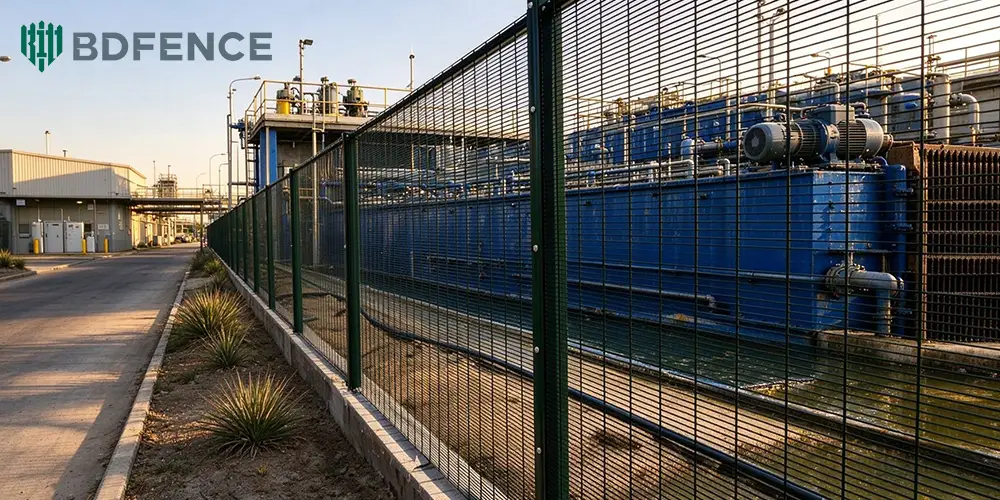
This South African application study examines how a 358 anti-climb fence could form part of the perimeter security design for a water treatment facility. The focus is on a problem that often causes trouble during construction: coordinating the fence with services and civil works that already occupy the site.
The mesh is only one part of that decision.
The Fence Cannot Ignore What Is Underground
At a water treatment facility, the perimeter may run beside buried cables, process pipes, drainage structures and concrete equipment foundations.
A fencing drawing rarely shows all these features.
That creates a problem when the contractor sets out the posts using only a general arrangement drawing. A proposed foundation may conflict with an existing service, even though the fence line itself appears unobstructed.
Moving the post a short distance might seem harmless. With rigid 358 panels, however, that movement changes the distance between supports.
The standard panel may no longer fit.
Before releasing the manufacturing dimensions, the contractor needs a coordinated drawing showing the fence alignment, known services and any restricted excavation areas.
Where the records are incomplete, the project team must verify the relevant service locations using appropriate site procedures.
No supplier can solve an unidentified underground obstruction by choosing a stronger fence post.
The Pipe Crossing Needs Its Own Detail
Consider the point where the fence crosses a service pipe route.
The first question is whether the pipe passes beneath the proposed foundation, beneath a panel or through a dedicated service opening.
These are different situations.
If a pipe passes below the fence, the foundation design must respect the required clearance and maintenance access around that service.
If the route requires an opening through the barrier, the designer needs a purpose-made detail that preserves the specified perimeter protection without obstructing the pipe or its movement.
Cutting an opening in a finished 358 panel should not become the default solution.
It can damage the protective coating, alter the welded mesh and leave a connection that does not match the approved security design.
There may also be pipe supports, insulation, movement allowances or inspection requirements to consider.
The right approach is to resolve the crossing on the approved drawings before deciding whether the adjoining panels need special dimensions.
For the manufacturer, that means receiving a clearly identified special panel or interface detail instead of an instruction to provide one extra standard panel.
The Gate Must Work with the Maintenance Road
Water facilities need access for maintenance vehicles, service contractors and equipment deliveries.
In this application, the proposed gate sits near a drainage channel at the edge of the maintenance road.
A gate elevation alone will not show whether the arrangement works.
The contractor should confirm the clear vehicle opening, finished road levels, gate movement and the location of any gate-support foundations.
A swing gate needs sufficient room for its leaves. A sliding arrangement requires suitable space and supporting infrastructure beside the entrance.
Drainage also matters.
A ground-mounted stop or bolt receiver must not interfere with the channel or create an avoidable maintenance obstruction.
The gate supplier and civil contractor should therefore work from the same released entrance drawing.
There is little value in manufacturing a gate to the correct width if the final road layout leaves nowhere for it to open.
Why a 358 Mesh System Was Considered
The water treatment compound needs a physical perimeter barrier that discourages climbing while allowing security staff to maintain visibility around the equipment areas.
358 welded mesh offers a narrow rectangular aperture, commonly 76.2 × 12.7 mm. The small openings restrict conventional hand and footholds.
For the initial product discussion, BDFENCE’s 358 range includes different wire combinations, panel heights and post arrangements.
A preliminary schedule for this application could consider:
| Component | Preliminary Design Basis |
|---|---|
| Fence system | 358 welded anti-climb mesh |
| Mesh opening | 76.2 × 12.7 mm |
| Wire combination | 4.0 × 4.0 mm option |
| Nominal panel height | 2,400 mm |
| Panel width | To suit the approved post layout |
| Finish | Project-specified galvanized and coated system |
| Posts and fixings | Designed for the selected panels and site loads |
| Gate | Separately detailed maintenance entrance |
These dimensions are illustrative, not a confirmed customer order.
The project engineer would need to approve the complete fence design, including the posts, foundations, connection details and security requirements.
A 358 panel provides anti-climb characteristics. It does not eliminate the need to coordinate gates, service crossings and other perimeter interfaces.
A Coating Decision for a Wet Working Environment
The facility’s normal operations may involve wet ground, washdown areas and drainage equipment.
That does not mean every section of fence experiences the same exposure.
A panel beside a regularly wet process area may face different conditions from one on a dry, exposed boundary.
The coating specification needs to account for the actual location, maintenance expectations and any relevant project standards.
For this application, galvanized steel with a compatible additional coating could be considered, subject to the approved corrosion protection requirements.
Posts, clamps and fasteners also need suitable protection.
It would make little sense to specify a carefully finished mesh panel and leave incompatible fittings at every connection.
The procurement documents should identify the finish for each component, along with inspection and repair requirements.
The Material Schedule Changed When the Civil Details Were Reviewed
The first fence estimate might contain standard panels, matching posts and one gate.
After coordinating the service drawings, the contractor could need a different combination:
- Standard panels for the unobstructed boundary sections
- Special-width panels beside a service crossing
- Revised post positions near existing utilities
- Separately designed connections at drainage structures
- Gate posts and foundations coordinated with the access road
- Clearly identified fittings for non-standard locations
This is not necessarily a larger order. It is a better-defined one.
The change is important for overseas procurement because the factory manufactures against dimensions that the contractor provides.
If those dimensions change after production, replacing a custom panel can involve more than shipping a small missing accessory.
The drawing revision should therefore reach the manufacturer before the final panel and post schedules are approved.
Checking the Order Before Manufacturing
For a project like this, I would put the fence layout and civil-services drawings beside each other.
Start with the proposed post locations. Are any too close to a service route or an excavation restriction?
Then follow the fence past each pipe crossing and drainage structure.
Does every special connection have an approved detail? Are the adjoining panel dimensions shown? Does the material schedule identify those components separately?
Move to the entrance.
Check the gate-post positions, clear opening and finished levels against the maintenance-road drawing.
Finally, compare the approved schedule with the supplier’s quotation.
A quotation that includes the correct total number of panels can still be wrong if it contains standard panels where the drawing requires special ones.
The purpose of this review is to resolve those differences before steel is cut, welded or coated.
What This Application Means for South African Contractors
The main purchasing lesson is not that every water treatment facility needs custom fencing.
Many boundary sections may use standard 358 panels.
The difficulty lies where the perimeter meets work completed by other trades. Underground services, drainage structures, access roads and existing concrete can change the installation arrangement.
For the contractor, the best time to resolve these interfaces is before approving the manufacturing schedule.
For the importer, the essential documents are the released panel schedule, post schedule, special connection details and component quantities.
For the manufacturer, the job becomes much clearer when each non-standard item has its own drawing reference.
That is better than shipping a container of correct-looking panels and hoping the installation team can make every section fit.
Discuss a 358 Fence Package with BDFENCE
BDFENCE supplies 358 security fencing for international distributors, engineering contractors and industrial project buyers.
Our 358 Security Fence range includes welded mesh panels with different wire configurations, panel dimensions, post options and finishes.
For infrastructure projects, buyers can send the fence layout, panel schedule and relevant details for gates or special connections. We can review the requested manufacturing specifications and discuss the available supply arrangements.
You can also review our complete fencing product range for other perimeter requirements.
Planning a 358 Fence Project in South Africa?
If your project has pipe crossings, unusual foundations, drainage interfaces or non-standard panels, include those drawings with your RFQ.
A detailed material schedule gives us a much better starting point than a total perimeter length alone.
BDFENCE — Hebei Bendin Industrial Technology Co., Ltd.
Website: bd-fence.com
WhatsApp: +86 18703287372
Email: info@bd-fence.com