



The Project Situation
An industrial facility needs a perimeter fence that does more than mark the edge of its property. It must also discourage climbing, restrict unauthorized access and allow security personnel to monitor the surrounding area.
This type of requirement often leads project teams to reconsider conventional fencing.
For this South African industrial facility application, the proposed upgrade focuses on replacing sections of general perimeter fencing with a 358 anti-climb mesh system. The objective is to improve physical access control without creating a completely enclosed visual barrier.
The project requires more than a supply of welded mesh panels. The contractor also needs to coordinate fence height, supporting posts, panel connections and surface protection before preparing the final material schedule.
Why the Existing Perimeter Design Needed Reviewing
A perimeter fence can remain physically intact while no longer meeting the security requirements of a facility.
For example, conventional mesh may provide basic boundary separation but offer more accessible footholds than a narrow-aperture security panel.
The project team therefore needs to consider several questions:
- Can someone obtain hand or foot holds on the existing mesh?
- Are the current posts suitable for a heavier welded panel system?
- Do vehicle entrances create vulnerable sections?
- Does the site need better visibility for security patrols?
- Will the replacement fence follow the existing boundary line?
These questions influence the final design more than the product name alone.
In this application, the proposed solution uses 358 mesh for selected industrial perimeter sections where climbing resistance is a priority.
Selecting the 358 Mesh Specification
The defining feature of 358 security fencing is its narrow rectangular mesh opening.
The commonly used dimensions are approximately 76.2 × 12.7 mm, with a traditional 8-gauge wire designation. Manufacturers commonly describe the wire diameter as approximately 4 mm in metric configurations.
For this application, the contractor should confirm the following before production:
| Specification | Project Consideration |
|---|---|
| Mesh opening | Approximately 76.2 × 12.7 mm |
| Wire diameter | Approximately 4 mm, subject to approved specification |
| Panel height | Based on the site security assessment |
| Panel width | Matched to post spacing and boundary layout |
| Surface treatment | Selected according to environmental exposure |
| Panel fixing | Compatible with the proposed security posts |
The exact panel dimensions should follow the approved project drawing.
This is important because even a small change in panel width can affect post positions, fixing quantities and the overall material calculation.
The Supporting Structure Was Part of the Solution
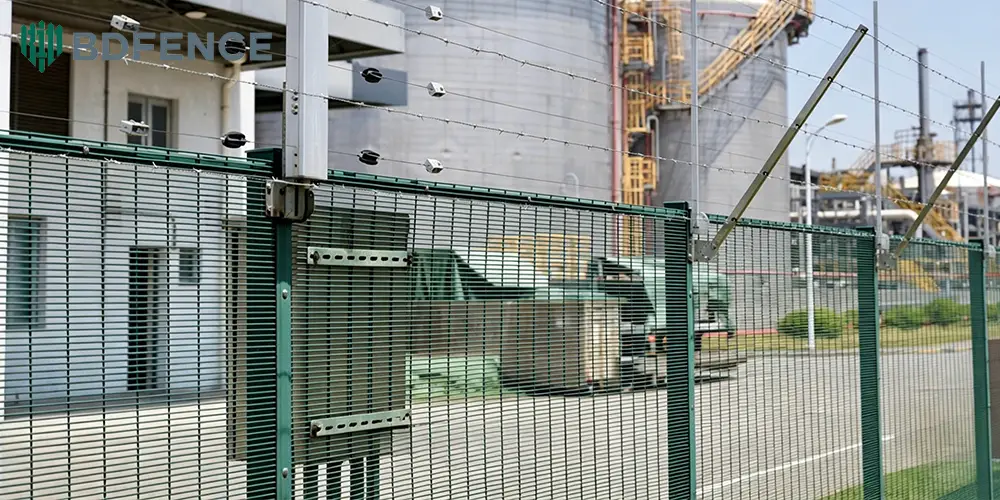
Replacing conventional mesh with 358 panels does not mean the existing support structure can automatically remain unchanged.
The contractor needs to review the posts and connections as part of the upgrade.
For this application, the material schedule should account for:
Security fence posts: Their cross-section, wall thickness, length and spacing must match the selected panels and structural requirements.
Panel clamps: The fixing arrangement needs to hold the welded panels securely against the posts.
Bolts and fasteners: Their dimensions and corrosion protection should match the specified system.
Post caps: These complete the post assembly and protect exposed openings.
Gate connections: Existing access gates may need modification or replacement to work with the upgraded perimeter.
The post foundations also deserve attention. Ground conditions, fence height and wind exposure can influence the structural design. A qualified project engineer should confirm the foundation requirements before installation.
Surface Protection for a South African Industrial Environment
South Africa has varied environmental conditions. An industrial facility in an inland location may face different corrosion risks from one near the coast.
For this reason, the project specification should identify the required surface protection rather than simply state that the fence must be galvanized.
A hot-dip galvanized finish provides a zinc coating that helps protect steel against corrosion.
Where the project requires a coloured finish, buyers can also consider powder coating over an appropriately prepared galvanized surface.
For a facility near Durban or another coastal location, the project team should pay particular attention to salt exposure and coating requirements.
The specification should cover the panels, posts and fixing components. There is little value in selecting suitable mesh protection while overlooking the other exposed steel parts.
Managing the Replacement Without Disrupting Site Operations
An industrial perimeter upgrade needs careful installation planning.
The facility may continue operating while contractors replace selected fence sections. This creates practical considerations that do not appear on a basic product quotation.
For example, the installation team may need to:
- Divide the perimeter into manageable work sections
- Maintain temporary access restrictions during replacement
- Coordinate vehicle and pedestrian entrances
- Confirm the position of existing underground services
- Check the condition of foundations before installing new posts
- Inspect completed sections before moving to the next area
Where the site requires continuous perimeter protection, the contractor should establish suitable temporary security arrangements before removing existing fencing.
The final installation sequence depends on the facility’s operating requirements and approved construction plan.
What the Contractor Needs from the Manufacturer
For a project involving several perimeter sections, a simple price per panel is not enough.
The contractor needs a quotation that reflects the complete material requirement.
The procurement package should identify:
- 358 mesh panel dimensions
- Horizontal and vertical wire specifications
- Surface treatment
- Post dimensions and quantities
- Panel fixing components
- Gate requirements
- Packaging and shipment details
A BOQ and site drawing can help the manufacturer check quantities and identify missing components before production.
The contractor should also agree on inspection criteria before placing the order. Mesh dimensions, wire diameter, welding consistency and coating condition are useful reference points during product inspection.
For a first order, reviewing a physical sample can help establish the expected finish and workmanship.
Why 358 Fence Was Considered for This Upgrade
The decision to use 358 mesh comes down to the security requirements of the selected perimeter sections.
Its narrow openings make conventional climbing more difficult because they offer limited space for hand and foot placement. The rigid welded construction also differs from flexible woven mesh systems.
For industrial facilities that need a stronger anti-climb barrier, these characteristics can make 358 fencing a suitable option.
However, the fence itself is only one part of the site’s security arrangement. Access control, gates, lighting, surveillance and operational procedures still play important roles.
A good perimeter design considers all of these elements together.
BDFENCE Supply Considerations
BDFENCE supplies 358 anti-climb fencing for international distributors, contractors and project procurement teams.
For an industrial perimeter upgrade, buyers can discuss panel dimensions, wire specifications, surface treatment, posts and fixing accessories as one coordinated supply requirement.
Our 358 Security Fence product range provides a starting point for reviewing available configurations.
If the project includes different boundary zones, buyers can also review our complete fencing product range for other perimeter fencing options.
Preparing a Similar Industrial Fence Upgrade?
If you are planning to replace conventional perimeter fencing with 358 anti-climb panels in South Africa, start with the existing site layout and the required security level.
A useful inquiry should include:
- Existing fence height and approximate boundary length
- Required 358 panel height and width
- Mesh opening and wire diameter
- Surface treatment requirements
- Existing or proposed post dimensions
- Gate locations and quantities
- BOQ or technical drawings
- Required delivery location
BDFENCE can review the supplied specifications and discuss the required panels, posts and accessories for your procurement plan.
Contact BDFENCE
Hebei Bendin Industrial Technology Co., Ltd.
Website: bd-fence.com
WhatsApp: +86 18703287372
Email: info@bd-fence.com
Frequently Asked Questions
Why would an industrial facility replace conventional mesh with 358 fencing?
A facility may need stronger resistance to climbing and a more restrictive mesh opening. The decision should follow a security assessment of the existing perimeter.
Can 358 fence panels connect to existing posts?
Not automatically. The contractor should check post dimensions, fixing positions, structural capacity and panel compatibility before reusing existing posts.
What surface treatment should be specified for a South African industrial fence?
The choice depends on the installation environment. Inland and coastal facilities may have different corrosion protection requirements. Buyers should specify the coating system for panels, posts and accessories.
Does a perimeter upgrade require new gates?
Not necessarily. Existing gates may remain suitable, but their dimensions, frames, hinges and connection details should be checked against the upgraded fence system.
What information should a contractor provide when requesting a quotation?
A site layout, estimated perimeter length, required panel dimensions, wire specifications, surface treatment, post requirements and gate details provide a useful starting point.
Can BDFENCE supply panels and supporting components together?
Yes. Buyers can request a coordinated quotation for 358 mesh panels, security posts, fixing clamps, bolts and other compatible components.