



A residential community needs a fence that defines its property without making the surroundings feel closed off. Residents want clear boundaries, property managers need controlled access, and the developer wants the fencing to fit the landscaping and buildings.
For this illustrative U.S. residential development, the proposed solution uses PVC-coated chain link fencing around selected community boundaries, shared green spaces and service areas. The green-coated mesh provides a more coordinated appearance than unfinished steel mesh, while the woven structure allows residents and security personnel to see through the perimeter.
However, selecting the mesh is only one part of the project. Wire diameter, PVC coating, post spacing, gates and installation details all affect the final system.
The following case examines how a residential development could approach these decisions before placing an order with an overseas manufacturer. It is an illustrative application scenario, not a confirmed BDFENCE customer installation in the United States.
Project Overview
| Project Item | Proposed Details |
|---|---|
| Country | United States |
| Project Type | Residential Community Development |
| Main Product | PVC-Coated Chain Link Fence |
| Reference Mesh Opening | 50 × 50 mm (approximately 2 × 2 inches) |
| Reference Steel Core Diameter | 3.0 mm (approximately 0.118 inches) |
| Reference Fence Height | 1,800 mm (approximately 6 feet) |
| Surface Treatment | Galvanized Steel Wire with PVC Coating |
| Color | Green, subject to final approval |
| Supporting Components | Round Posts, Top Rails, Tension Bars and Fittings |
| Access Points | Pedestrian Gates and Vehicle Gates |
| Project Status | Illustrative Application Scenario |
The dimensions above provide a reference configuration for discussing the project. They are not a universal U.S. residential fence specification. The final design must follow the approved site drawings, local requirements and community association rules.
What Did the Residential Community Need?
The proposed development contains residential buildings, shared green spaces, internal roads, parking areas and service facilities. The developer wants a consistent boundary around the property while keeping the community visually open.
Different parts of the development have different fencing requirements.
Community perimeter
The outer boundary separates the residential property from surrounding roads and neighboring land. It needs a continuous fence line with suitable access points for residents, visitors and maintenance personnel.
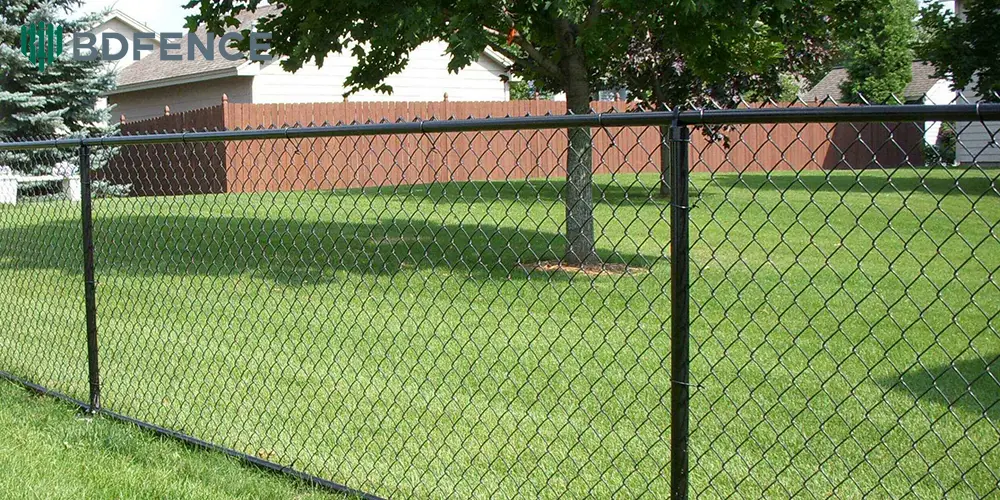
PVC-coated chain link mesh offers a practical option for this type of boundary. Its diamond pattern allows visibility through the fence, while the polymer finish gives the steel a more consistent appearance.
Shared green spaces
The community may also have landscaped areas, walking routes and small recreational spaces. These locations need clearly defined boundaries without blocking the surrounding views.
A green PVC-coated finish can blend more naturally with lawns, trees and planting areas than an unfinished metallic surface.
However, the mesh opening and fence height should still reflect the intended use. A boundary around a general landscaped area may have different requirements from a playground or restricted service area.
Parking and service areas
Parking areas need controlled vehicle access, while maintenance areas may require separate pedestrian or service entrances.
For these sections, the contractor should plan the gate openings before calculating the final mesh quantities. Gate locations can affect post positions, fence lengths and the number of short closing sections.
Why Was PVC-Coated Chain Link Fence Considered?
The developer wanted a boundary system that combined visibility, practical installation and a finished appearance suitable for residential surroundings.
Compared with bare galvanized mesh, PVC-coated chain link fencing has an additional polymer layer over the steel wire. This changes the surface appearance and provides another protective layer.
For this proposed development, the main considerations were:
- A colored finish that complements the landscaping.
- An open mesh structure that maintains visibility.
- Different mesh openings and wire diameters for separate areas.
- Roll-form mesh that can follow the planned property boundary.
- Matching posts, rails and fittings.
- Separate pedestrian and vehicle access arrangements.
The coating does not eliminate the need for proper material selection or maintenance. Its performance depends on the steel substrate, metallic coating, polymer coating and manufacturing quality.
Choosing the Right PVC-Coated Mesh
Mesh opening and wire diameter
The first specification to confirm is the mesh opening. Chain link fencing uses woven steel wires to create diamond-shaped spaces, and different openings suit different applications.
For the proposed residential community, a 50 × 50 mm opening serves as a reference option. The buyer could also review other available sizes according to the project design.
Wire diameter needs equal attention. A 3.0 mm steel core and a 4.0 mm steel core do not contain the same amount of steel, even when their mesh openings match.
For a bulk order, the manufacturer should identify the steel core diameter separately from the finished diameter after PVC coating.
This distinction matters because the polymer layer increases the outside diameter. A buyer who compares finished diameters without checking the steel core may misunderstand the actual material specification.
Reference product options
BDFENCE publishes several chain link fence configurations for residential, commercial and industrial applications.
| Specification | Published Options |
|---|---|
| Steel Core Wire Diameter | 2.5 / 3.0 / 3.5 / 4.0 / 4.5 mm |
| Mesh Opening | 40 × 40 / 50 × 50 / 60 × 60 / 75 × 75 / 100 × 100 mm |
| Roll Height | 1.2 / 1.5 / 1.8 / 2.0 / 2.4 / 2.8 / 3.0 m |
| Roll Length | 9 / 10 / 15 / 18 / 20 / 25 / 30 m |
| Top Rail Diameter | 32 / 40 / 48 mm |
| Round Post Diameter | 40 / 48 / 60 / 75 mm |
| Post Wall Thickness | 1.5 / 1.8 / 2.0 / 2.5 mm |
| Edge Finish | Knuckled or Twisted |
These options are published product configurations. The buyer should confirm the actual steel core diameter, finished coated diameter, PVC coating requirements and available combinations before production.
PVC Coating: What Should U.S. Buyers Check?
Not all PVC-coated chain link products use the same coating arrangement. The steel substrate and the method used to apply the polymer layer both matter.
ASTM F668-25 is the current ASTM specification for PVC, polyolefin and other polymer-coated steel chain link fence fabric. It covers polymer-coated fabric produced by coating the wire before weaving.
The standard identifies three coating classes:
- Class I: Polymer coating extruded over metallic-coated steel wire.
- Class 2a: Polymer coating extruded and adhered to metallic-coated steel wire.
- Class 2b: Polymer coating fused and adhered to metallic-coated steel wire.
These categories describe different coating constructions. Buyers should not assume that every PVC-coated chain link product automatically meets the same class.
For the proposed U.S. project, the procurement documents would identify the required ASTM F668 class, steel core diameter, metallic coating, polymer coating thickness and finished wire requirements where applicable.
The standard also addresses mesh size, diamond count, fabric height, selvage, breaking strength, coating weight and roll length.
For reference, see ASTM F668-25: Polymer-Coated Steel Chain Link Fence Fabric.
Why does the metallic coating beneath PVC matter?
The polymer coating forms the outer surface, but the steel wire beneath it remains an important part of the product.
For example, the coating may sit over zinc-coated steel wire. This gives the product a metallic protective layer beneath the polymer finish.
However, the buyer should confirm the specified zinc coating and polymer coating separately. Simply writing “PVC coated” in a purchase order does not describe every part of the protective system.
For this reason, the supplier should identify the coating class and provide the relevant product documentation where the project requires it.
Green or Black PVC-Coated Fence?
Color is often an important consideration for residential communities.
Green mesh is frequently selected for landscaped boundaries because it works with grass, shrubs and trees. Black mesh provides a different appearance and may suit modern buildings or darker exterior finishes.
Neither color determines the corrosion resistance of the finished product. The steel substrate, metallic coating, polymer formulation and coating thickness still need to meet the approved specification.
For the proposed development, green is the initial design preference. Before placing the order, the developer would approve a color sample or reference code.
The same finish should also be considered for the posts, top rails, tension bars and exposed fittings. A green mesh combined with visibly different metallic accessories may produce an inconsistent result along the boundary.
Posts, Top Rails and Fittings Must Match the Mesh
Chain link mesh does not form a complete fence system by itself. Posts and fittings support the fabric and keep it properly tensioned.
For this residential community, the proposed framework includes:
- Line posts along the regular fence runs.
- Terminal posts at ends and tension points.
- Corner posts where the boundary changes direction.
- Top rails between supporting posts.
- Tension bars and tension bands.
- Post caps, rail ends and fence ties.
- Gate posts and matching gate hardware.
The post dimensions depend on fence height, spacing, ground conditions and design loads. A short decorative boundary does not necessarily need the same framework as a taller perimeter fence.
The contractor should also confirm the post installation method. Embedded posts and surface-mounted posts use different connection arrangements.
For the proposed project, the final post schedule would be prepared after the contractor reviews the boundary layout and gate positions.
Planning Pedestrian Gates and Vehicle Entrances
A residential community needs convenient access for residents, visitors and service vehicles. The fence layout should therefore include the gate schedule from the beginning.
Pedestrian gates
Pedestrian gates provide access to walking paths, shared facilities and designated entrances.
The frame can use matching chain link infill to maintain a consistent appearance. However, the opening width, hinges, latch and locking hardware need separate specifications.
If the community uses electronic access control, the developer should also coordinate the gate hardware with the access-control supplier.
Vehicle gates
The main entrance may require a swing gate or sliding gate depending on the available space and traffic arrangement.
A swing gate needs room for its leaves to open. A sliding gate needs a suitable travel area alongside the opening.
The gate schedule should identify the clear opening, frame dimensions, supporting posts and required operating hardware.
For a residential development, the gate should also allow suitable access for maintenance vehicles and emergency services according to the approved site and local requirements.
Do not calculate the fence quantities before the gate positions are confirmed. Every opening changes the number of mesh rolls, posts and fittings required along the boundary.
Installation Planning for a Residential Community
Long residential boundaries often include landscaped areas, paved roads, drainage channels and changes in ground level. The installation team should review these conditions before setting the posts.
For this project, the proposed installation sequence would include:
- Survey the property boundary and confirm the approved fence layout.
- Mark gate openings, corners and changes in direction.
- Identify underground services before excavation.
- Position line, terminal and corner posts according to the drawings.
- Install the posts and allow concrete foundations to reach the required condition.
- Fit the top rails and specified tension components.
- Unroll the PVC-coated chain link mesh carefully.
- Stretch and secure the fabric using compatible tension bars, bands and fittings.
- Install pedestrian and vehicle gates.
- Inspect the fence alignment, connections and finished coating.
During installation, the crew should protect the PVC coating from unnecessary abrasion, sharp impacts and unsuitable handling tools.
If the coating is damaged, the team should follow the approved repair procedure rather than leave exposed steel untreated.
How Should the Fence Be Maintained?
PVC-coated chain link fencing is suitable for outdoor applications, but it still needs periodic inspection.
For a residential community, the property management team can include the fence in its routine maintenance schedule.
Useful inspection points include:
- Visible cuts, scratches or peeling in the PVC coating.
- Exposed steel or corrosion around damaged areas.
- Loose ties, tension bands or fasteners.
- Changes in mesh tension or fence alignment.
- Post movement or concrete foundation damage.
- Gate hinges, latches and locking components.
- Vegetation pressing against the mesh or restricting drainage.
Landscaping deserves particular attention. Climbing plants and shrubs can gradually cover the mesh and make inspection more difficult.
Keeping a suitable clearance around the fence allows the property manager to inspect the coating and supporting components more easily.
Where damage occurs, the maintenance team should identify the affected section and use a repair method compatible with the specified coating system.
What Should the U.S. Buyer Check Before Ordering?
For an imported residential fencing project, the buyer should provide more than a product name and estimated perimeter length.
A clear RFQ helps the manufacturer understand the required mesh, finish and supporting components.
| Purchase Requirement | Information to Confirm |
|---|---|
| Mesh Opening | Required diamond dimensions |
| Steel Core Diameter | Nominal diameter before PVC coating |
| Coating Class | Required ASTM F668 classification, if specified |
| Metallic Coating | Zinc or other specified protective layer |
| PVC Coating | Thickness, finished diameter and color |
| Roll Dimensions | Height and length |
| Edge Finish | Knuckled or twisted |
| Posts and Rails | Dimensions, wall thickness and finish |
| Gates | Opening dimensions, frame and hardware |
| Delivery | Packing, shipping terms and destination |
U.S. residential developments may also have homeowner association rules, architectural guidelines and local zoning requirements. Fence height, front-yard placement, property boundaries and pool enclosure requirements should be checked with the relevant local authorities and project professionals.
Do not assume that one fence height or gate arrangement is permitted throughout the United States.
Factory Inspection and Export Packing
For a bulk residential fencing order, the manufacturer should check the product against the approved specification before shipment.
The inspection plan for this proposed project would include:
| Inspection Item | What to Check |
|---|---|
| Steel Core | Wire diameter and material requirements |
| Mesh | Opening size, roll height and roll length |
| PVC Coating | Color, thickness, surface condition and specified class |
| Metallic Coating | Required zinc or other metallic coating documentation |
| Edge Finish | Knuckled or twisted configuration |
| Posts and Rails | Dimensions, wall thickness and surface treatment |
| Accessories | Quantities and compatibility with the selected fence |
| Packing | Protection, package labels and packing list |
PVC-coated mesh needs suitable protection during transport. If rolls rub against each other or sharp steel components, the outer polymer layer may suffer damage.
For this reason, the buyer should discuss packing before production is complete.
Depending on the order, the manufacturer can consider protective wrapping, pallet packing, separate bundles for posts and cartons for smaller fittings.
Clear package labels also help the receiving team identify different roll heights, mesh sizes and accessory groups.
How BDFENCE Can Support a Residential Community Fence Order
BDFENCE is a China-based metal fencing manufacturer supplying overseas contractors, distributors and project buyers.
Its published Chain Link Fence range includes galvanized, PVC-coated and galvanized-plus-PVC product options. The available configurations cover different mesh openings, wire diameters, roll heights, roll lengths and supporting post systems.
For a U.S. residential community enquiry, useful documents include the property layout, required fence height, mesh specification, PVC coating requirements, gate schedule and bill of quantities.
BDFENCE can review the requested mesh, posts, rails and fittings against the supplied project information. If the project specifies ASTM F668-25 or a particular coating class, include that requirement in the enquiry so the manufacturing and documentation scope can be checked.
For more information, visit the Chain Link Fence product page.
For a project-based quotation, send your drawings, BOQ or technical requirements through Contact BDFENCE.
FAQ
Why use PVC-coated chain link fence for a residential community?
PVC-coated chain link fencing combines an open woven mesh structure with a colored polymer finish. It can suit community boundaries, landscaped areas and selected common spaces where visibility and appearance both matter.
Is PVC-coated chain link fence better than galvanized chain link fence?
The choice depends on the project requirements. PVC coating provides an additional polymer layer and a colored finish, while galvanized mesh uses a zinc protective layer. Buyers should compare the steel core, metallic coating and polymer coating rather than judge the products by appearance alone.
What is ASTM F668-25?
ASTM F668-25 is the current ASTM specification for PVC, polyolefin and other polymer-coated steel chain link fence fabric. It covers coating classes and requirements relating to mesh, wire, fabric dimensions and coating properties.
Which color should a residential community choose?
Green and black are common color choices for PVC-coated chain link fencing. The final selection should match the architectural design, landscaping and community guidelines. Confirm the available color and reference sample with the manufacturer.
Can PVC-coated chain link fence include matching posts and gates?
Yes. A complete fence package can include compatible posts, top rails, tension bars, fittings, pedestrian gates and vehicle gates. The buyer should identify the required components in the BOQ.
What information is needed for a U.S. residential fence quotation?
Provide the site layout, fence height, mesh opening, steel core diameter, PVC coating requirements, color, roll dimensions, post details, gate openings and delivery destination.
Contact BDFENCE
Hebei Bendin Industrial Technology Co., Ltd. (BDFENCE)
Planning a PVC-coated chain link fence project for a residential community in the United States? Send your site layout, BOQ or technical specification for a quotation based on your required mesh, coating, posts and gates.
Phone: +86 18703182863
WhatsApp: +86 18703287372
Email: info@bd-fence.com
Website: https://bd-fence.com/
Inquiry: Contact BDFENCE