



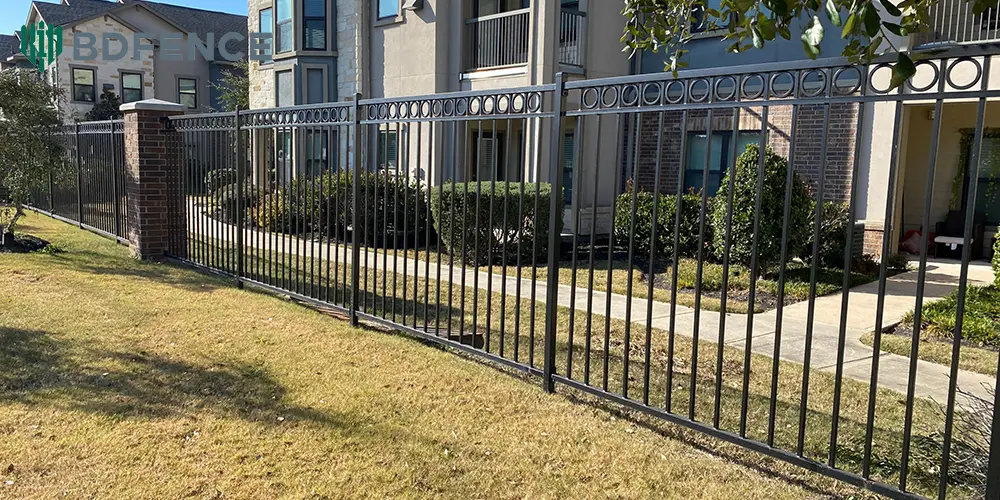
A commercial residential development in Singapore required a new Steel Tubular Fence system around landscaped boundaries, pedestrian routes, parking areas, service zones, and controlled entrances.
The project needed more than a clean architectural appearance.
Because the fence would remain outdoors in a high-humidity environment with frequent rain and long periods of moisture exposure, corrosion protection became an important part of the specification.
For this project, BDFENCE supplied a galvanized and powder-coated Steel Tubular Fence system with steel picket panels, posts, pedestrian gates, vehicle gates, brackets, fasteners, and installation accessories.
Project Profile
| Project Item | Details |
|---|---|
| Country | Singapore |
| Sector | Commercial Residential Development |
| Application | High-Humidity Outdoor Perimeter |
| Product | Steel Tubular Fence |
| Surface Treatment | Galvanized + Powder Coated |
| Main Requirement | Corrosion Protection + Architectural Appearance |
| Access | Pedestrian and Vehicle Gates |
| Supply Scope | Panels, Posts, Gates, Brackets, Fasteners and Accessories |
The Climate Changed the Finish Strategy
The fence would not operate in a dry inland environment.
The site was exposed to:
- High humidity
- Frequent rainfall
- Wet landscaping
- Surface condensation
- Long-term outdoor moisture
Therefore, the project team needed to think about what happened beneath the visible powder-coated surface.
Why Galvanized + Powder-Coated Steel Was Selected
The customer wanted a finished color that matched the modern development.
At the same time, relying only on the visible outer coating was not the preferred direction for the humid environment.
The project therefore used a combined finish strategy:
- Galvanized base protection
- Powder-coated outer finish
This allowed the fence to combine corrosion protection with a more refined architectural appearance.
The Fence Needed to Look Clean Around Public Areas
The perimeter remained visible around:
- Main entrances
- Pedestrian walkways
- Landscaped boundaries
- Parking areas
- Residential frontage
For these areas, a plain industrial metallic finish would not have matched the design intent as well.
Powder coating allowed the project to use a consistent architectural color across the fence system.
Why Base Protection Still Matters Under Powder Coating
Powder coating creates a finished outer surface, but fences can still experience scratches during transport, installation, or long-term use.
In a high-humidity environment, exposed steel can become a local corrosion point.
Using galvanized steel beneath the powder-coated finish provided an additional protection layer rather than relying only on the colored outer surface.
Post Bases Were a High-Priority Detail
The lower part of the fence post can experience more moisture than the upper panel.
Post bases may be exposed to:
- Standing rainwater
- Wet concrete
- Landscape irrigation
- Soil moisture
- Cleaning water
For this reason, the project considered post-base protection and drainage as part of the fence system.
Drainage Was Important Around Landscaped Areas
The development included planted areas close to the fence line.
Landscape irrigation can increase moisture around the lower steel components if drainage is poor.
The installation team therefore needed to avoid creating water traps around:
- Post foundations
- Gate posts
- Low points in the terrain
- Landscape edges
Good drainage helped reduce unnecessary long-term moisture exposure.
Welded Areas Needed the Same Protection Logic
Steel Tubular Fence is a fabricated product.
Vertical pickets are welded to horizontal rails, while gate frames include additional fabricated joints.
The project therefore considered the completed steel component rather than treating each tube as an isolated material.
Important areas included:
- Picket-to-rail welds
- Gate-frame welds
- Bracket connections
- Cut edges
The Gates Faced More Wear Than Fixed Panels
Fence panels remain fixed, but gates move every day.
That repeated movement can create more wear around:
- Hinges
- Locks
- Stops
- Gate frames
- Gate posts
In a humid environment, these moving components also needed a suitable corrosion-protection strategy.
Pedestrian Gates Needed to Match the Fence Finish
The project included several pedestrian entrances.
These gates used matching steel picket infill and the same overall finish direction as the surrounding fence.
This created better consistency between:
- Fence panels
- Gate frames
- Gate posts
- Visible hardware
Vehicle Gates Required Heavier Structural Components
Vehicle entrances used larger gate frames and stronger supporting posts.
The project reviewed:
- Gate opening width
- Gate height
- Frame tube size
- Frame wall thickness
- Gate post size
- Hardware
- Surface treatment
The corrosion-protection approach needed to remain consistent even when the steel sections became larger.
Fasteners and Brackets Could Not Be Ignored
Small steel components can become visible maintenance points if their protection level does not match the rest of the fence.
The project therefore considered:
- Brackets
- Bolts
- Nuts
- Washers
- Gate hardware
These components remained exposed to the same humidity and rainfall as the main fence.
What BDFENCE Supplied
| Component | Project Function |
|---|---|
| Steel Tubular Fence Panels | Main perimeter and landscape boundary |
| Galvanized + Powder-Coated Posts | Support standard fence sections |
| Corner and End Posts | Support direction changes and terminations |
| Pedestrian Gates | Resident, staff and visitor access |
| Vehicle Gates | Controlled vehicle access |
| Gate Posts | Support larger entrance structures |
| Brackets | Connect panels to posts |
| Fasteners and Accessories | Complete the installation system |
Factory Checks Included Finish Consistency
Because the powder-coated surface was highly visible, appearance remained part of quality control.
| Component | Inspection Focus |
|---|---|
| Fence Panels | Dimensions, picket spacing, welds and visible finish |
| Steel Posts | Section size, wall thickness, length and coating condition |
| Pedestrian Gates | Frame dimensions, alignment and surface condition |
| Vehicle Gates | Frame structure, post compatibility and finish |
| Brackets | Fit and coating consistency |
| Fasteners | Type, quantity and compatibility |
Color Consistency Was Important Across the Project
Large fence projects can include multiple production batches.
If the visible finish varies noticeably between panels, posts, and gates, the completed perimeter can look inconsistent.
For this reason, the project focused on maintaining a coordinated finish across:
- Panels
- Posts
- Gate frames
- Gate posts
- Visible brackets
Packaging Needed to Protect the Powder-Coated Surface
A finished coating can be damaged during transport if steel components rub against one another.
BDFENCE organized the shipment to reduce unnecessary surface contact.
Panels were stacked and secured, posts were bundled separately, and smaller accessories were packed by category.
Gate components were also identified and protected separately.
Installation Needed to Avoid Coating Damage
The factory-applied finish still depends on careful installation.
The installer needed to avoid unnecessary:
- Grinding
- Cutting
- Impact damage
- Scraping with tools
- Dragging components across hard surfaces
Where site modification was unavoidable, exposed areas needed suitable repair according to the project requirements.
Typical Installation Sequence
- Confirm the site boundary and gate openings
- Set out line, corner, end, and gate posts
- Prepare foundations and drainage areas
- Install the coated steel posts
- Install Steel Tubular Fence panels
- Connect panels with the specified brackets and fasteners
- Install pedestrian gates
- Install vehicle gates
- Inspect visible coating condition
- Check drainage, alignment, and gate operation
What the Completed Fence Delivered
| Project Requirement | Fence Response |
|---|---|
| High-Humidity Exposure | Galvanized base protection |
| Architectural Appearance | Powder-coated outer finish |
| Landscape Integration | Open Steel Picket Fence design |
| Pedestrian Access | Matching pedestrian gates |
| Vehicle Access | Matching vehicle gates |
| System Consistency | Panels, posts, gates and accessories supplied together |
Why High-Humidity Projects Should Not Compare Color Alone
Two suppliers can offer the same black or gray Steel Tubular Fence while using very different base-protection systems.
Buyers should compare:
- Base steel treatment
- Galvanizing requirement
- Powder-coating specification
- Post protection
- Gate-frame protection
- Fastener protection
- Surface preparation
The visible color does not tell the complete corrosion-protection story.
Why the Weakest Component Can Control Maintenance
A fence does not need every component to fail before maintenance becomes necessary.
If hinges, fasteners, post bases, or gate hardware deteriorate earlier than the panels, the site still needs repair work.
For this reason, the complete system should follow one consistent protection strategy.
What Buyers Should Check for Humid-Climate Steel Fence
Before ordering, confirm:
- Fence height
- Picket size
- Picket wall thickness
- Rail specification
- Post size and wall thickness
- Galvanizing requirement
- Powder-coated finish
- RAL color
- Gate specification
- Bracket and fastener protection
- Drainage conditions
- Maintenance expectations
What Should a High-Humidity Fence RFQ Include?
For a more accurate quotation, send BDFENCE:
- Project country
- Project application
- Climate or humidity information
- Total fence length
- Fence height
- Panel width
- Picket tube size
- Picket wall thickness
- Rail specification
- Post size and wall thickness
- Required galvanizing system
- Powder-coated RAL color
- Pedestrian gate sizes and quantities
- Vehicle gate sizes and quantities
- Project drawing
- BOQ
- Destination port
If the corrosion-protection system has not yet been finalized, BDFENCE can review the available environment and technical requirements before preparing the quotation.
Why Choose BDFENCE for Humid-Climate Steel Fence Projects?
Hebei Bendin Industrial Technology Co., Ltd. (BDFENCE) manufactures Steel Tubular Fence and Steel Picket Fence systems for commercial developments, residential communities, schools, industrial sites, logistics facilities, coastal properties, and humid-climate projects.
Our project supply can include:
- Galvanized Steel Tubular Fence
- Powder-coated Steel Picket Fence
- Galvanized + powder-coated systems
- Customized tube sizes and wall thicknesses
- Steel posts
- Pedestrian gates
- Vehicle gates
- Sliding gates
- Brackets and fasteners
- Custom RAL colors
Project buyers can send BOQ documents, fence drawings, gate schedules, finish requirements, and site information directly to BDFENCE for review and quotation.
Project Takeaway
For this Singapore project, the fence finish needed to solve two different problems at the same time.
The galvanized base supported corrosion protection in the high-humidity environment, while the powder-coated outer layer created the architectural appearance required around the development.
The important lesson was that the finish could not stop at the fence panels.
Posts, gate frames, gate posts, brackets, fasteners, drainage, and installation quality all influenced the long-term performance of the perimeter.
For buyers working in humid climates, the most useful RFQ should specify the complete protection system rather than only a color.
Contact BDFENCE
Hebei Bendin Industrial Technology Co., Ltd. (BDFENCE)
Phone:
+86 18703182863
WhatsApp:
+86 18703287372
Email:
info@bd-fence.com
Website:
https://bd-fence.com/
FAQ
Why use galvanized and powder-coated Steel Fence in a humid environment?
The galvanized base provides corrosion protection, while the powder-coated outer layer adds color and another barrier against moisture exposure.
Is powder coating alone enough for a high-humidity project?
It depends on the project specification and environment. For more demanding outdoor applications, buyers may consider a galvanized base beneath the powder-coated finish.
Do fence posts need the same protection as the panels?
The panels, posts, gates, brackets, fasteners, and other exposed steel components should be reviewed as one corrosion-protection system.
Why are post bases important in humid environments?
Post bases can remain exposed to standing water, wet concrete, soil moisture, irrigation, and cleaning water. Good drainage and suitable protection help reduce long-term corrosion pressure.
Do gates need more maintenance than fixed fence panels?
Gate hinges, locks, frames, and posts experience repeated movement and therefore deserve regular inspection, especially in humid environments.
Can BDFENCE supply custom powder-coated colors?
Yes. BDFENCE can supply different RAL colors according to confirmed project requirements.
Can the fence system include galvanized + powder-coated gates?
Yes. Pedestrian gates, vehicle gates, gate posts, and matching fence panels can follow the same approved surface-treatment system.
Can I send a humid-climate project BOQ for quotation?
Yes. BDFENCE can review fence drawings, BOQ documents, gate schedules, coating requirements, and environmental information before preparing a quotation.