


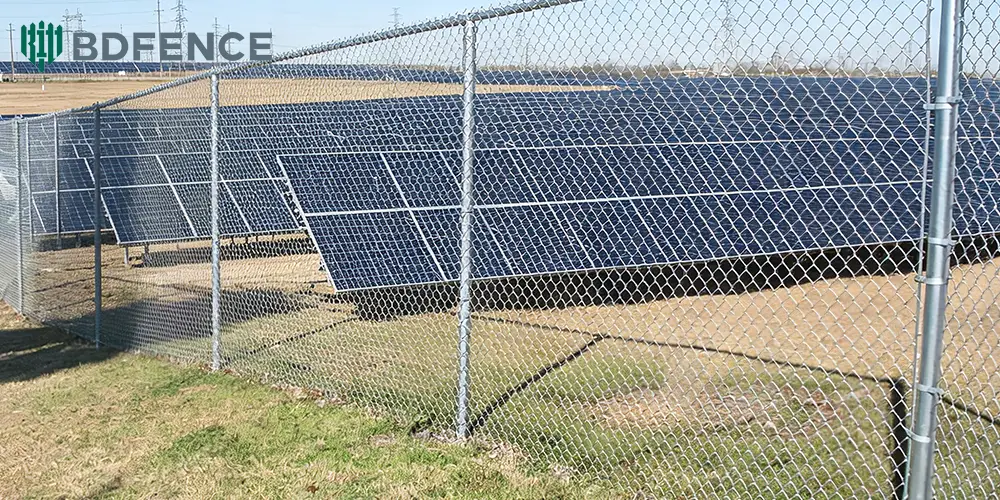
A solar farm can cover a large area, but its perimeter is rarely a simple rectangle.
There may be access roads, drainage channels, inverter stations, cable routes and maintenance entrances along the boundary. Some sections run across open ground. Others pass close to equipment foundations or follow changes in terrain.
For the fencing contractor, the challenge is not simply calculating how many metres of Chain Link Fence are required. The fence must follow the site layout without blocking access or interfering with other work.
This is particularly important when the fencing package comes from an overseas manufacturer. A supplier can manufacture the correct mesh rolls and posts, but the installation team still needs a clear layout showing where each section begins and ends.
BDFENCE supplies Chain Link Fence systems for industrial, agricultural and commercial applications. For solar farm projects, the mesh specification is only one part of the purchasing discussion.
A Solar Farm Boundary Has Several Different Sections
Look at a typical utility-scale solar site plan.
The outer boundary may appear continuous, yet the conditions along it can change considerably.
One section might cross relatively flat ground. Another may run beside a drainage channel. A third could approach a transformer area or an access road used by maintenance vehicles.
These sections should not automatically receive the same installation arrangement.
For example, a fence beside a drainage route needs enough consideration for water flow and future maintenance. A section near an equipment entrance needs a gate or another approved access arrangement.
The contractor should mark these locations before calculating the final material quantities.
A useful drawing identifies:
- The complete site boundary
- Main vehicle entrances
- Pedestrian access points
- Internal maintenance roads
- Drainage channels and culverts
- Equipment areas near the perimeter
- Changes in ground level
The drawing does not need to show every electrical detail. It does need to identify the locations that could affect fence alignment, post foundations or access.
The Fence Should Not Become an Obstacle to Maintenance
Solar installations require regular inspection and maintenance. Technicians need access to equipment, while vehicles may need to reach different sections of the site.
A poorly positioned fence can make these activities unnecessarily difficult.
Consider an access road that runs parallel to the perimeter. If the fence sits too close to the road, vehicles may have difficulty passing larger equipment or carrying out maintenance work.
The same issue can arise around equipment entrances.
A pedestrian gate might be sufficient for routine inspections. However, replacing a large component or bringing maintenance equipment onto the site may require a wider opening.
The contractor should ask the project team who will use each entrance and what needs to pass through it.
Gate positions should follow the actual maintenance routes rather than simply being placed at convenient intervals along the fence.
There is also a question of responsibility. Does the fencing contractor supply the gates, or does another contractor provide the access-control system?
That needs to appear in the RFQ.
Choosing the Mesh Specification for a Solar Farm
Chain link mesh is a practical option for many large perimeter projects because manufacturers can supply it in rolls and contractors can install it along different boundary layouts.
The specification still needs to match the project requirements.
For example, a preliminary material schedule might consider:
| Specification | Example Configuration |
|---|---|
| Fence type | Galvanized Chain Link Fence |
| Mesh opening | 50 × 50 mm |
| Wire diameter | 3.0 mm |
| Fence height | 2.0 m |
| Roll length | According to installation sections |
| Supporting posts | Steel posts with suitable corrosion protection |
| Accessories | Tension bars, bands, ties and fittings |
These are example purchasing specifications, not a universal solar farm standard.
Some projects may require different wire diameters, smaller mesh openings or greater fence heights. The project drawings and security requirements should determine the final configuration.
A buyer should also confirm whether the quoted wire diameter refers to the steel wire before coating or the finished coated wire.
It is a small detail, but it makes a difference when comparing quotations from different manufacturers.
Don’t Calculate the Mesh Quantity from the Perimeter Alone
This is where early project estimates can become misleading.
Suppose a solar site has a total boundary length of 1,200 metres.
A simple calculation might suggest ordering 1,200 metres of chain link mesh. However, the actual requirement depends on the layout.
Gate openings reduce the mesh length. Corners divide the installation into separate runs. Some sections may require different heights or special connections.
There may also be temporary openings during construction.
The purchasing team should separate the total boundary measurement from the actual mesh quantity.
A practical material calculation needs to consider:
Standard fence sections: The lengths that can use the selected standard mesh height and configuration.
Gate openings: The clear openings that do not require mesh fabric.
Corner sections: The locations where the fence changes direction and needs suitable supporting posts.
Special sections: Areas where drainage, equipment access or ground conditions affect the standard arrangement.
Installation allowance: Any additional material required under the agreed cutting, joining and installation plan.
Roll length also matters. A 30-metre roll does not necessarily suit every site section, particularly when the fence line contains many gates and corners.
For a large solar project, the contractor should prepare a mesh schedule rather than divide the perimeter length by one standard roll length.
Drainage Must Be Considered Before the Posts Go Into the Ground
A solar farm may have long drainage routes along its boundary.
During heavy rainfall, water needs to move through the designed drainage system. The fence installation should not create an obstruction or interfere with culverts and maintenance access.
The contractor should identify any drainage crossings before selecting post locations.
There are several points worth checking:
- Does a proposed post foundation conflict with a drainage structure?
- Will the mesh restrict access to a channel that needs cleaning?
- Does the ground level change across the proposed fence run?
- Is a special opening or connection required at a culvert?
- Can maintenance crews reach the drainage system after installation?
The answer depends on the civil drawings and site conditions.
A standard fence panel should not simply be cut around a drainage structure without an approved detail. The resulting connection still needs to meet the project’s boundary and security requirements.
What Happens When the Fence Crosses Uneven Ground?
Solar developments often use large areas of land with changing ground levels.
Chain link mesh has an advantage here: its woven structure offers more flexibility than rigid welded panels.
However, flexibility does not remove the need for a proper installation plan.
On a gradual slope, the mesh may follow the ground profile with suitable post positions and tensioning. On steeper sections, the contractor may consider stepped arrangements or another approved installation method.
The choice affects the bottom clearance, mesh quantity and post arrangement.
For example, a fence that follows the ground too closely may interfere with drainage or vegetation maintenance. A fence installed too high above the ground may leave openings that conflict with the project’s containment requirements.
The contractor should therefore confirm the permitted ground clearance and installation arrangement before ordering the full quantity.
The Post and Gate Schedule Should Be Separate from the Mesh Schedule
A common problem with large fencing enquiries is that the buyer sends a total mesh quantity but no clear post or gate schedule.
The manufacturer can quote the mesh, but the contractor still needs to determine the supporting components.
For a solar farm perimeter, the procurement schedule should distinguish:
| Component | Information to Confirm |
|---|---|
| Chain link mesh | Opening, wire diameter, height and coating |
| Line posts | Dimensions, finish and spacing |
| Corner posts | Positions and supporting arrangement |
| Terminal posts | Fence ends and gate connections |
| Gate posts | Clear opening and gate design |
| Top support | Top rail or specified tension arrangement |
| Tension components | Bars, bands, ties and related fittings |
| Foundations | Based on the site and structural design |
The gate schedule deserves particular attention.
A main vehicle entrance, pedestrian gate and maintenance access gate may all have different requirements. Treating them as identical openings can create problems when the materials arrive.
For a complete supply package, the contractor should ask the manufacturer to quote mesh, posts and compatible accessories together where possible.
Galvanized or PVC Coated Mesh?
Solar farms operate in different climates. A project in a dry inland region does not face the same exposure as one in a humid or coastal location.
Galvanized chain link mesh is a common choice for outdoor perimeter applications. Its zinc coating protects the underlying steel against corrosion.
PVC-coated mesh is another option. It adds a polymer layer over the steel wire and offers different colour choices.
However, buyers should not select a finish based only on appearance.
The quotation should identify the coating specification, including the relevant zinc protection and PVC coating requirements where applicable.
Posts, rails and fittings also need compatible protection.
For projects in coastal Australia or humid Southeast Asian locations, the purchaser should discuss environmental exposure with the manufacturer before finalizing the finish.
What Should a Solar Farm EPC Contractor Send with the RFQ?
A complete enquiry helps manufacturers understand the project instead of guessing the missing details.
For chain link fencing, the following information is useful:
- Project location and site boundary drawing.
- Total perimeter length.
- Required fence height.
- Mesh opening and wire diameter.
- Galvanized or PVC-coated finish.
- Roll length preferences.
- Line, corner and terminal post requirements.
- Vehicle and pedestrian gate quantities.
- Drainage crossings and unusual ground conditions.
- Required delivery port and supply schedule.
If the project has several installation phases, the contractor should identify the quantities needed for each phase.
This helps the purchasing team coordinate manufacturing and shipping with the construction programme.
A clear RFQ also makes supplier quotations easier to compare. One manufacturer may quote mesh only, while another includes posts, tension components and gates. The supply scope needs to be consistent before the prices can be compared fairly.
Chain Link Fence Supply from BDFENCE
BDFENCE supplies chain link fencing for overseas distributors, construction contractors, industrial buyers and project procurement teams.
Our Chain Link Fence product range includes galvanized and PVC-coated options with different mesh openings, wire diameters and roll dimensions.
Related supply items can include:
- Steel line and corner posts
- Terminal posts
- Top rails
- Tension bars and bands
- Fixing accessories
- Compatible fencing components
For a solar farm or other large perimeter project, buyers can send the site drawing and requested specifications for review.
BDFENCE also supplies other metal fencing products for projects that require different perimeter arrangements.
Request a Chain Link Fence Quotation for Your Solar Project
If you are sourcing chain link mesh for a solar farm, energy facility or large industrial development, send us the project information rather than only the estimated perimeter length.
Include the mesh specifications, fence height, gate positions, post requirements and delivery destination.
If drainage routes or uneven ground affect the fence line, mark those sections on the drawing.
Our team can review the requested material configuration and discuss the available supply options.
BDFENCE — Hebei Bendin Industrial Technology Co., Ltd.
Website: bd-fence.com
WhatsApp: +86 18703287372
Email: info@bd-fence.com