



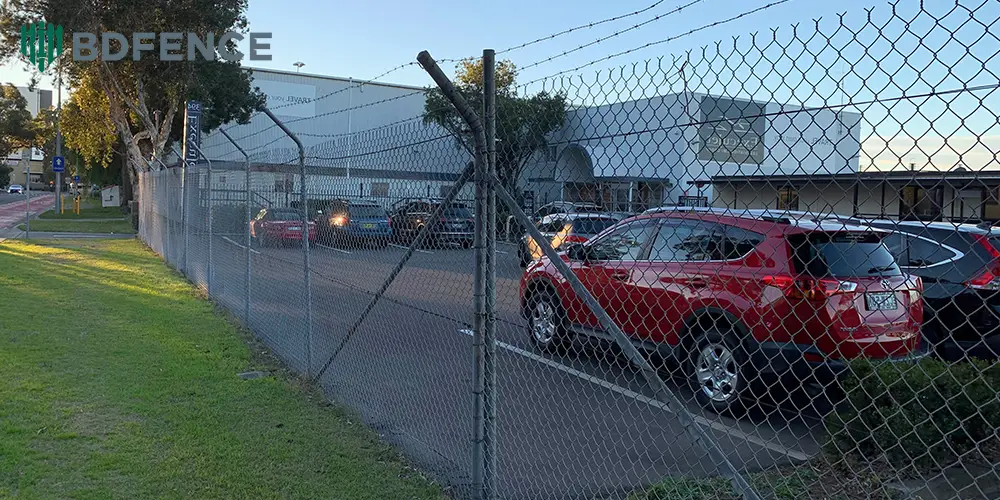
A commercial distribution facility in Australia required a perimeter fence around service yards, parking areas, delivery routes, storage zones, and controlled entrances.
The customer needed a practical boundary that could cover long fence runs while maintaining visibility through the site.
At the main vehicle entrance, a normal swing gate would have taken up too much operating space near the driveway.
For this project, BDFENCE supplied a Chain Link Fence and Sliding Gate System with galvanized mesh, steel posts, tension components, a sliding vehicle gate, pedestrian gates, gate posts, fittings, and installation accessories.
Project Profile
| Project Item | Details |
|---|---|
| Country | Australia |
| Sector | Commercial Distribution |
| Application | Commercial Facility Perimeter and Vehicle Access |
| Main Product | Chain Link Fence |
| Main Gate Type | Sliding Vehicle Gate |
| Fence Finish | Galvanized |
| Access | Sliding Vehicle Gate and Pedestrian Gates |
| Supply Scope | Mesh, Posts, Sliding Gate, Pedestrian Gates, Tension Components and Accessories |
The Commercial Facility Needed an Entrance That Did Not Block the Driveway
The site handled regular deliveries, staff vehicles, service traffic, and occasional larger commercial vehicles.
That meant the main entrance needed a wide clear opening.
However, a wide swing gate would have required additional free space for the gate leaves to open.
This could interfere with:
- Vehicle approach lanes
- Internal parking
- Delivery movement
- Service roads
- Pedestrian routes
A sliding gate allowed the entrance to open sideways along the fence line instead of swinging into the traffic area.
Why Chain Link Fence Worked for the Main Perimeter
The facility had long boundary sections around operational areas.
Chain Link Fence provided a practical way to enclose those areas while keeping the site visually open.
The woven mesh allowed staff to maintain sightlines through the perimeter around:
- Parking areas
- Service yards
- Vehicle entrances
- Outdoor storage
- Delivery routes
For a commercial site where much of the perimeter was functional rather than architectural, this was a useful balance.
The Sliding Gate Needed Its Own Structural Design
A sliding gate is not simply a Chain Link Fence panel with wheels.
The gate frame carries its own weight, the chain link infill, hardware, and repeated movement.
Therefore, the gate design needed to consider:
- Clear opening width
- Gate frame tube size
- Frame wall thickness
- Internal bracing
- Chain link mesh infill
- Guide system
- Support posts
- Closing and locking hardware
These details had to be coordinated before fabrication.
The Sliding Direction Was Important
Before production, the project layout needed to confirm where the gate would move when opening.
The side of the entrance needed enough clear space to accommodate the gate.
The project team therefore reviewed:
- Gate opening width
- Available sliding space
- Fence line beside the entrance
- Vehicle route
- Pedestrian access
- Nearby structures
This prevented the gate movement from conflicting with the rest of the site layout.
The Gate Posts Had a Different Job from Line Posts
Normal line posts support the Chain Link Fence mesh along the perimeter.
Gate posts support a moving structure.
Because of that, the project did not treat them as the same component.
Gate-post selection considered:
- Gate width
- Gate height
- Frame weight
- Mesh infill weight
- Operating method
- Support system
- Foundation requirements
This was especially important at the main commercial entrance.
Pedestrian Access Was Kept Separate
Employees and visitors did not need to use the sliding vehicle gate for normal foot access.
The project therefore included separate pedestrian gates.
These gates used matching Chain Link Fence infill so they remained visually connected to the surrounding perimeter.
This allowed the commercial facility to manage people and vehicles through different access points.
The Mesh and Gate Infill Needed to Match
For a cleaner result, the Chain Link Fence mesh used in the gate system matched the general perimeter specification.
The project needed to coordinate:
- Mesh opening
- Wire diameter
- Fence height
- Surface treatment
- Gate infill
This helped the sliding gate remain part of the same fence system instead of looking like a separate product.
Long Fence Runs Needed Proper Tension
Chain Link Fence depends on correct mesh tension.
The commercial facility included several long perimeter sections.
Therefore, the fence system used suitable tension and support components according to the confirmed project specification.
These could include:
- Tension bars
- Tension bands
- Brace bands
- Wire ties
- Top support components where required
- Bolts and nuts
- Post caps
The mesh, posts, and fittings needed to work together to maintain a cleaner fence line.
Corner and Terminal Posts Were Important Control Points
The site included changes in direction and several separate fence runs.
At these locations, normal line posts were not enough.
Corner and terminal posts helped manage mesh tension and establish the ends of fence sections.
The project therefore separated:
- Line posts
- Corner posts
- Terminal posts
- Gate posts
This created a more logical support system across the perimeter.
What BDFENCE Supplied
| Component | Project Function |
|---|---|
| Galvanized Chain Link Mesh | Main commercial perimeter |
| Line Posts | Support standard fence sections |
| Corner Posts | Support direction changes |
| Terminal Posts | Anchor tensioned fence runs |
| Sliding Vehicle Gate | Main delivery and service access |
| Gate Posts | Support the sliding entrance system |
| Pedestrian Gates | Staff and visitor access |
| Tension Components | Maintain mesh position and alignment |
| Fittings and Fasteners | Complete the fence assembly |
The Sliding Gate Required Separate Factory Checks
The sliding gate was more complex than the normal fence line.
BDFENCE therefore checked the gate structure independently before packing.
| Gate Item | Inspection Focus |
|---|---|
| Gate Frame | Overall dimensions and squareness |
| Chain Link Infill | Mesh fit and tension |
| Frame Welds | Connection condition |
| Gate Posts | Section size, wall thickness and length |
| Guide / Support Components | Compatibility with the gate system |
| Hardware | Type and quantity |
The Fence Mesh Was Also Checked Before Shipment
The main Chain Link Fence specification needed to remain consistent throughout the commercial perimeter.
Factory inspection included:
- Mesh opening
- Wire diameter
- Fence height
- Roll dimensions
- Visible surface condition
Post size, wall thickness, and fitting compatibility were also checked according to the production requirements.
Packaging Followed the Installation Function
The shipment included mesh rolls, steel posts, a large sliding gate, pedestrian gates, and many smaller fittings.
These components required different packing methods.
BDFENCE organized the shipment by product category.
Mesh rolls were prepared separately, posts were bundled by type, and fittings were packed in identified groups.
The sliding gate and related support components were also identified separately so the installation team could locate them easily after delivery.
Installation Started with the Main Vehicle Entrance
The sliding gate affected the surrounding fence layout.
Therefore, the entrance position and gate movement direction were confirmed before the normal fence line was completed.
The contractor first established:
- Vehicle gate opening
- Sliding direction
- Gate support positions
- Pedestrian gates
- Fence corners
- Terminal points
After those control points were fixed, the line posts could be positioned more accurately.
Typical Installation Sequence
- Confirm the commercial facility perimeter
- Set out the main sliding gate opening
- Confirm gate movement direction and support locations
- Mark corner, terminal, line, and gate posts
- Install the steel posts and complete the required foundations
- Install the Chain Link Fence support and tension components
- Position and tension the mesh
- Install the sliding gate system
- Install pedestrian gates
- Check gate movement, fence tension, and final alignment
What the Completed System Delivered
| Commercial Requirement | Project Response |
|---|---|
| Long Perimeter Coverage | Galvanized Chain Link Fence |
| Open Visibility | Woven mesh structure |
| Wide Vehicle Access | Sliding gate system |
| Reduced Gate Swing Space | Sideways gate movement |
| Personnel Access | Separate pedestrian gates |
| Stable Mesh | Matched posts and tension components |
| Complete Perimeter | Fence, gates, posts, fittings, and accessories supplied together |
Why Sliding Gates Can Work Well for Commercial Facilities
Commercial properties often need wide vehicle openings but have limited free space near the entrance.
A sliding gate can help because the gate does not swing into the vehicle route.
This can be useful around:
- Distribution centers
- Warehouses
- Commercial service yards
- Industrial properties
- Delivery entrances
However, the gate still needs enough clear space along the fence line to open fully.
What Buyers Should Check Before Choosing a Sliding Gate
Before confirming the gate type, check:
- Required clear opening
- Available sliding space
- Ground conditions
- Gate frame specification
- Gate post specification
- Operating frequency
- Manual or powered operation
- Vehicle approach route
A sliding gate is useful only when the site layout supports its movement.
Why Gate Cost Should Be Reviewed Separately
The sliding gate may represent a significant part of the total fence package.
Its cost can depend on:
- Gate opening width
- Frame size
- Wall thickness
- Internal bracing
- Mesh infill
- Gate posts
- Guide components
- Hardware
- Operating system
Therefore, buyers should not compare only the Chain Link Fence price per meter and treat the main gate as a minor accessory.
What Commercial Buyers Should Compare Between Quotations
Two suppliers can both quote “Chain Link Fence with sliding gate” while offering different systems.
Before comparing price, confirm:
- Mesh opening
- Actual wire diameter
- Fence height
- Line post size and wall thickness
- Terminal post specification
- Post spacing
- Sliding gate clear opening
- Gate frame tube size
- Gate frame wall thickness
- Gate post specification
- Guide or support system
- Hardware
- Surface treatment
Once these details match, the quotations become much easier to compare.
What Should a Commercial Facility RFQ Include?
For a more accurate quotation, send BDFENCE:
- Project country
- Commercial facility type
- Total fence length
- Fence height
- Mesh opening
- Wire diameter or gauge standard
- Surface treatment
- Line post specification
- Corner and terminal post requirements
- Post spacing
- Sliding gate clear opening
- Available sliding space beside the entrance
- Gate operating method
- Pedestrian gate dimensions and quantities
- Site layout
- BOQ or fence schedule
- Destination port
If the gate system is still being developed, BDFENCE can review the site layout and available entrance requirements before preparing the quotation.
Why Choose BDFENCE for Chain Link Fence and Gate Projects?
Hebei Bendin Industrial Technology Co., Ltd. (BDFENCE) manufactures Chain Link Fence systems for commercial facilities, warehouses, logistics centers, industrial plants, solar farms, utility sites, and infrastructure projects.
Our project supply can include:
- Galvanized Chain Link Fence
- PVC-coated Chain Link Fence
- Different mesh openings and wire diameters
- Line, corner, and terminal posts
- Pedestrian gates
- Swing vehicle gates
- Sliding vehicle gates
- Gate posts
- Tension components
- Fence fittings and accessories
Project buyers can send BOQ documents, commercial-site layouts, gate schedules, and technical fence specifications directly to BDFENCE for review and quotation.
Project Takeaway
For this Australian commercial facility, the most important decision was not only which fence mesh to use.
The vehicle entrance had to work with daily delivery traffic and limited driveway space.
By combining Chain Link Fence with a matching sliding gate system, the project created a practical perimeter while keeping the entrance clear for commercial vehicle movement.
For buyers planning a similar project, the best quotation starts with both the perimeter drawing and the gate opening. The fence and entrance should be designed together.
Contact BDFENCE
Hebei Bendin Industrial Technology Co., Ltd. (BDFENCE)
Phone:
+86 18703182863
WhatsApp:
+86 18703287372
Email:
info@bd-fence.com
Website:
https://bd-fence.com/
FAQ
Why use a sliding gate with Chain Link Fence?
A sliding gate moves sideways along the fence line instead of swinging into the driveway. This can help preserve vehicle space at commercial and industrial entrances.
Can the sliding gate use the same Chain Link Mesh as the fence?
Yes. Matching mesh opening, wire diameter, height, and finish can help keep the gate visually consistent with the surrounding perimeter.
Does a sliding gate need stronger posts?
Gate posts perform a different structural role from normal line posts. Their size and wall thickness should follow the gate width, height, frame weight, operating method, and foundation design.
How much space is needed for a sliding gate?
The site needs enough clear space beside the opening for the gate to move into its open position. The exact requirement depends on the gate type and design.
Can BDFENCE supply pedestrian gates with the sliding gate?
Yes. BDFENCE can supply pedestrian gates, sliding vehicle gates, gate posts, mesh infill, hardware, and related components as part of the complete fence package.
Can the Chain Link Fence be PVC coated?
Yes. Galvanized and PVC-coated Chain Link Fence options can be manufactured according to the project specification.
Can the sliding gate be automated?
Gate operation can be planned according to project requirements. Buyers should provide the gate opening, expected traffic, operating method, and site layout when requesting a quotation.
Can I send a commercial site plan for quotation?
Yes. BDFENCE can review perimeter drawings, gate openings, available sliding space, mesh specifications, post schedules, and BOQ documents before preparing a quotation.