



A power substation does not need an attractive boundary fence. It needs a perimeter that clearly separates electrical equipment from the surrounding area and helps control unauthorized access.
Chain link fencing is one option for this type of boundary. It provides an open mesh barrier, allows visibility through the fence and can be combined with additional security features when the approved design calls for them.
For this example, consider a power substation in South Africa. The proposed perimeter uses galvanized chain link fencing with razor wire along the top.
At first glance, the material list looks straightforward: mesh, posts, fittings and razor wire.
However, the details become more complicated around corners, gates and the connection between the upper security system and the fence below.
This is an illustrative project scenario based on common perimeter-fencing questions. It does not describe a verified BDFENCE installation or shipment.
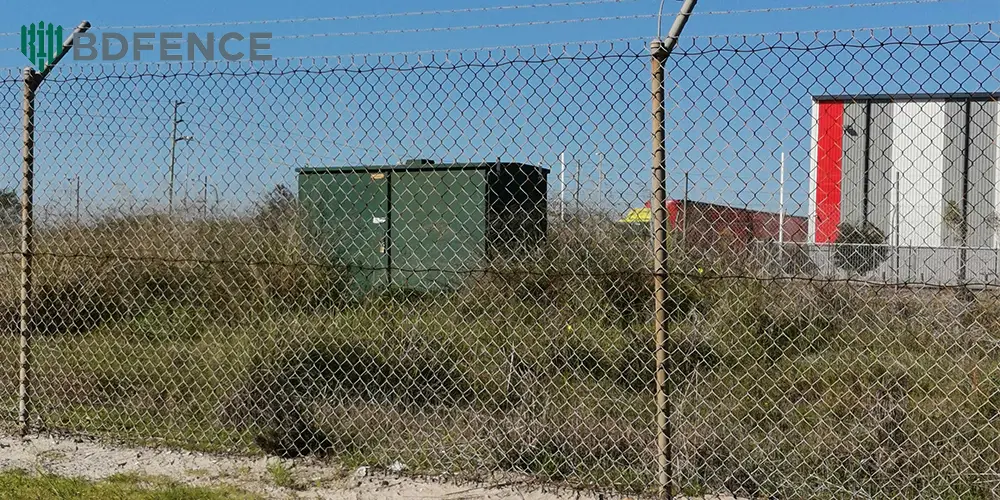
A Fence Line Around Electrical Equipment
The proposed substation sits inside a defined property boundary, with a main access gate for maintenance vehicles and a smaller entrance for authorized personnel.
The fence follows the site’s approved perimeter layout.
Most of the boundary consists of regular chain link sections. However, the line changes direction at several corners and connects to gate posts near the access road.
These are the areas where the contractor needs more information than a basic price per meter.
The fence must also follow the site’s electrical safety requirements. Grounding, bonding, required clearances and access arrangements need review by the responsible electrical engineers.
A fence supplier should not assume that a standard perimeter detail meets every substation’s electrical safety rules.
Project Information
| Item | Project Details |
|---|---|
| Country | South Africa |
| Application | Power substation perimeter |
| Product | Chain Link Fence with Razor Wire |
| Fence mesh | Galvanized chain link fabric |
| Top security | Razor wire, subject to approved design |
| Support system | Steel posts, rails or tension members and fittings |
| Gates | Maintenance vehicle and personnel access |
| Fence dimensions | According to approved project drawings |
| Project type | Illustrative supply scenario |
The project description does not assign an arbitrary fence height, wire diameter or razor wire size.
Those dimensions should come from the actual security specification and approved drawings.
The Chain Link Mesh Was Only One Part of the Question
When a contractor asks for chain link fencing, the first figures usually concern mesh height, opening size and wire diameter.
Those details matter, but they do not describe the complete fence.
A galvanized mesh panel or roll needs a support system that can hold it correctly along the boundary.
For this example, the material schedule would need to distinguish regular line posts from terminal posts at ends, corners and gates.
It would also need to identify the required tension bars, bands, ties and other fittings.
If the approved design includes top rails or tension wires, those items belong in the quotation as well.
A supplier quoting only the chain link fabric may appear cheaper than one pricing the full perimeter package.
That difference becomes clear only when the buyer compares the material lists.
The Razor Wire Could Not Be Treated as a Separate Decoration
The upper security barrier changes the fence design.
Razor wire requires its own support arrangement, and that arrangement connects to the posts or another approved support structure.
The project team must therefore consider the loads, connections, safety clearances and maintenance access associated with the complete top-security system.
A short description such as “chain link fence with razor wire on top” leaves too many questions open.
The drawing should identify the specified razor wire product, the approved support details and the areas where the top barrier begins or ends.
This is particularly important near gates.
A continuous-looking perimeter on a plan may contain several locations where the top security system needs a separate approved detail.
For safety, razor wire placement must also comply with local requirements and the facility owner’s rules.
The Corner That Changed the Material Schedule
Consider a section of the perimeter where the fence turns around the edge of the substation property.
On the straight run, the contractor can repeat the regular post and mesh arrangement.
At the corner, the support conditions change.
The chain link fabric needs a suitable terminal arrangement, and the upper security system must follow the approved corner detail.
The corner post may therefore require a different specification from an ordinary line post.
If the factory receives only the total fence length, it cannot determine the correct number of corner components.
A marked perimeter drawing solves much of that problem.
Even a simple drawing that identifies straight runs, corners and gates gives the supplier a better starting point than a single quantity such as “600 meters of security fence.”
A Vehicle Gate Breaks the Security Line
The substation needs access for maintenance vehicles.
That opening is not simply an empty space between two standard fence posts.
The gate requires its own supports, frame, mesh infill and hardware according to the approved design.
The project team must also decide how the security barrier continues at the entrance without creating an unsafe arrangement.
Razor wire near moving gates needs particular care. Clearances, safe operation, maintenance access and the facility’s security rules all affect the approved solution.
For this reason, the gate should appear as a separate item in the BOQ.
The contractor may need to supply the gate opening width, gate type, frame specification and relevant access-control requirements.
We would rather confirm those details before quoting than assume that a standard chain link gate will suit the substation.
Why the Post Specification Matters
A chain link fence transfers loads through its mesh and tension system to the posts.
The top security arrangement may introduce additional demands.
Consequently, the post design must account for the complete system, not just the chain link fabric.
Wind exposure, soil conditions, fence height, post spacing and the approved foundation details all affect the project.
For a substation, electrical safety considerations add another layer of review.
The responsible engineers should confirm the required grounding or bonding arrangement and other relevant safety measures.
BDFENCE can manufacture fence components to the confirmed specification, but the site’s engineering team must approve the design.
Galvanized Mesh and Outdoor Exposure
South Africa has different environmental conditions across its regions.
An inland site may have different corrosion exposure from a coastal installation.
Therefore, the coating requirements should follow the actual project location.
For galvanized chain link fencing, the buyer should confirm the required galvanizing standard and coating specification.
The same applies to posts, fittings and other steel components.
A quotation that mentions “galvanized fence” without describing the required finish may not provide enough information for a technical comparison.
The razor wire product also needs its own material and coating specification.
The fence supplier should not assume that every metal component uses the same coating system.
What the Factory Needs Before Production
A complete material schedule helps the factory separate the regular fence sections from the special components.
For this substation example, the supply scope may include the following items:
| Component | Information Required |
|---|---|
| Chain link fabric | Mesh opening, wire diameter, height and finish |
| Line posts | Size, wall thickness, length and coating |
| Terminal posts | End, corner and gate locations |
| Rails or tension wires | Approved type and dimensions |
| Mesh fittings | Tension bars, bands, ties and other specified parts |
| Razor wire | Approved product and material specification |
| Razor wire supports | Approved support and connection details |
| Vehicle gate | Opening, frame, hardware and security requirements |
| Personnel gate | Opening and access details |
| Packing | Component references and quantity schedule |
Not every project uses the same arrangement.
The final list should match the approved drawing rather than a generic product catalog.
Packing the Materials for an Overseas Site
A substation fence order may contain several groups of components.
Chain link fabric can be packed in rolls. Posts and rails may need separate bundles, while fittings require clear quantity identification.
The razor wire and its supports also need suitable handling and packing arrangements because of their sharp edges.
For international shipment, the packing list should help the receiving team identify each component group.
That matters when the installation contractor did not participate in the factory’s production planning.
If a gate component or special corner part arrives without a clear reference, the site team may spend unnecessary time identifying it.
A well-organized packing list does not replace the installation drawing, but it makes material handling easier.
What We Would Check in the BOQ
For a project like this, the BOQ needs to do more than state the total perimeter length.
It should distinguish the regular chain link sections from gates, corners and other special areas.
The mesh specification must be clear. So must the post and fitting schedule.
The razor wire needs a separate description, including its approved product specification and support arrangement.
We would also check whether the quotation includes the complete fence package or only selected components.
A missing item may not look important during the purchasing stage, but it can become a problem when the contractor begins installation.
This is why BDFENCE prefers to work from the customer’s existing project documents.
Request a Chain Link Fence Quotation from BDFENCE
If you are sourcing chain link fencing for a power substation, utility facility or industrial security project, send us your current BOQ or approved drawing.
We can prepare a quotation for the specified mesh, posts, fittings, gates and related components.
If your project includes razor wire, please provide the approved top-security specification and support details.
There is no need to prepare a new document just for our factory.
Phone: +86 18703182863
WhatsApp: +86 18703287372
Email: info@bd-fence.com
What This Substation Example Shows
The chain link mesh may be the most visible part of the fence, but it is not the only part that determines the supply scope.
Corners need suitable terminal details. Gates require separate supports and hardware. The upper security system must connect to the fence according to an approved design.
For an electrical facility, grounding, bonding and access safety also need proper engineering review.
A clear drawing and material schedule help the supplier prepare an accurate quotation while allowing the contractor to plan the installation around the approved system.
BDFENCE Chain Link Fence Manufacturing
BDFENCE is the metal fencing brand of Hebei Bendin Industrial Technology Co., Ltd., a manufacturer based in China.
Our team has more than 30 years of experience in metal fencing. The factory covers approximately 15,000㎡ and has more than 190 employees and over 80 machines.
BDFENCE supplies fencing products to international contractors, distributors and project buyers.
For chain link fence projects, we can review customer specifications and prepare quotations covering the requested mesh, posts, fittings, gates and related fence components.
When a project includes special security requirements, we work from the approved documents rather than assume that one standard fence arrangement fits every site.
FAQ
Can chain link fencing be used around a power substation?
Yes, chain link fencing may be used for substation perimeters when the complete system meets the facility’s security, structural and electrical safety requirements.
Why add razor wire to a chain link fence?
Some security designs specify razor wire as an additional barrier against unauthorized access. Its use must follow the approved design, applicable rules and safe maintenance requirements.
Does a chain link fence around a substation need grounding?
Electrical safety requirements vary by facility and jurisdiction. The responsible electrical engineer should determine the required grounding, bonding and related safety measures.
Can BDFENCE supply chain link fence posts and fittings?
Yes. We can prepare quotations for chain link fabric and the specified supporting components, including posts, rails, tension fittings and gates.
What information is needed to quote a fence with razor wire?
Send the fence drawing, mesh specification, post schedule, gate details and approved razor wire requirements. A BOQ is also helpful.
Can BDFENCE quote from an existing EPC project BOQ?
Yes. You can send your current BOQ, tender drawing or technical specification. We can use the available details to prepare a quotation and identify any items that need clarification.
Contact BDFENCE
Hebei Bendin Industrial Technology Co., Ltd. (BDFENCE)
Phone: +86 18703182863
WhatsApp: +86 18703287372
Email: info@bd-fence.com
Website: https://bd-fence.com/