



Project Introduction
Railway maintenance depots require reliable perimeter fencing systems to protect rolling stock, maintenance equipment, spare parts, technical buildings, and restricted operational areas.
Unlike ordinary commercial properties, railway facilities often cover large areas and require continuous vehicle movement, controlled personnel access, and long-term outdoor perimeter protection.
In 2026, Hebei Bendin Industrial Technology Co., Ltd. (BDFENCE) supplied a customized Chain Link Fence system for a railway maintenance depot development project in Poland.
The project required a complete perimeter fencing package around maintenance workshops, rail service zones, equipment storage yards, vehicle access areas, and restricted operational sections.
BDFENCE supplied galvanized Chain Link Fence mesh, steel posts, pedestrian gates, vehicle gates, fence fittings, tension components, and installation accessories according to the approved project requirements.
Customer Background
The customer was an infrastructure contractor involved in railway facility construction and modernization in Poland.
Because the project included several operational zones, the procurement team required a fencing manufacturer capable of supporting:
- Large-volume project production
- Consistent fence specifications
- Customized posts and gate systems
- Complete fence fittings supply
- Export packaging
- Reliable delivery schedules
- Technical communication during project execution
The customer evaluated suppliers based on complete project capability rather than comparing only the price of fence rolls.
BDFENCE was selected because of its Chain Link Fence manufacturing capability, customization support, quality control process, and ability to supply a coordinated perimeter fencing system.
Project Highlights
| Project Item | Details |
|---|---|
| Country | Poland |
| Application | Railway Maintenance Depot |
| Product | Galvanized Chain Link Fence |
| Project Type | Railway Infrastructure Perimeter Protection |
| Total Fence Length | 11,200 meters |
| Protected Area | Approx. 265,000㎡ |
| Fence Height | 2,400 mm |
| Mesh Opening | 50 × 50 mm |
| Wire Diameter | 4.0 mm |
| Steel Posts | Approx. 4,150 pcs |
| Vehicle Gates | 20 sets |
| Pedestrian Gates | 32 sets |
| Surface Treatment | Heavy Hot Dip Galvanized |
| Production Period | 37 working days |
| Shipment | Multiple 40HQ containers |
Project Requirements
Large Railway Facility Perimeter
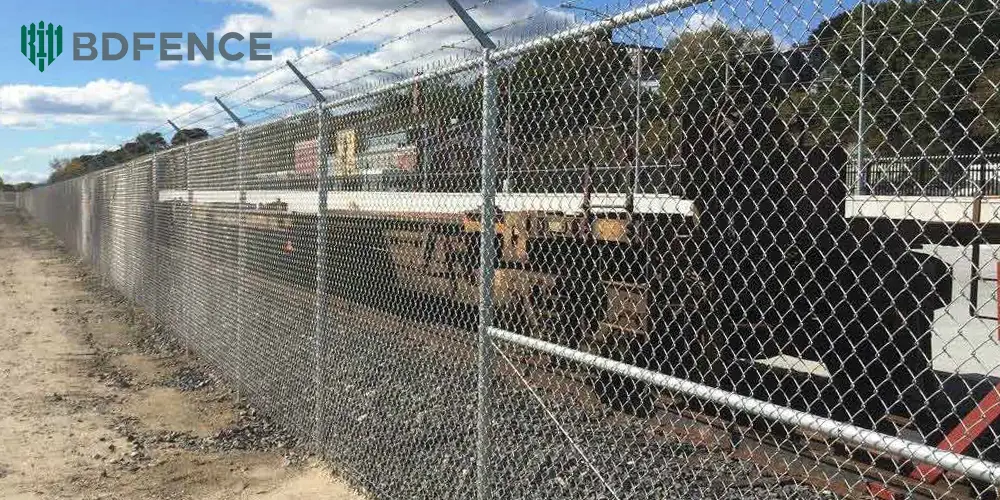
The railway maintenance depot covered a large operational area and required more than 11 kilometers of continuous fencing.
The fencing system needed to protect:
- Maintenance workshops
- Railway service areas
- Equipment storage yards
- Spare parts warehouses
- Vehicle circulation areas
- Restricted technical zones
For the contractor, the fence had to provide reliable perimeter separation without creating unnecessary complexity during installation.
Clear Visibility Across Operational Areas
Railway facilities require good visibility around tracks, maintenance areas, and access points.
The customer therefore required a fencing system that could support:
- Security patrols
- CCTV monitoring
- Vehicle observation
- Routine site inspection
- Operational supervision
The open mesh structure of Chain Link Fence provided the required visibility while maintaining a clear physical boundary.
Long-Term Outdoor Durability
The fence system would remain permanently exposed to outdoor conditions.
The customer therefore focused on:
- Corrosion resistance
- Wire quality
- Post strength
- Surface treatment
- Long-term maintenance requirements
A heavy hot dip galvanized Chain Link Fence system was selected for the project.
Multiple Vehicle Access Points
The railway depot required frequent entry and exit of:
- Maintenance vehicles
- Service trucks
- Equipment transport vehicles
- Emergency vehicles
Multiple heavy-duty vehicle gates were therefore included in the perimeter design.
Pedestrian Access Management
Separate pedestrian gates were required for:
- Railway employees
- Maintenance teams
- Contractors
- Security personnel
- Authorized visitors
The gate system needed to work with the surrounding Chain Link Fence while maintaining a consistent installation configuration.
Project Challenges
Managing an 11.2-Kilometer Perimeter
One of the main project challenges was maintaining consistent fence quality across more than 11 kilometers of installation.
Variations in:
- Mesh opening
- Wire diameter
- Roll length
- Post dimensions
- Fence fittings
- Surface treatment
could create installation problems when different production batches were used on the same site.
BDFENCE therefore controlled critical specifications throughout production.
Multiple Post Configurations
The project required different posts for different perimeter positions.
These included:
- Standard line posts
- Reinforced corner posts
- Terminal posts
- Gate posts
Correct identification and packaging were important because using the wrong post configuration could delay installation.
Large Quantity of Fence Fittings
A long railway perimeter requires thousands of small installation components.
The project included:
- Tension components
- Fence clamps
- Fasteners
- Post caps
- Gate hardware
- Other fence fittings
The procurement team wanted these components supplied together with the main fence system to reduce compatibility and shortage risks.
Coordinating Delivery with Construction Progress
The contractor needed the fence materials to arrive according to the site construction schedule.
Delivery planning therefore had to consider:
- Production sequence
- Container loading
- Site storage capacity
- Installation progress
- Gate installation schedule
Why BDFENCE Was Selected
For this railway infrastructure project, the customer evaluated BDFENCE as a complete project supplier rather than simply a Chain Link Fence producer.
BDFENCE was selected based on:
- Professional Chain Link Fence manufacturing capability
- Large-project production capacity
- Customized post and gate manufacturing
- Complete fence fittings supply
- Quality inspection procedures
- Export packaging experience
- Container loading capability
- International project support
BDFENCE Chain Link Fence Solution
After reviewing the project drawings and technical requirements, BDFENCE prepared a complete perimeter fencing solution for the railway maintenance depot.
The supplied package included:
- Heavy hot dip galvanized Chain Link Fence mesh
- Galvanized line posts
- Reinforced corner posts
- Terminal posts
- Heavy-duty gate posts
- Pedestrian gates
- Vehicle gates
- Fence fittings
- Tension components
- Installation accessories
Galvanized Chain Link Fence Configuration
The selected fence configuration used:
- Fence height: 2,400 mm
- Mesh opening: 50 × 50 mm
- Wire diameter: 4.0 mm
- Surface finish: Heavy hot dip galvanized
This specification provided a practical balance between perimeter security, visibility, durability, and project cost.
Complete Post System
Different posts were manufactured according to their installation positions.
This helped the contractor maintain:
- Correct structural support
- Consistent post spacing
- Better corner stability
- Reliable gate installation
Customized Railway Access Gates
BDFENCE manufactured pedestrian and vehicle gates according to the approved project dimensions.
The gate system included:
- Heavy-duty steel frames
- Matching Chain Link Fence infill
- Hinges
- Locking components
- Gate posts
- Compatible gate fittings
Complete Fence Fittings Package
Fence fittings were supplied together with the mesh and posts.
The accessory package included:
- Tension wire components
- Clamps
- Fixing brackets
- Bolts and fasteners
- Post caps
- Gate hardware
Supplying the complete system from one manufacturer helped reduce component compatibility problems during site installation.
Technical Specifications
Based on the railway maintenance facility layout, security requirements, and long-term outdoor operating conditions, BDFENCE supplied a heavy-duty galvanized Chain Link Fence system designed for large-scale infrastructure use.
| Component | Specification |
|---|---|
| Fence Type | Galvanized Chain Link Fence |
| Application | Railway Maintenance Facility Perimeter Security |
| Total Fence Length | 11,200 meters |
| Fence Height | 2,400 mm |
| Mesh Opening | 50 × 50 mm |
| Wire Diameter | 4.0 mm |
| Surface Treatment | Heavy Hot Dip Galvanized |
| Post System | Line Posts, Corner Posts, Terminal Posts and Gate Posts |
| Pedestrian Gates | 32 sets |
| Vehicle Gates | 20 sets |
| Fence Fittings | Clamps, Tension Components, Fasteners, Post Caps and Gate Hardware |
Manufacturing Process
For an 11.2-kilometer railway perimeter, manufacturing consistency was essential. Differences between production batches could create problems during installation, especially when thousands of posts, rolls, and fence fittings needed to work together.
BDFENCE therefore controlled the complete manufacturing process from raw material preparation to final packaging.
Raw Material Inspection
Before production, raw materials were checked against the confirmed technical specifications.
Inspection focused on:
- Steel wire diameter
- Steel tube dimensions
- Material condition
- Required quantities
- Project specification compliance
Chain Link Mesh Production
The steel wire was processed using Chain Link Fence manufacturing equipment to produce the required 50 × 50 mm mesh opening.
Production control focused on:
- Mesh opening consistency
- Wire diameter
- Roll dimensions
- Mesh tension
- Edge treatment
Maintaining consistent mesh dimensions was particularly important because the fencing would be installed continuously across multiple sections of the railway facility.
Steel Post Manufacturing
Different steel posts were prepared according to their structural positions within the perimeter system.
The project included:
- Standard line posts
- Reinforced corner posts
- Terminal posts
- Heavy-duty gate posts
Separating the post types during production and packaging helped simplify identification after the materials arrived at the project site.
Gate Manufacturing
The railway maintenance facility required multiple pedestrian and vehicle access points, so customized gates were manufactured according to the approved gate schedule.
Gate fabrication included:
- Steel frame preparation
- Chain Link Fence infill installation
- Welding
- Hinge preparation
- Locking component preparation
- Dimensional inspection
Quality Control Before Shipment
For railway infrastructure projects, quality control must cover the complete fencing system rather than only the Chain Link Fence mesh.
BDFENCE inspected mesh, posts, gates, fence fittings, and packaging before shipment.
Chain Link Fence Mesh Inspection
Production batches were checked for:
- Mesh opening
- Wire diameter
- Roll dimensions
- Weaving consistency
- Edge condition
- Surface condition
Steel Post Inspection
Posts were inspected for:
- Dimensions
- Length
- Straightness
- Surface condition
- Compatibility with the fence system
Fence Fittings Inspection
Although fence fittings represent a relatively small part of the total project value, missing or incompatible accessories can stop installation on site.
The fittings inspection therefore included:
- Clamps
- Tension components
- Bolts and fasteners
- Post caps
- Gate hinges
- Locking components
- Other installation hardware
Quantities were checked against the project requirements before packaging.
Gate Inspection
Pedestrian and vehicle gates were checked before shipment for:
- Frame dimensions
- Welding quality
- Hinge position
- Opening operation
- Locking component compatibility
- Surface condition
Export Packaging for the Railway Fence Project
The complete Chain Link Fence system needed to travel internationally before reaching the railway maintenance facility. Packaging was therefore planned not only for transportation protection but also for easier material management after arrival.
Chain Link Fence Roll Packaging
Fence rolls were securely bundled and protected to reduce movement and deformation during transportation.
The packaging method was designed to support:
- Efficient container loading
- Safe handling
- Convenient unloading
- Organized site storage
Steel Post Packaging
Posts were bundled according to type and specification.
Clear identification allowed the contractor to distinguish between:
- Line posts
- Corner posts
- Terminal posts
- Gate posts
Fence Fittings Packaging
Small fence fittings and installation accessories were packed separately and labeled according to their function.
This reduced the risk of:
- Missing small components
- Mixing different fittings
- Installation delays
- Unnecessary site sorting
Gate Packaging
Customized gates and associated hardware were protected separately because of their larger dimensions and different handling requirements.
Container Loading and Delivery Coordination
For a project involving more than 11 kilometers of fencing, container planning directly affected transportation efficiency.
The loading plan considered:
- Fence roll dimensions
- Post lengths
- Gate dimensions
- Accessory packages
- Weight distribution
- Container space utilization
The objective was to balance product protection with efficient container utilization while making unloading manageable for the contractor.
Installation Process
After the fencing materials arrived at the railway facility, the local contractor carried out installation according to the approved project drawings and construction schedule.
Step 1: Fence Line Confirmation
The installation team first confirmed:
- Perimeter boundaries
- Fence alignment
- Corner positions
- Gate locations
- Restricted railway areas
Step 2: Post Positioning
Post positions were marked according to the approved spacing and fence layout.
Special attention was given to:
- Corners
- Fence termination points
- Vehicle gates
- Pedestrian gates
- Changes in fence direction
Step 3: Post Installation
The different post types were installed according to their designated locations.
The contractor checked:
- Post spacing
- Vertical alignment
- Foundation stability
- Fence-line consistency
Step 4: Chain Link Mesh Installation
After the supporting posts were secured, Chain Link Fence mesh was positioned along the perimeter.
Installation included:
- Mesh positioning
- Tension adjustment
- Connection to posts
- Fence fittings installation
- Alignment inspection
Step 5: Gate Installation
Vehicle and pedestrian gates were installed at the planned access points.
The installation team checked:
- Gate post alignment
- Opening clearance
- Hinge operation
- Locking components
- Connection with adjacent fence sections
Project Results
After installation, the railway maintenance facility achieved approximately 11.2 kilometers of continuous perimeter protection.
The completed Chain Link Fence system provided:
- Clear separation between public and restricted areas
- Improved protection for maintenance equipment and technical facilities
- Controlled pedestrian access
- Controlled vehicle access
- Good visibility for security monitoring
- Durable outdoor perimeter protection
Better Security Without Blocking Visibility
One of the main advantages of the completed system was the balance between physical separation and visibility.
Security personnel could maintain visual observation across important sections of the railway facility while the fence established a clear controlled boundary.
Efficient Installation Across a Large Perimeter
Supplying the mesh, posts, gates, fence fittings, and accessories as a coordinated package helped the contractor reduce component compatibility issues during installation.
This was especially important for an infrastructure project involving thousands of repeated components.
Simplified Project Procurement
Instead of purchasing fence rolls, posts, gates, and accessories from multiple suppliers, the contractor received a coordinated fencing package from BDFENCE.
This helped simplify:
- Technical communication
- Specification management
- Quality control
- Material tracking
- Installation preparation
Why Chain Link Fence Was Selected for Railway Security
Railway maintenance facilities have different fencing requirements from residential or ordinary commercial properties.
They often require long perimeter lines, multiple access points, good visibility, durable outdoor performance, and reasonable total project cost.
Cost-Effective for Long Perimeters
When a project requires several kilometers of fencing, material and installation efficiency become important procurement considerations.
Chain Link Fence provides a practical solution for large railway and industrial perimeters without requiring a solid barrier along the entire boundary.
Visibility for Security Monitoring
The open mesh structure supports:
- CCTV monitoring
- Security patrols
- Operational observation
- Routine perimeter inspection
Flexible Gate Integration
Railway facilities often require different access widths for personnel, maintenance vehicles, and service equipment.
Chain Link Fence can be coordinated with customized pedestrian and vehicle gates according to the site access plan.
Suitable for Large Infrastructure Projects
Chain Link Fence can be used for extensive perimeter applications such as:
- Railway facilities
- Logistics centers
- Industrial plants
- Ports
- Warehouses
- Energy facilities
Why Choose BDFENCE for Chain Link Fence Projects?
Hebei Bendin Industrial Technology Co., Ltd. (BDFENCE) manufactures Chain Link Fence systems for distributors, contractors, industrial buyers, and infrastructure projects.
Complete Fence System Supply
BDFENCE can supply:
- Galvanized Chain Link Fence
- PVC Coated Chain Link Fence
- Steel posts
- Pedestrian gates
- Vehicle gates
- Fence fittings
- Installation accessories
Customized Project Manufacturing
The fencing system can be customized according to:
- Fence height
- Mesh opening
- Wire diameter
- Roll dimensions
- Post specifications
- Gate requirements
- Surface treatment
Support for Large Project Procurement
For EPC contractors and infrastructure buyers, BDFENCE can support:
- Technical specification confirmation
- Drawing review
- BOQ coordination
- Bulk production planning
- Quality inspection
- Export packaging
- Container loading
- International shipment coordination
Conclusion
This railway maintenance facility project demonstrates why Chain Link Fence remains a practical perimeter security solution for large infrastructure developments.
For a site requiring approximately 11.2 kilometers of fencing, the contractor needed more than low material cost. The project also required consistent production, compatible posts and fence fittings, customized gates, reliable packaging, and coordinated international delivery.
By supplying the major components as one complete system, BDFENCE helped simplify procurement and support efficient installation across the large railway perimeter.
For railway depots, logistics facilities, industrial plants, warehouses, ports, and other large perimeter projects, BDFENCE can manufacture customized Chain Link Fence systems according to project drawings and technical requirements.
Contact BDFENCE for Your Chain Link Fence Project
Hebei Bendin Industrial Technology Co., Ltd. (BDFENCE)
Website: https://bd-fence.com/
Phone: +86 18703182863
WhatsApp: +86 18703287372
Email: info@bd-fence.com
FAQ
Why is Chain Link Fence suitable for railway facilities?
Chain Link Fence provides large-area perimeter separation, good visibility, flexible gate integration, and practical installation, making it suitable for railway depots, maintenance facilities, and other infrastructure sites.
Can Chain Link Fence be customized for railway security projects?
Yes. Mesh opening, wire diameter, fence height, post specifications, surface treatment, gates, and fence fittings can be customized according to project requirements.
Can BDFENCE supply the posts and fence fittings together?
Yes. BDFENCE can provide Chain Link Fence mesh, line posts, corner posts, terminal posts, gate posts, tension components, clamps, fasteners, gates, and other installation accessories as a coordinated package.
Is galvanized Chain Link Fence suitable for long-term outdoor installation?
Galvanized Chain Link Fence is commonly selected for outdoor perimeter applications because the zinc coating helps protect the steel against corrosion. The appropriate coating specification should be selected according to the project environment and service requirements.
Can BDFENCE manufacture according to railway project drawings?
Yes. EPC contractors and project buyers can provide drawings, BOQ documents, technical specifications, gate schedules, and installation requirements for review before production.
Can BDFENCE handle large Chain Link Fence orders?
Yes. BDFENCE supports bulk project procurement with production planning, quality inspection, export packaging, container loading, and international shipment coordination.
What information should I provide for a quotation?
For an accurate quotation, provide the total fence length, fence height, mesh opening, wire diameter, surface treatment, post specifications, gate sizes and quantities, fence fittings requirements, project drawings if available, and destination country or port.