


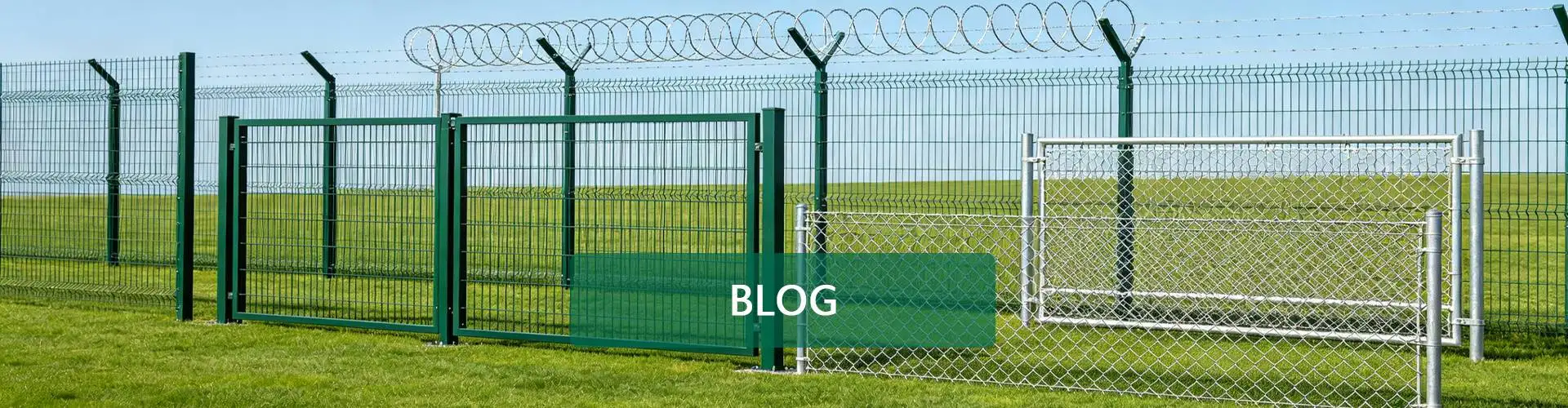

The unusual part of this Australian correctional facility project was visible in one dimension on the drawing: 4.2 meters.
For BDFENCE, that number was not entered directly into a production order.
First, it had to be translated.
Where would one mesh section finish and the next begin? Which steel members belonged to the tall fence line? Which components changed at an entrance? How would similar parts be separated after production? And, finally, how could the shipment arrive without leaving the site team with an unidentified collection of panels, posts and boxes?
This is the story of the project from that perspective: from one height on a drawing to an organized 358 fence shipment.
The First Job Was to Remove Ambiguity from “4.2m”
A height written beside a fence line can look perfectly clear until manufacturing starts.
For example, 4.2m could describe the height of the mesh portion. It could describe the installed fence above the finished ground level. In another design, it could refer to a larger assembly containing additional elements at the top.
These possibilities cannot be treated as interchangeable.
So the manufacturing discussion began by separating the required installed height from the dimensions of the individual parts used to create it.
That gave the rest of the order a fixed reference.
Next, We Stopped Thinking in Meters
A project buyer may purchase fencing by total perimeter length.
A factory cannot manufacture “meters.”
It manufactures individual pieces.
The project therefore had to move from a linear quantity into a component schedule.
Instead of one description such as:
4.2m high 358 fence
the working information became a group of physical items:
- welded mesh sections;
- steel support members;
- connection components;
- corner and end items;
- entrance-related components;
- small hardware packages.
This was a much more useful language for production.
We Used the Drawing to Decide Where Repetition Was Possible
Factories like repetition.
If the same part can be produced repeatedly, dimensions are easier to control, quantities are easier to count and packages are easier to organize.
The long regular sections of the correctional boundary were therefore treated differently from interruptions in the fence line.
Those interruptions included changes in direction and access areas.
Rather than forcing every location into the same production detail, the regular sections formed the repeating portion of the order while unusual positions were identified separately.
This kept special components from spreading unnecessarily across the entire project.
4.2m Created a Vertical Layout, Not Just a Tall Product
Another decision concerned how the specified installed height would be formed.
It is easy to assume that a 4.2m fence requires a single piece of welded mesh with the same height.
That assumption is not necessary.
The individual mesh dimensions and their vertical arrangement depend on the approved fence design.
For production, this distinction matters because section size affects fabrication, handling and packaging long before installation begins.
Therefore, the order followed the defined vertical arrangement instead of treating “4.2m” as an automatic panel dimension.
The Steel Beside the Mesh Became Just as Important as the Mesh
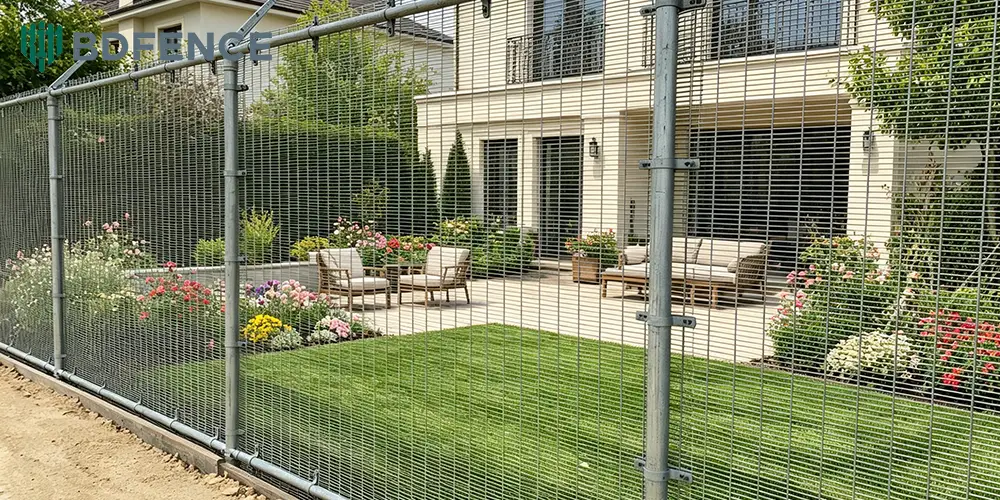
At normal viewing distance, the mesh dominates the appearance of a 358 fence.
On the production list for this project, the supporting steel demanded equal attention.
A tall installation places different demands on its supporting arrangement than a substantially lower fence.
Consequently, post section, wall thickness, length, spacing, connection positions and foundation interface could not simply be copied from another project because both projects happened to use 358 mesh.
They had to correspond with the design used for this fence.
Where structural verification is required, these items need to follow the applicable engineering criteria and actual site conditions.
Then We Looked at the Places Where the Fence Stops Being Repetitive
The middle of a long straight run is usually predictable.
The ends are more interesting.
At a corner, steel and mesh meet in a different geometry. At an entrance, the fixed fence approaches a moving gate. At a termination point, the final section has to finish against another defined condition.
These positions were treated as locations rather than as generic accessories.
That small change in thinking made the production list easier to understand:
| Location | Production Question |
|---|---|
| Straight run | Which components repeat? |
| Corner | What changes when direction changes? |
| Fence end | How does the final section terminate? |
| Entrance | Where does fixed fencing meet the gate assembly? |
The Entrance Was Given Its Own Boundary
For manufacturing purposes, an entrance should not disappear inside the total fence length.
We treated it as a break between two fixed fence runs.
That made it possible to consider the components immediately before and after the opening independently from the gate itself.
This distinction matters more as fence height increases because the fixed fence and the access assembly can involve different supporting arrangements.
It also prevents a common procurement problem: receiving a gate quotation that does not clearly explain how the surrounding fence connects to it.
Small Hardware Was Counted from the Assembly Backward
Panels and posts are easy to see on a factory floor.
A missing package of connection hardware is not.
Instead of estimating small parts as a general accessory allowance, quantities can be checked against the connection arrangement used by the approved assembly.
This creates a simple chain:
number of assemblies → connection positions → required hardware → packing quantity.
For an export order, this is more useful than discovering an accessory shortage after the main steel has already travelled overseas.
We Wanted Production Marks to Survive the Journey
The people unloading the shipment in Australia were not the same people who organized it at the BDFENCE factory.
That sounds obvious, but it affects how a mixed fence order should be packed.
Factory staff may recognize a component immediately because they have seen it throughout production. A site team opening the shipment weeks later does not have that context.
Therefore, identification has practical value.
Where the order contains different component groups, the packing references can follow the production schedule so that the meaning of the parts does not disappear once they enter a container.
Inspection Followed the Order Structure
The same logic continued into checking.
Instead of viewing inspection as one final look at the finished fence products, the relevant characteristics were tied back to the component schedule.
Depending on the approved specification, checks can include mesh dimensions, wire diameter, fabricated section dimensions, post dimensions, wall thickness, connection locations, visible finish condition and quantities.
For this type of order, quantity verification matters alongside dimensional inspection because the shipment contains both large steel parts and much smaller supporting items.
Only After That Did the Order Become a Shipping Problem
A perimeter is measured horizontally on a site plan.
A container has completely different constraints.
Long steel components, welded sections, gates and accessory packages occupy cargo space in different ways. Their weight and packing arrangement also affect loading.
Therefore, the project could not use a meaningful universal conversion such as:
one container = a fixed number of meters of 4.2m 358 fence.
The loading plan had to come from the finished component list.
In this project, production information came first; shipping information followed it.
The Project in One Table
| Drawing Information | What the Factory Needed to Turn It Into |
|---|---|
| 4.2m installed height | Defined vertical component arrangement |
| 358 fence line | Individual welded mesh sections |
| Long perimeter runs | Repeatable production groups |
| Changes in direction | Identified transition components |
| Access opening | Separate fixed-fence and gate interface |
| Connection detail | Counted hardware packages |
| Project BOQ | Production and packing schedule |
| Australian destination | Export packing and loading arrangement |
What Should Another Buyer Take from This Project?
The most useful information in an RFQ is not always more product data.
Sometimes it is better project data.
For example, a drawing showing where the fence changes direction can be more useful than another paragraph describing 358 mesh. A gate schedule can answer questions that total perimeter length cannot. A section drawing can clarify what a height figure actually means.
For another 4.2m project, we would therefore prefer to receive the available project documents rather than only a short request for a price per meter.
The starting package can include:
- perimeter drawing;
- section or elevation drawing;
- BOQ;
- mesh and wire requirement;
- post specification, if already defined;
- connection detail;
- gate schedule;
- surface-treatment requirement;
- destination information.
Not every project will have all of these documents at the inquiry stage. The available information can still be used to identify what remains undefined.
Why the 358 Mesh Still Made Sense for the Project
The close welded mesh associated with 358 fencing provides small openings with limited conventional hand and foot holds while retaining visibility through the fence line.
Those characteristics explain why this type of mesh is considered for controlled boundaries such as correctional and other security-sensitive sites.
However, the mesh should not be treated as the entire security design.
Its performance within a project also depends on the supporting structure, connections, foundations, access points and the broader site-security plan.
That distinction was particularly important at 4.2m.
What BDFENCE Supplied as a Manufacturer
BDFENCE approached this order as a collection of coordinated manufactured components rather than a single product measured only by meter.
The project supply scope covered the specified 358 mesh arrangement together with corresponding steel support components, connection hardware and related fence items required by the confirmed scope.
Production, quantity checking, component identification and export packing followed the project schedule.
This manufacturing approach is also suitable for other projects where fence height, access points or site geometry create several component types within one perimeter.
A Better Way to Describe the Finished Project
Calling this project “4.2m high 358 fencing” is technically useful, but incomplete.
A more accurate description would be:
a 4.2m boundary translated from drawings into repeatable steel assemblies, identified components and an export-ready fence package.
That translation was the real manufacturing work behind the project.
If you are sourcing 358 Fence for a correctional facility or another controlled site, send BDFENCE the available drawing, BOQ or fence schedule. We can review the manufacturing scope before preparing the quotation.
About BDFENCE
Hebei Bendin Industrial Technology Co., Ltd. (BDFENCE) manufactures metal fencing for overseas contractors, distributors and project buyers.
With more than 30 years of metal fence manufacturing experience, BDFENCE operates a 15,000㎡ factory with 190+ employees and more than 80 machines. Our products have been exported to more than 70 countries.
Our product range includes 358 Fence, Steel Tubular Fence, Chain Link Fence, 2D and 3D welded mesh fencing, Temporary Fence and other metal fence systems.
Contact BDFENCE
Hebei Bendin Industrial Technology Co., Ltd. (BDFENCE)
Phone:
+86 18703182863
WhatsApp:
+86 18703287372
Email:
info@bd-fence.com
Website:
https://bd-fence.com/
FAQ
What should be confirmed first when buying a 4.2m 358 Fence?
Clarify what the 4.2m dimension represents. The installed height, individual mesh dimensions and any additional upper components should not be assumed to mean the same thing.
Should a buyer request a price per meter for this type of fence?
A preliminary price may be discussed that way, but the final comparison is more useful when suppliers quote against the same panel arrangement, posts, connections, gates, finish and accessory scope.
What drawing is most useful for a tall 358 Fence?
A perimeter plan shows where the fence runs, while section or elevation information helps explain the vertical arrangement. Gate details and the BOQ add further information for manufacturing review.
Can BDFENCE manufacture project-specific 358 Fence configurations?
Yes. Manufacturing can follow confirmed project drawings and specifications, including project-specific panel arrangements, supporting steel and related components.