


Two 358 Fence panels can have exactly the same mesh opening and still feel like very different products.
The reason can be only one millimeter of steel.
A 3mm, 4mm, or 5mm wire changes the amount of steel inside every square meter of welded mesh. As the wire becomes thicker, the panel becomes heavier and more rigid. At the same time, material consumption and project cost increase.
Therefore, the best 358 Fence is not automatically the one with the thickest wire.
The better choice is the wire diameter that matches the security role of the perimeter.
Start with What Does Not Change
When comparing these three options, keep the mesh geometry consistent.
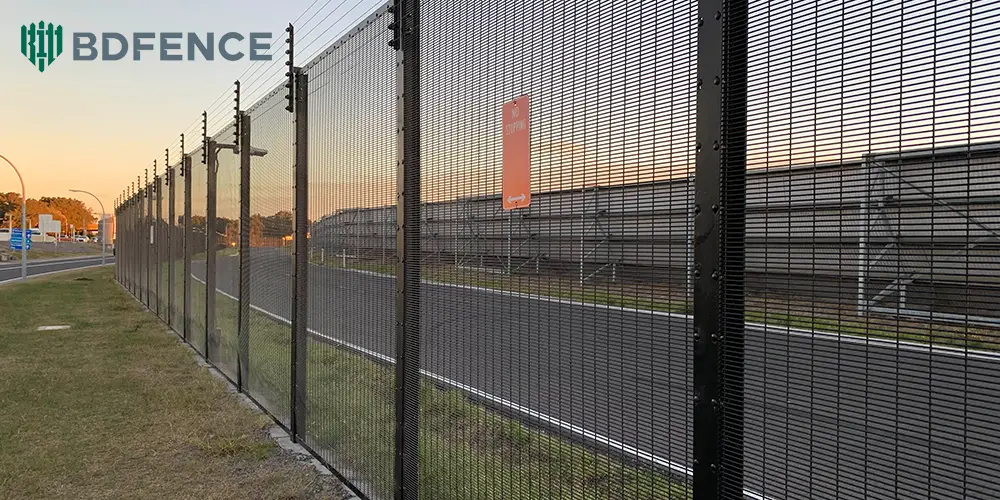
A common 358 Fence uses approximately 76.2 × 12.7 mm mesh.
That narrow opening gives the system its recognizable anti-climb character.
If the mesh opening stays the same and only the wire diameter changes, buyers can see more clearly what the additional steel is actually doing.
| Version | Wire Diameter | General Panel Character |
|---|---|---|
| 3mm 358 | 3.0 mm | Lighter welded panel |
| 4mm 358 | 4.0 mm | Balanced heavy security panel |
| 5mm 358 | 5.0 mm | Very heavy welded panel |
However, these descriptions should not replace the project specification. Panel height, post design, fixing system, and other details still affect the complete fence.
One Extra Millimeter Is More Significant Than It Looks
A move from 3mm to 4mm does not mean the panel simply becomes “one-third stronger.” Fence engineering is not that simple.
However, increasing wire diameter does increase the cross-sectional area of every wire.
That means more steel runs through both directions of the welded mesh.
As a result, increasing the diameter can change:
- Panel weight
- Panel stiffness
- Steel consumption
- Handling requirements
- Post loading
- Transport weight
- Material price
This is why a 5mm 358 panel should not be treated as simply a slightly upgraded 4mm panel.
What Does a 3mm 358 Fence Give You?
A 3mm configuration keeps the narrow 358 mesh geometry while reducing the amount of steel compared with heavier versions.
That can make it useful where the buyer wants the visual and anti-climb character of small mesh but does not need the heaviest panel construction.
Possible applications may include:
- Controlled commercial boundaries
- Internal security zones
- Lower-risk sections of larger sites
- Projects where panel weight is an important consideration
However, 3mm wire should not be selected simply because it provides the lowest material cost.
The project team should first confirm that the lighter construction meets the required security specification.
Why 4mm Is a Common Reference Point for 358 Fence
When buyers discuss standard 358 Security Fence, 4.0 mm wire is often the metric specification they expect to see.
Combined with the typical 76.2 × 12.7 mm mesh, it creates the familiar 358 welded security panel.
For many projects, 4mm provides a practical balance between:
- Panel rigidity
- Anti-climb mesh
- Steel weight
- Post requirements
- Installation handling
- Project cost
For this reason, it is often considered for data centers, industrial facilities, utilities, controlled infrastructure, and other security-sensitive sites.
What Changes When the Wire Reaches 5mm?
Moving to 5mm adds considerably more steel across the welded panel.
The result is a heavier mesh structure.
That may be useful when a project specifies a more substantial physical barrier. However, the rest of the fence system now deserves another look.
A 5mm panel can influence:
- Post section requirements
- Post wall thickness
- Fixing quantity
- Panel handling
- Gate infill weight
- Foundation design
- Freight planning
Therefore, upgrading the mesh without reviewing the supporting components can create an unbalanced specification.
Think About Kilograms, Not Only Millimeters
Wire diameter is easy to read on a technical sheet. Steel weight tells buyers more about the commercial impact.
When the same mesh opening and panel size are used, thicker wire increases the kilograms of steel inside each panel.
Now multiply that difference across a large project.
A small change at panel level can become significant across:
- 500 panels
- 1,500 panels
- 5,000 panels
- Several kilometers of perimeter
For this reason, procurement teams should ask whether the additional steel creates useful security value for the specific site.
Do You Need 5mm Wire Around an Entire Site?
Often, no.
Large facilities rarely carry the same security risk at every point.
A site may contain:
- Critical equipment areas
- Main restricted boundaries
- Public-facing sections
- Internal separation zones
- Parking areas
- Lower-risk service boundaries
If the security plan allows different specifications, the buyer can allocate heavier fencing to the areas where it creates real value.
Example: A Data Center Campus
Consider a data center campus with several security layers.
The perimeter closest to critical infrastructure may require a heavier 358 specification.
Meanwhile, another internal boundary may only need to separate operational zones.
Instead of automatically using 5mm wire everywhere, the designer can evaluate each security layer separately.
| Data Center Zone | Possible Selection Direction |
|---|---|
| Critical Restricted Perimeter | 4mm or heavier as specified |
| High-Risk Equipment Zone | Heavier configuration may be considered |
| Standard Controlled Boundary | 4mm common reference |
| Lower-Risk Internal Separation | 3mm may be considered if approved |
The final selection should always follow the approved security design rather than this example alone.
Example: A Prison Perimeter
A correctional facility creates a different decision.
Here, physical perimeter resistance may receive more emphasis than material savings.
The project may therefore specify heavier panels, taller fence sections, stronger posts, additional security toppings, or multiple perimeter layers.
In that situation, the extra steel in a heavier wire specification may provide more project value than it would around a general commercial boundary.
The Post Specification Must Follow the Panel
One of the most common mistakes in fence comparison is focusing on the mesh while ignoring the posts.
A 5mm welded panel paired with a light post system does not automatically create a stronger complete fence.
Likewise, a 3mm panel does not necessarily require the same support as a much heavier configuration.
Therefore, buyers should review:
- Post section size
- Post wall thickness
- Post length
- Post spacing
- Base plate or embedded installation
- Foundation requirements
The panel and post should be specified together.
The Fixing System Matters More as Panel Weight Increases
358 Fence panels need secure connections to the supporting posts.
Depending on the project, the system may use:
- Full-length fixing bars
- Steel clamp plates
- Security brackets
- Anti-tamper bolts
- Specialized nuts
As panel weight and security requirements increase, the fixing arrangement deserves greater attention.
Therefore, a supplier quotation for 5mm mesh should not be evaluated without checking how that heavier panel is attached to the post.
What About the Gates?
Wire diameter also affects matching gate infill.
A large vehicle gate filled with heavy 358 mesh carries more weight than one using a lighter welded panel.
That can influence:
- Gate frame sections
- Gate posts
- Hinges
- Hardware
- Opening method
For projects with many gates, this effect can become important to both cost and system design.
Heavier Wire Also Reaches the Shipping Container
The wire choice does not stop affecting the project when production ends.
More steel means more shipment weight.
Therefore, a heavier specification can influence:
- Bundle weight
- Forklift handling
- Container payload
- Number of shipping units
- Site unloading
For a small order, the difference may be manageable. For a large international project, logistics should be considered during the specification stage.
Does Thicker Wire Automatically Mean Better Anti-Climb Performance?
Not exactly.
The narrow 76.2 × 12.7 mm mesh opening is a major reason for the anti-climb character of 358 Fence.
Increasing wire diameter makes the panel more substantial, but it does not make the openings narrower.
Therefore, anti-climb performance should not be reduced to wire thickness alone.
The complete security result depends on:
- Mesh geometry
- Wire diameter
- Fence height
- Post construction
- Fixing system
- Gate design
- Security topping where specified
When 3mm Can Be the Smarter Purchase
Buying less steel can be the correct engineering decision when the project does not require more.
A 3mm configuration may make commercial sense if:
- The perimeter has a lower security classification
- The fence acts as an internal barrier
- The approved specification permits lighter mesh
- Project weight needs to be controlled
- The buyer wants narrow mesh without a heavy panel
In these cases, selecting 5mm simply because it is thicker can waste part of the fence budget.
When 5mm Can Be Worth the Additional Steel
The opposite is also true.
A high-security perimeter may justify the heavier specification when:
- The project explicitly requires 5mm wire
- Panel rigidity is a key design requirement
- The site protects critical assets
- The security strategy calls for a heavier physical barrier
- Posts and foundations are designed for the complete system
The important point is that the added steel should answer a defined project requirement.
Why 4mm Often Sits in the Middle
For many buyers, 4mm provides the easiest starting point because it corresponds with a widely recognized 358 configuration.
It offers more steel than a lighter 3mm option without automatically moving the project into the weight and cost of 5mm mesh.
Therefore, when a specification simply calls for standard 358 Security Fence, 4mm is often one of the first configurations reviewed.
Still, the project documents should always take priority over a general market convention.
Do Not Compare 3mm, 4mm and 5mm Prices Before Checking These Details
| Specification | Why It Matters |
|---|---|
| Mesh Opening | Confirms that all options use comparable 358 geometry |
| Actual Wire Diameter | Defines the steel wire size |
| Panel Dimensions | Changes total steel per panel |
| Panel Weight | Helps reveal material differences |
| Post Specification | Must support the selected panel |
| Fixing Method | Connects the panel to the security structure |
| Surface Treatment | Affects corrosion protection and cost |
| Gate Specification | Heavier infill may change gate design |
A Practical Selection Method
If you are still deciding between 3mm, 4mm, and 5mm, use the project in this order:
- Define the required security level
- Confirm the 358 mesh geometry
- Identify the fence height
- Review the project standard or tender specification
- Select the wire diameter
- Match the post system
- Match the security fixings
- Review gate construction
- Check panel and shipping weight
- Compare the complete system price
This sequence prevents price from driving the technical decision too early.
What Should You Send BDFENCE for a 358 Fence Recommendation?
If you are comparing several wire diameters, send BDFENCE the available project requirements.
Useful information includes:
- Project country
- Project application
- Total perimeter length
- Fence height
- Required mesh opening
- Preferred wire diameter
- Panel width
- Post size and wall thickness
- Post spacing
- Security fixing requirement
- Surface treatment and color
- Pedestrian gate dimensions and quantities
- Vehicle gate dimensions and quantities
- Additional security topping
- BOQ or fence drawings
- Destination port
If the wire diameter is not yet confirmed, BDFENCE can review the available project information and prepare suitable configurations for comparison.
How BDFENCE Supplies 358 Security Fence
Hebei Bendin Industrial Technology Co., Ltd. (BDFENCE) manufactures 358 Fence systems for data centers, prisons, industrial facilities, utilities, infrastructure projects, and other controlled-access sites.
Depending on the confirmed specification, our project supply can include:
- 358 welded mesh panels
- Different wire diameter options
- Customized steel posts
- Security fixing systems
- Anti-tamper fasteners
- Pedestrian security gates
- Vehicle security gates
- Surface treatment options
- Installation accessories
Project buyers can send BOQ documents, security fence drawings, gate schedules, and technical specifications directly to BDFENCE for review.
Final Answer: 3mm, 4mm or 5mm?
Choose the wire according to the job the fence needs to perform.
A 3mm 358 configuration can reduce panel weight and steel consumption where a lighter specification meets the project requirement.
A 4mm configuration provides a widely recognized reference for standard 358 Security Fence and often offers a useful balance between rigidity, weight, and cost.
A 5mm configuration adds considerably more steel and may be appropriate where the project requires a heavier physical barrier.
However, the wire diameter should never be selected by itself.
The correct 358 system combines the mesh, wire, panel height, posts, security fixings, gates, surface treatment, and foundations around the actual security requirement.
Contact BDFENCE
Hebei Bendin Industrial Technology Co., Ltd. (BDFENCE)
Phone:
+86 18703182863
WhatsApp:
+86 18703287372
Email:
info@bd-fence.com
Website:
https://bd-fence.com/
FAQ
What wire diameter is standard for 358 Fence?
A widely recognized metric 358 configuration uses approximately 4.0 mm wire with 76.2 × 12.7 mm mesh. However, final wire diameter should follow the project specification.
Is 5mm 358 Fence better than 4mm?
Not automatically. A 5mm panel uses more steel and creates a heavier structure, but that additional material is only useful when the project requires it. Posts, fixings, gates, and foundations must also match the heavier panel.
Is 3mm wire too thin for 358 Fence?
A 3mm configuration can be suitable for some applications if it meets the approved security and structural requirements. It should not be selected only because it costs less.
Does thicker 358 Fence wire make it harder to climb?
Thicker wire increases the physical weight and rigidity of the panel. However, the narrow 76.2 × 12.7 mm mesh geometry is a major factor in the anti-climb character of 358 Fence.
Does 5mm wire need stronger fence posts?
A heavier panel can increase the demand on the support structure. Therefore, post dimensions, wall thickness, spacing, foundations, and security fixings should be reviewed when selecting 5mm mesh.
Which wire diameter is best for data center fencing?
There is no universal wire diameter for every data center. A 4mm 358 configuration is commonly considered, while heavier specifications may be used where the approved security design requires them.
Can BDFENCE manufacture 3mm, 4mm and 5mm 358 Fence?
BDFENCE can manufacture 358 Security Fence according to the confirmed mesh, wire diameter, panel dimensions, post system, surface treatment, and other project requirements.
Can I send a BOQ to compare several 358 specifications?
Yes. BDFENCE can review your BOQ, perimeter drawing, gate schedule, and technical requirements and prepare suitable 358 Fence configurations for comparison.