



Illustrative Project Scenario | Power Infrastructure Perimeter Security
A substation fence has an unusual job. It must keep unauthorized people away from electrical infrastructure while allowing maintenance crews to enter safely, inspect equipment and carry out their work.
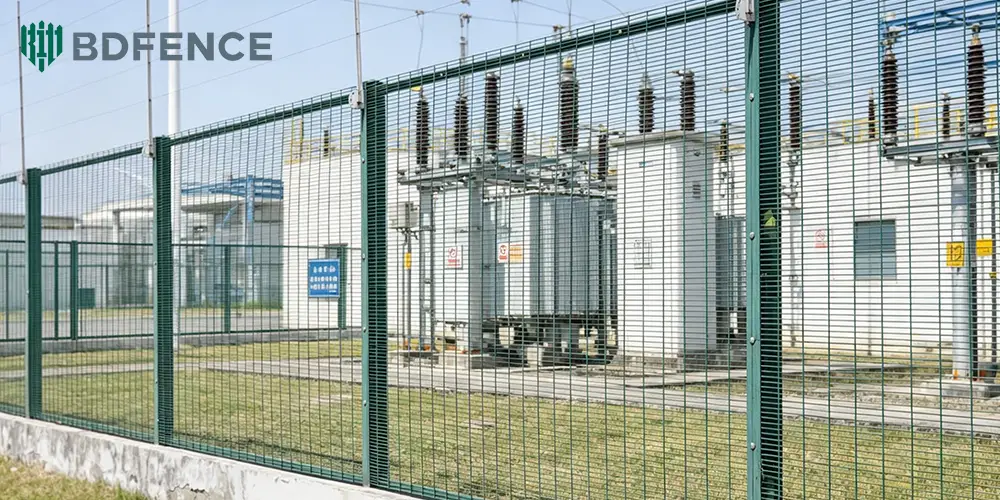
For a proposed power substation in Kenya, the perimeter concept combines three elements: 358 welded mesh panels, Y-shaped steel posts and a razor wire barrier above the fence.
The combination looks straightforward on a drawing. The difficult part is making sure those three elements belong to the same engineered system.
This article examines how a contractor might specify and procure that perimeter. It is a representative project scenario, not a record of a completed BDFENCE installation.
Where the Fence Meets the Y-Post
The proposed fence follows the substation boundary, with access points for maintenance vehicles and authorized personnel.
The main barrier uses 358 welded mesh, a product commonly selected for security fencing because of its narrow rectangular openings.
The familiar 358 mesh configuration has openings of approximately 76.2 × 12.7mm, often paired with 4.0mm wire. However, actual panel dimensions, wire sizes and tolerances must follow the approved project specification.
The narrow openings make the mesh difficult to use as a foothold and restrict access through the fence.
For a substation, those characteristics can be useful, but the mesh alone does not determine the security performance of the perimeter.
The posts, connections, gates and upper barrier must work together.
In this example, the design uses Y-shaped posts that extend above the mesh to support the specified razor wire arrangement.
That upper extension changes the post design. It also changes what the contractor needs to check before ordering.
The Proposed Fence Package
The following schedule illustrates the main components rather than setting final engineering dimensions.
| Component | Proposed Requirement |
|---|---|
| Application | Power substation perimeter |
| Location | Kenya |
| Main fence | 358 welded security mesh |
| Typical mesh reference | 76.2 × 12.7mm aperture |
| Wire reference | 4.0mm nominal, subject to specification |
| Posts | Y-top steel security posts |
| Panel connections | Approved security fixing system |
| Top barrier | Specified razor wire assembly |
| Finish | Corrosion protection suitable for site conditions |
| Access | Maintenance and personnel gates |
| Engineering | Approved structural, electrical and security drawings |
The final post dimensions, panel height, fixing details and top barrier configuration would need approval from the responsible project engineers.
Why the Y-Post Cannot Be Chosen from a Photograph
Y-post is a convenient product name, but it does not define a complete technical specification.
Two Y-top posts can look similar in a catalog while having different sections, wall thicknesses, extension lengths and connection details.
The upper arms also need to match the approved razor wire support arrangement.
For a contractor, that means the post drawing matters more than the product photograph.
The post must support the 358 panel and the additional loads associated with the top barrier. Wind exposure, the selected razor wire assembly, post spacing and foundation design can all affect the requirements.
A supplier should not simply add a Y-shaped extension to an ordinary post and assume that the result meets the project design.
The post and upper barrier need to be assessed as one assembly.
The Top Barrier Creates Its Own Questions
Razor wire is often included in security fence specifications as an additional deterrent.
However, writing “razor wire on Y-posts” is not enough for manufacturing.
The project documents need to identify the approved product, material, support arrangement and connection details.
They must also account for safe maintenance access and any applicable restrictions on razor wire use.
For this proposed substation, the project team would need to review how the top barrier continues around corners and terminates near entrances.
The gate area deserves particular attention.
A maintenance gate may need to open for large equipment or vehicles. The upper security arrangement cannot interfere with safe gate movement, authorized access or required clearances.
Those details should come from the facility’s approved security design.
A Gate Is Not Just Another Fence Bay
Along a straight boundary, 358 mesh panels repeat between regular posts.
At the entrance, that pattern stops.
The gate requires its own frame, supports, hardware and security arrangement.
For the proposed Kenyan substation, the maintenance entrance would need to accommodate the vehicles and equipment identified by the facility operator.
The pedestrian entrance may have different access-control requirements.
Neither opening should be priced as a standard fence panel.
If the BOQ lists only the total fence length, the gate components can easily disappear from the material comparison.
A clearer material schedule separates the regular 358 fence runs from vehicle gates, personnel gates and special terminal sections.
This allows the supplier to price the correct components and gives the contractor a more reliable basis for procurement.
Fixing the 358 Mesh to the Posts
The mesh-to-post connection is another detail that deserves a drawing.
Depending on the approved system, 358 fencing may use individual security clips, clamp bars or other purpose-designed connections.
These components are not automatically interchangeable.
The panel width, post section, hole positions and fasteners must match.
A panel supplied by one manufacturer may not fit a post and fixing package sourced independently from another.
That becomes particularly inconvenient when the materials arrive at a remote construction site.
For an EPC contractor, it is worth confirming the complete panel-to-post detail before placing the order.
The drawing should also establish the required post spacing. The nominal width of a mesh panel is not necessarily the same as the center-to-center distance between posts.
The Electrical Safety Detail That a Fence Catalog Cannot Answer
A power substation is different from an ordinary warehouse or commercial perimeter.
The fence may be close to electrical infrastructure and can be affected by the facility’s grounding and bonding design.
The responsible electrical engineer must determine the requirements for metallic fencing, gates and other conductive components under the applicable standards and site conditions.
That review may influence the approved arrangement at gates, fence sections and connections.
The fencing manufacturer should supply components that match the approved design, but it should not independently determine the site’s electrical safety measures from a generic product specification.
This distinction is important.
A mechanically secure fence is not automatically an electrically safe fence.
Corrosion Protection for an Outdoor Utility Site
The fence will remain outdoors throughout its service life.
Kenya includes different climatic and environmental conditions, so the coating requirements should reflect the actual substation location.
For the 358 mesh panels, the project may specify galvanizing, an additional coating or another approved finish.
The same review applies to Y-posts, fixing hardware and the razor wire assembly.
A fence can have a well-protected mesh panel but still develop problems around poorly protected connections.
For that reason, the quotation should identify the coating requirements for each component group.
The buyer should also check whether the proposed finish matches the project’s corrosion protection specification rather than relying on the phrase “weather-resistant fence.”
What the Contractor Should Find in the BOQ
For this type of project, a single line reading “358 security fence with razor wire” leaves too much open.
A practical BOQ should identify the main fence and the special components separately.
| BOQ Item | Information to Confirm |
|---|---|
| 358 mesh panels | Height, width, wire diameter, aperture and finish |
| Y-top posts | Section, wall thickness, length and approved top geometry |
| Panel fixings | Clip or clamp arrangement and security hardware |
| Razor wire | Approved material and product specification |
| Top-barrier supports | Approved connection and support details |
| Terminal and corner posts | Locations and special requirements |
| Vehicle gates | Opening, frame, hardware and access requirements |
| Personnel gates | Dimensions, hardware and security requirements |
| Packing | Identification of panels, posts and accessories |
The schedule should be read together with the approved drawings.
A quantity list cannot replace the details showing how the parts connect.
A Quotation Can Be Accurate and Still Be Incomplete
Consider two offers for the same perimeter length.
The first supplier quotes 358 panels, Y-posts and razor wire.
The second includes those items plus panel fixing hardware, special corner components and the required gate materials.
The first quotation may appear cheaper.
However, the difference may have little to do with factory pricing. The suppliers may simply be quoting different scopes.
For a contractor, the useful comparison is the cost of the complete approved supply package.
That means checking whether the quotation includes the required fixings, gate components, top-barrier supports and other accessories.
It also means confirming the exact mesh and post specifications.
A lower price for a different post wall thickness or an incomplete fixing package is not a like-for-like comparison.
Preparing the Fence Materials for Export
An overseas substation project may receive mesh panels, posts and accessories in separate packages.
The receiving contractor needs to identify those materials against the approved schedule.
358 panels should be protected during handling and transport. Posts and long steel components require suitable bundling, while smaller fittings need clear identification.
Razor wire requires additional care because of its sharp edges and handling hazards.
For a project with several gate types or special fence sections, the packing list should distinguish those components from the regular perimeter materials.
The purpose is straightforward: the site team should be able to match the delivered items to the drawings without having to guess which components belong together.
The actual packing method would be confirmed against the order quantity, component dimensions and transport requirements.
How BDFENCE Would Approach This Inquiry
BDFENCE is a Chinese metal fence manufacturer supplying 358 security fencing and other steel fence products for international markets.
For a substation perimeter inquiry, our starting point would be the customer’s existing drawing or BOQ.
We would review the specified 358 mesh dimensions, Y-post requirements, fixing details and coating.
If the project includes razor wire, the approved top-barrier specification and connection drawings would also be needed.
The quotation scope should clearly distinguish standard fence materials from gates, special posts and other accessories.
Where details remain unclear, they should be confirmed before manufacturing rather than left to interpretation.
BDFENCE’s role is to supply the specified fence components. Structural design, electrical safety and final security-system approval remain with the responsible project professionals.
What This Example Means for Utility Fence Buyers
The main lesson is not that every substation should use the same 358 fence.
Different facilities have different security requirements, electrical safety conditions and environmental exposure.
The useful lesson is that the upper barrier, the Y-post and the mesh panel cannot be purchased as unrelated parts without checking their compatibility.
The project becomes easier to quote when the drawing identifies the full connection system.
For EPC companies and procurement teams, that reduces uncertainty when comparing factory offers.
It also gives the installation contractor a clearer understanding of what should arrive on site.
FAQ
Is 358 security fencing suitable for power substations?
358 mesh can be used as part of a substation perimeter security system when the complete fence meets the approved structural, security and electrical safety requirements.
What is the purpose of a Y-post on a 358 fence?
A Y-top post provides an extended support arrangement for an approved upper security barrier. Its dimensions and connections must match the project design.
Can razor wire be installed on any 358 fence post?
No. The post and connections must be designed or approved for the specified top barrier and its associated loads and safety requirements.
What mesh size is commonly used for 358 fencing?
A common 358 mesh reference is approximately 76.2 × 12.7mm with 4.0mm wire. Actual dimensions and tolerances should follow the approved specification.
Does a substation security fence require grounding or bonding?
The responsible electrical engineer must determine the applicable grounding, bonding and other electrical safety requirements for the specific facility.
Can BDFENCE quote from an EPC contractor’s existing BOQ?
Yes. Send the current BOQ, approved drawings or technical specifications. BDFENCE can prepare a quotation for the requested fence components and identify details that require confirmation.
Contact BDFENCE
Hebei Bendin Industrial Technology Co., Ltd. (BDFENCE)
BDFENCE manufactures metal fencing products for overseas contractors, distributors and project buyers. Our team has more than 30 years of metal fencing experience, supported by a factory of approximately 15,000㎡, more than 190 employees and over 80 machines.
For a 358 security fence inquiry, you can send your existing BOQ, drawings or material schedule.
Phone: +86 18703182863
WhatsApp: +86 18703287372
Email: info@bd-fence.com
Website: https://bd-fence.com/