


The difference between two security fence quotations can hide in a single number.
One supplier offers 76 × 25 mm Clear View mesh. Another specifies 76.2 × 12.7 mm 358 mesh. Both panels are welded steel, both allow visibility through the fence, and both may come in the same black finish. In a product photograph, the difference is easy to miss.
On a technical drawing, it is much harder to ignore.
For contractors and industrial buyers, the question isn’t whether Clear View fencing looks similar to 358 Fence. It is whether the offered panel matches the mesh geometry and complete fence system required by the project.
This comparison matters particularly in South Africa, where suppliers use terms such as Clear View, clearview, anti-climb mesh and 358 fencing across related product ranges. Some names describe appearance, some refer to a particular mesh construction, and others are associated with branded products.
Before comparing prices, buyers need to separate those terms from the actual specifications.
Are 358 Fence and Clear View Fencing the Same Product?
They can be, but not always.
The term Clear View fencing generally describes a category of welded mesh panels that allow people to see through a property boundary. In South Africa, suppliers offer several mesh patterns within this category. The openings, steel wire sizes and supporting systems vary between products.
358 is more specific. The name comes from the traditional imperial description of a mesh measuring approximately 3 inches by half an inch, using an eight-gauge wire reference. In metric product literature, that commonly corresponds to nominal spacing of 76.2 × 12.7 mm with approximately 4 mm steel wire.
In other words, a conventional 358 panel can be described as Clear View fencing. However, a product advertised as Clear View fencing does not automatically have conventional 358 mesh.
That distinction becomes important when a tender uses both terms without providing dimensions. The purchasing team might believe it has requested a defined security product, while suppliers interpret the wording as permission to quote different mesh patterns.
There is also a naming issue. ClearVu is associated with a particular manufacturer’s branded fencing, whereas buyers and sellers often use Clear View or clearview more broadly. The safest way to avoid confusion is to specify the physical product instead of relying on a trade name.
The Mesh Comparison That Actually Matters
Look at the short dimension of the opening. It tells you more about the difference between these products than the overall appearance of a finished fence.
South African product ranges commonly include the following nominal welded mesh patterns:
| Mesh Pattern | Common Market Description | What Changes |
|---|---|---|
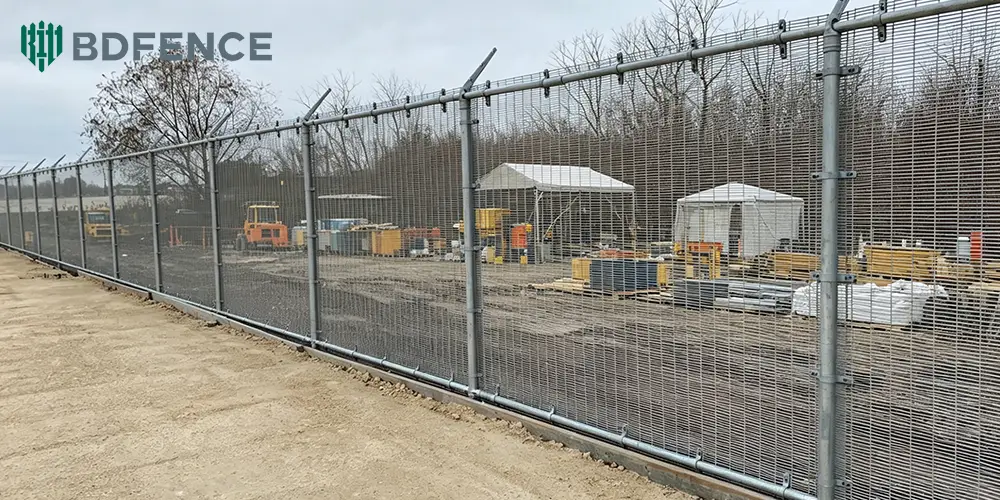
| 76.2 × 12.7 mm | 358 / Narrow-Mesh Clear View | Very close wire spacing in one direction; commonly selected where climbing deterrence is a key concern |
| Approximately 76 × 25 mm | Medium-Aperture Clear View | Wider spacing than conventional 358 mesh; a different panel specification |
| Approximately 76 × 50 mm | Wide-Aperture Clear View | More open pattern; may suit other perimeter applications subject to the design requirements |
These descriptions help buyers identify product families. They do not establish standardized security ratings. Individual manufacturers may use different names, wire diameters or panel details for the same nominal opening.
For a warehouse perimeter, the project designer might select a particular mesh based on the security assessment and site conditions. A commercial development may have different priorities, including architectural appearance, visibility and access control.
Neither buyer should select the panel solely from its marketing category.
Check how the opening is measured
Suppose a drawing states 12.7 mm spacing and 4 mm wire. Is the 12.7 mm dimension measured from wire centre to wire centre, or between the wire surfaces?
The answer changes the geometry.
If 12.7 mm means centre-to-centre spacing, the clear gap between two nominal 4 mm steel wires is approximately 8.7 mm before coating. If the drawing instead requires a 12.7 mm clear gap, the wire centres sit farther apart.
Don’t try to settle that question from a photograph. Obtain a dimensioned mesh detail showing the measurement points and wire orientation.
The same applies to the 25 mm and 50 mm variants. A number in a catalogue is useful for identifying a product range, but the approved drawing determines what the factory should manufacture.
Does a Smaller Mesh Opening Mean a More Secure Fence?
A narrow opening can contribute to climbing deterrence. The close spacing in conventional 358 mesh leaves less room for ordinary handholds and footholds than many wider-opening panels.
It may also make it harder to reach through the mesh with certain tools. However, that is not the same as proving the fence will resist a particular attack for a specified period.
Consider the complete perimeter. Even a dense mesh panel relies on posts, fixings, gate assemblies and foundations. If the connections do not match the security design, the narrow opening cannot compensate for the rest of the system.
For this reason, terms such as “anti-climb,” “anti-cut” and “high security” should lead to further technical questions rather than end the discussion.
Does the project require a tested performance classification? Which complete fence assembly was tested? Do the proposed gates and fixing components form part of that tested arrangement?
If the tender names a particular security standard or test method, ask for evidence that addresses that requirement. A supplier’s description of the mesh alone is not proof of a certified security rating.
The Wire Diameter Can Change the Comparison Again
Now imagine that two suppliers agree to quote 76.2 × 12.7 mm mesh. Their products still may not match.
One manufacturer offers 4.0 mm wires in both directions. Another lists a 4.0 × 3.0 mm configuration. A third uses a different steel wire arrangement.
All three descriptions can appear alongside a narrow 358-style mesh in product catalogues, but they represent different material configurations.
Wire diameter affects the amount of steel in a panel. For equal lengths of round steel wire, a 4.0 mm diameter provides about 78% more cross-sectional area than a 3.0 mm diameter. That difference can affect material weight and manufacturing cost.
It does not mean the whole fence is 78% stronger. Weld quality, steel grade, panel design and connections still determine how the structure behaves under load.
When reviewing quotations, identify the horizontal and vertical wire sizes separately. Also check whether the dimensions describe the bare steel wire or the finished wire after coating.
A larger finished diameter caused by a protective layer should not be mistaken for a larger steel core.
For example, BDFENCE’s Industrial Park 358 Fence range publishes several wire configurations, including 4.0 × 3.0 mm, 4.0 × 4.0 mm, 4.5 × 3.0 mm and 4.5 × 4.5 mm. Those are catalogue options; a buyer must still identify which combination meets the approved specification.
When the Panels Look Similar but the Installed Systems Differ
Mesh dimensions are visible in a technical drawing. Some of the most important purchasing differences are less obvious.
Take the connection between the panel and the post.
A supplier may offer square steel posts with brackets. Another may propose an H-section post system or a full-length fixing bar. Each arrangement has its own hardware, panel positioning and installation dimensions.
Now imagine the contractor has already marked the post foundations. The manufacturer supplies panels with the correct nominal width, but the proposed fixing arrangement uses different post centres. The mesh itself is correct; the installation layout is not.
That is why a complete quotation needs a coordinated panel-and-post drawing.
The same issue appears at gates. A standard fence panel ends at a post, while a pedestrian or vehicle gate needs a frame, support structure, hinges or sliding hardware, and a closing arrangement. Matching mesh infill helps preserve the appearance of the boundary, but the gate still needs its own design.
Buyers should pay particular attention to entrance transitions, corners and short closing sections. These are the places where a standard panel schedule often stops matching the site layout.
How Would the Choice Change Between a Warehouse and a Commercial Property?
Consider two different developments.
The first is a warehouse and distribution centre. It has loading yards, goods storage and regular delivery traffic. The security designer may prioritize a narrow-mesh fence system with specified fixing hardware and controlled entrances.
The second is a commercial office property. Its boundary faces public walkways and landscaping. The developer may want a clear view through the perimeter and a fence style that matches the buildings.
Both projects could use welded mesh fencing. However, they may arrive at different panel specifications because they have different operating needs.
For the warehouse, the purchasing team might focus on the complete security system: mesh construction, post connections, vehicle gates and the requirements of the site’s security plan.
For the office property, appearance and visibility may receive greater attention. Even so, the project still needs suitable post dimensions, safe gate operation and the specified corrosion protection.
Neither example means that one opening is automatically sufficient for every warehouse or that a wider opening is always acceptable for commercial use. The responsible designer must decide what the site requires.
The purpose of comparing 358 and Clear View products is not to assign a universal winner. It is to prevent a buyer from treating different specifications as equivalent simply because their market names overlap.
Coating and Visibility: Two Details That Deserve Separate Decisions
Clear View fencing gets its name partly from its open appearance. Yet actual visibility depends on more than the mesh opening.
Wire thickness, viewing angle, lighting, distance and the objects behind the fence can all affect what people see. A security camera may have a different view through the same panel when its position changes.
For a facility that relies on CCTV, the project team should consider the actual camera locations and sightlines. Do not assume that choosing a particular mesh guarantees unobstructed surveillance.
Corrosion protection is another separate issue. Galvanized, powder-coated and polymer-coated products can look similar when new, but the protective systems may differ.
For an industrial site near the coast, salt exposure may influence the coating requirements. An inland warehouse may face other conditions, such as standing water or industrial pollutants.
Ask for the specified finish on the mesh, posts, clamps, fasteners and gates. A black colour reference tells the supplier how the fence should look; it does not fully describe how the steel must be protected.
How to Compare 358 and Clear View Supplier Quotations
Return to the two quotations from the beginning of this article. One supplier offers 76 × 25 mm Clear View mesh. The other quotes 76.2 × 12.7 mm 358 mesh.
Before negotiating the price, the buyer should establish whether the project’s approved specification permits both options.
If the drawing requires conventional 358 mesh, the wider opening is a technical difference. The supplier can submit it as an alternative, but the responsible project team must decide whether to accept that change.
Once the intended mesh geometry is clear, compare the rest of the supply:
- Panel: wire diameter, mesh spacing, height, width and manufacturing tolerances.
- Post: steel profile, wall thickness, length and connection arrangement.
- Fixings: brackets, clamp bars and specified security hardware.
- Gates: openings, frames, supports and included operating components.
- Finish: corrosion-protection system and required inspection evidence.
- Delivery: component quantities, packing method, freight terms and exclusions.
For imported fencing, the buyer also needs to consider the total delivered cost. A low panel-only quotation may exclude posts and hardware that another supplier includes. Freight and customs-related costs can create further differences depending on the shipping terms.
One practical step is to issue every supplier the same technical schedule and request a separate list of proposed deviations. That makes the purchasing decision easier to review because the buyer can see which supplier matches the specification and which is offering an alternative.
What BDFENCE Can Provide for a Project Enquiry
BDFENCE is a China-based metal fencing manufacturer supplying overseas importers, distributors, contractors and industrial project buyers.
Its published 358 product range includes narrow-mesh welded panels, several wire configurations, different panel sizes and supporting post systems. The requested specification determines which components the factory needs to review.
When enquiring about 358 or Clear View fencing, it helps to send the actual mesh dimensions rather than only the product name. A site layout, gate schedule and BOQ can clarify the required panel quantities and supporting components.
If the project uses the term Clear View but specifies a wider mesh, state that opening clearly. Conversely, if the tender requires conventional 358 geometry, identify the narrow mesh and wire arrangement on the drawing.
For buyers who need a broader introduction to the product, BDFENCE also publishes What Is a 358 Fence? Mesh Size, Wire Diameter and Specifications Explained.
The factory can review a proposed manufacturing scope, but structural approval, site-specific security requirements and any independent testing or certification must follow the applicable project documents.
Frequently Asked Questions
Is 358 fencing a type of Clear View fencing?
Yes. Conventional 358 welded mesh can be described as Clear View fencing. However, the broader Clear View category also includes products with wider openings, so the names are not always interchangeable.
Is 76 × 25 mm Clear View mesh the same as 358 mesh?
No. The nominal mesh geometry differs from conventional 358, which commonly uses approximately 76.2 × 12.7 mm spacing. A 76 × 25 mm panel should be treated as a different specification unless the project approves it as an alternative.
Does every 358 fence use 4 mm steel wire?
Approximately 4 mm wire is a common reference, but manufacturers may offer other wire combinations. Buyers should confirm the horizontal and vertical wire diameters, including whether the measurement refers to the steel core or coated wire.
Which product is better for an industrial site?
The choice depends on the security assessment and approved specification. Where narrow-mesh climbing deterrence is a key design requirement, conventional 358 geometry may be appropriate. Other industrial boundaries may use different welded mesh configurations.
What should I send when requesting a Clear View or 358 fence quotation?
Send the mesh dimensions, wire specifications, panel height and width, post and fixing details, coating requirements, gate schedule and estimated quantities. Include the site drawing and delivery destination if available.
Conclusion
The mistake is not calling a 358 panel Clear View fencing. The mistake is assuming that every panel carrying the Clear View name meets the same specification.
A few millimetres in the mesh spacing can represent a different product. Different wire configurations, connections and coatings create further differences that are not always visible in a photograph.
When buyers identify those details before comparing quotations, they can distinguish a compliant offer from a proposed alternative. That is a more reliable basis for purchasing a security fence than the product name or headline price alone.
Request a Fence Quotation from BDFENCE
Hebei Bendin Industrial Technology Co., Ltd. (BDFENCE)
Comparing 358 Fence and Clear View Fencing for a warehouse, commercial property or industrial project? Send us your drawings, BOQ or mesh specifications. We can review the requested panels, posts, fixing components and gates for a project-based factory quotation.
Phone: +86 18703182863
WhatsApp: +86 18703287372
Email: info@bd-fence.com
Website: https://bd-fence.com/
Inquiry: Contact BDFENCE