


A 358 fence can meet every requirement on the material schedule and still leave a security problem at the bottom.
The panels arrive with the correct mesh opening. The posts are straight. The coating looks good. Then the installer sets the first few bays along a sloping boundary and finds a triangular gap beneath one panel. At the next post, the bottom edge almost touches the concrete.
The panels aren’t necessarily defective. The drawing may simply have treated uneven ground as though it were flat.
For South African contractors ordering 358 security fence panels, ground levels deserve attention before the factory cuts steel. A high-security mesh specification has little value if the finished installation leaves an opening that the security design never intended.
The Plan View Won’t Show the Problem
Imagine a security fence running along the edge of an industrial property in Gauteng. One section crosses a gradual slope. Another passes over a shallow drainage depression before reaching a vehicle entrance.
The site plan shows a continuous boundary. The panel schedule lists a standard height and width.
Nothing looks unusual until someone draws the fence elevation against the actual ground profile.
Take a nominal 2.4 m panel bay with a ground fall of 150 mm from one post to the next. If the installer keeps the panel horizontal, the difference in ground level must appear somewhere. Depending on the panel position, it may create an excessive opening below the mesh.
Lowering the entire panel isn’t always an answer. The bottom could then interfere with the ground at the higher end, while the effective fence height changes.
The contractor needs to know what clearance the project permits, where to measure it and how the panel should follow the ground.
That decision belongs on the drawing, not in a conversation after installation has started.
Stepping the Panels Changes More Than Their Appearance
One common solution is to step the fence.
Each panel stays level, but the next panel sits higher or lower to follow the changing ground. This works with rigid welded mesh, provided the post and fixing system accommodates the selected arrangement.
There is a catch.
The step between adjacent panels needs a proper connection detail. A change in level must not leave an unintended opening beside the post or interrupt the required fixing arrangement.
The panels also need enough height and suitable positioning to maintain the required barrier above the finished ground.
For shallow gradients, an approved standard-panel arrangement may be sufficient. Steeper ground can call for shorter bays or specially configured panels.
There is no single allowable step that applies to every 358 fence product. The permitted movement depends on the particular panel, post and clamp system.
Before ordering, ask the supplier to confirm the available stepped-panel arrangements against the project’s elevation drawing.
A Shorter Bay Can Be Better Than a Bigger Gap
Suppose the ground changes height sharply over a short distance.
Keeping the standard panel width may produce an awkward step or excessive clearance beneath the mesh.
A shorter panel changes the geometry. It can allow the fence to follow the ground more closely without forcing a large vertical difference into one bay.
But shorter panels mean extra posts and foundations. They also change the fixing quantities.
This is where a contractor needs to compare the complete installed arrangement rather than the price of a standard panel.
A custom-width section may cost more per metre of mesh. It could still be the more sensible choice if it avoids a poorly fitting boundary detail.
The manufacturer should receive the actual bay dimensions and ground levels before preparing that section.
Cutting a finished panel on site is another possible approach, but it brings new questions about exposed edges, coating repairs and the approved connection arrangement.
For a security installation, those details should not depend on whatever tools happen to be available to the installation crew.
Don’t Use the Mesh to Solve a Drainage Problem
Industrial sites often have shallow drainage channels, concrete aprons or changes in paving level along the boundary.
It may seem convenient to extend a 358 panel down into the depression.
First check what the channel does.
If the mesh blocks cleaning access or traps debris, the detail may create a maintenance problem. If the panel ends above the channel, the remaining opening may conflict with the site’s security requirements.
A special bottom closure, revised panel geometry or a separately designed drainage interface may be necessary.
None should be selected without understanding the drainage layout.
The same applies where the fence crosses a concrete kerb. Finished ground level is not necessarily the soil level shown on an early survey.
Ask for the final civil levels. A difference of a few centimetres can matter at the bottom of a high-security fence.
The Post Schedule Must Follow the Elevation
A common purchasing mistake is to order all posts at one length because the fence panels have one nominal height.
On sloping ground, the relationship between finished ground, panel top and foundation level changes from post to post.
The designer may need different post lengths, fixing positions or foundation arrangements.
Consider a fence that steps downward over several bays. If the post tops must follow a particular security profile, the drawing has to show how the panels and any additional security components continue through each change in level.
The foundation design also needs attention.
An extra-long post does not automatically compensate for unsuitable ground or inadequate embedment. Soil conditions, loads and the approved structural design still determine the foundation requirements.
For South African industrial projects, the contractor should resolve these details before the manufacturer finalizes the post schedule.
Otherwise, a shipment may contain the correct number of posts but the wrong combination of lengths.
Check the Connection at the Lowest Point
Here is a practical drawing review.
Take the fence elevation and mark the lowest point of every bay. Then look at each change in ground level.
Ask four questions.
Does the bottom clearance stay within the approved security requirement?
Can the selected panel attach to the posts at the proposed elevation?
Is the required barrier height maintained?
Will the installation leave an unintended opening at a step, corner or drainage feature?
Now compare the elevation with the material schedule.
If the drawing shows three shorter bays but the quotation contains only standard-width panels, something has been missed.
Do the same with the posts. A change in panel elevation may alter the required post length or fixing position.
Finally, mark every section that requires cutting, special coating repair or a non-standard connection.
Those notes should reach the factory while the components can still be manufactured to suit.
What to Include in a South African 358 Fence RFQ
An approximate perimeter length is useful for an initial budget. It is not enough for a final quotation on uneven ground.
The following documents can make the manufacturer’s review more useful:
| Information | Why It Matters |
|---|---|
| Boundary plan | Shows corners, gates and overall fence runs |
| Ground elevation | Identifies slopes and changes in level |
| Required fence height | Establishes the minimum barrier requirement |
| Maximum bottom clearance | Defines an important security limit |
| Panel schedule | Separates standard and special panels |
| Post schedule | Identifies post lengths and fixing arrangements |
| Drainage details | Shows channels, kerbs and ground interfaces |
| Surface treatment | Defines protection for panels, posts and modified edges |
The approved drawings should also state the required mesh dimensions.
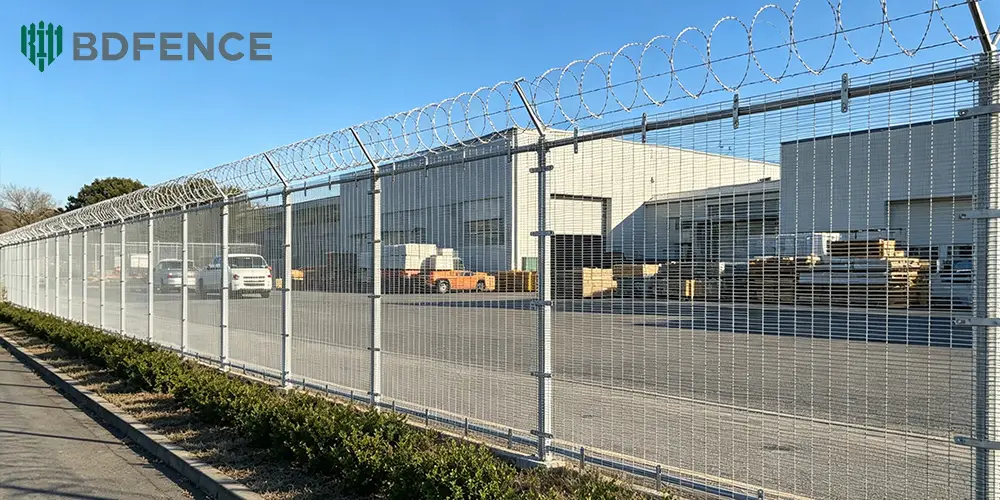
BDFENCE offers 358 anti-climb fencing with different wire configurations, panel dimensions, post systems and finishes. Buyers should select the final combination according to the project specification rather than assume that every 358 product uses identical components.
For a contractor working on a site with significant level changes, it is worth identifying the non-standard sections separately in the RFQ. The factory can then review those components without confusing them with the ordinary straight runs.
Before the Fence Leaves the Factory
A final check should compare three documents: the panel schedule, the post schedule and the fence elevation.
Every special-width panel needs a location. Every changed panel level needs a corresponding fixing detail. Posts should match their designated positions.
The packing list should also identify non-standard components clearly enough for the installation team to find them.
A crate marked only “358 panels” is not especially helpful when several panels look alike but have different dimensions.
Small identification details can save unnecessary sorting and measurement on site.
More importantly, they reduce the chance of an installer fitting the wrong panel and trying to compensate by creating an unsuitable gap.
Send BDFENCE Your Fence Elevation, Not Just the Perimeter Length
BDFENCE supplies 358 security fencing for international contractors, distributors and industrial project buyers.
If your South African project includes slopes, drainage channels or changes in finished ground level, send the relevant elevations with the RFQ.
Our team can review the requested panel sizes, post specifications, coating options and matching components against the information you provide.
You can also browse our fencing product range for other perimeter applications.
For an initial discussion, include the site location, panel height, approximate quantities and any drawings showing difficult ground sections.
BDFENCE — Hebei Bendin Industrial Technology Co., Ltd.
Website: bd-fence.com
WhatsApp: +86 18703287372
Email: info@bd-fence.com