


We sometimes receive a 358 Fence inquiry with a panel size, a fence height and a total quantity.
Then we ask for the layout.
That is usually where the useful discussion starts.
A drawing may show 600 meters of fence, but those 600 meters are rarely just identical panels placed one after another. There is a gate near the entrance. One run finishes against a wall. The ground changes level on the far side. A corner interrupts another run.
All of this affects installation.
More importantly for an overseas buyer, it affects what should be manufactured and packed before the shipment leaves China.
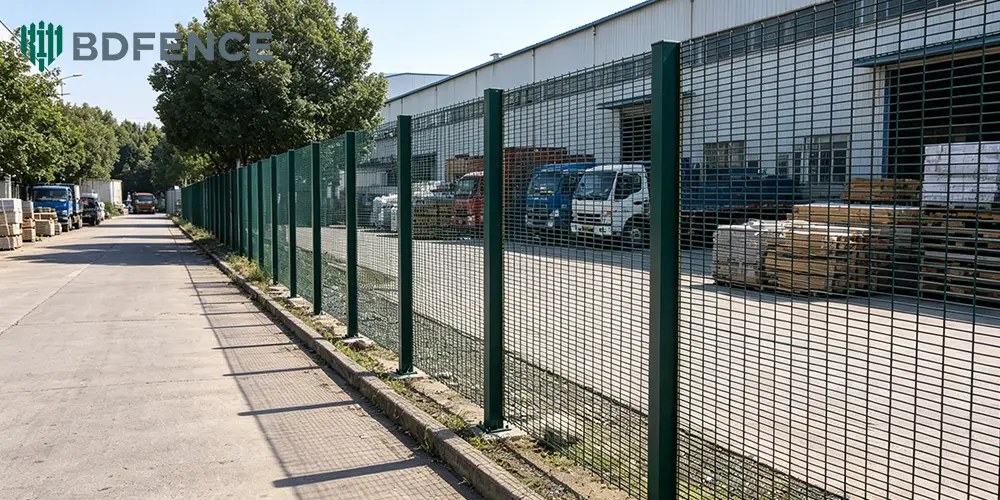
We Would Check the Fence Line First
Take a simple perimeter drawing.
Do not look at the mesh specification yet. Follow the fence line with your finger.
Start here. Straight run. Corner. Another run. Vehicle gate. Short section. Wall.
Now the project already looks different from a quotation that says only:
358 Fence — 2.4m high — 1,000m.
The long straight runs are usually the easy part. The points where something changes are what we want to identify before production.
We normally want to know about:
- corners;
- ends;
- pedestrian gates;
- vehicle gates;
- walls or buildings;
- changes in fence height;
- obvious changes in ground level.
This information helps turn a panel quantity into an actual fence schedule.
A 358 Panel Is Rigid. That Matters on Site.
Chain link mesh gives installers some flexibility along a fence line.
A welded 358 panel behaves differently.
Its width is already fixed. The mesh grid is welded. The panel has to meet the next post in the position expected by the connection system.
So one measurement deserves particular attention:
panel width is not automatically the same as post center-to-center spacing.
We would not advise a contractor to prepare hundreds of post foundations using the panel width alone.
First confirm the post. Then confirm the fixing detail. Then use the approved installation spacing for that system.
The Post Drawing Is More Useful Than the Word “Heavy-Duty”
“Heavy-duty post” appears in plenty of fence inquiries.
It is not much of a specification.
For production, we need actual information: post section, wall thickness, length, surface treatment and the way the panel connects to it.
The required post also depends on the project.
A 358 Fence around a normal commercial boundary should not automatically be copied into a taller exposed security perimeter just because the mesh looks similar.
Fence height, spacing, site exposure, gates, additional security components and the structural design can all affect the post arrangement.
For projects with structural requirements, the post and foundation system should follow the appropriate engineering review.
One Detail We Want Settled Before Making the Posts
Will the posts go into the foundation, or will they connect to an approved concrete or structural surface using a base arrangement?
This sounds like an installation decision.
It can also become a manufacturing decision.
Post length and the lower connection detail may change.
That is why changing the installation method after the steel posts have already been produced can create unnecessary work.
The concrete foundation itself is a site and engineering matter. There is no single hole size that we can responsibly recommend for every 358 Fence.
Ground conditions in one project may be very different from another. Fence height and exposure can also change the design requirements.
Now Put the First Panel Between the Posts
This first bay deserves some patience.
Check where the panel sits vertically.
Check the ground clearance required by the project.
Look along the top edge.
Look along the fence line.
Then check the connection against the approved fixing detail.
A small error in one bay may not look serious. Repeat it across a long straight perimeter and the error becomes much harder to ignore.
Good alignment is not created by tightening the last bolt. It starts with the post positions.
About the Clips
Buyers sometimes send us a photo of a 358 panel and ask, “How many clips do I need?”
We need to see the post system too.
There are different ways to connect welded security panels to posts. A project may use clips, clamps, cover-type arrangements or another specified fixing system.
Panel height matters as well.
So we do not treat one clip quantity as a universal rule for every 358 Fence.
When checking a quotation, look for the actual fixing scope. If the supplier has priced panels and posts, ask what connects them.
Also check whether bolts and related hardware are part of the offer.
A Small Hardware Difference Becomes Large on a Long Perimeter
On one post, a missing fixing is a small item.
Across a large project, it is no longer small.
This is one reason we prefer to calculate the fixing package from the confirmed fence configuration rather than add a rough box of accessories at the end of the quotation.
The same applies to special brackets and top-security components.
They should belong to a known position in the system.
Then the Drawing Reaches a Wall
This is a common point that a price-per-meter inquiry does not show.
The standard panels have repeated nicely along the main run. Now only part of a normal bay remains between the last post position and a wall.
There are several possible project solutions, depending on the approved layout.
One option may be to identify a closing section before production rather than expecting the installer to make every adjustment on site.
We prefer to keep the main run standardized wherever possible and treat unusual widths as exceptions.
That makes production simpler and gives the special pieces a clear reason for being special.
We Would Mark That Panel
If a project has a small number of non-standard panels, there is little value in packing them so that they look identical to every other bundle.
A simple panel reference can connect the drawing, production list and package mark.
For example, the main run might use one panel reference while the closing section beside a wall has another.
The exact coding method is not important.
What matters is that the installer can identify the exception without measuring a stack of panels after unloading.
At the Gate, Stop Repeating the Standard Bay
A vehicle entrance is not just a missing fence panel.
There are gate supports, the gate itself and the fence sections approaching the opening.
The gate posts may have different requirements from ordinary fence posts, particularly for larger openings.
The nearby fixed panels also need to finish in the correct position.
For this reason, we prefer gate openings to appear clearly on the fence schedule.
Give us the opening width, required height and gate type if it has already been selected.
If the gate design is still being developed, say that. It is better than treating the opening as a normal panel bay.
The Ground Starts Climbing
Now the drawing is no longer enough. An elevation or site information becomes useful.
Rigid 358 panels do not simply bend to follow a changing ground profile.
Depending on the approved project design, sloping areas may use stepped sections or another arrangement suited to the site.
The important thing for the supplier is to know that the slope exists.
If all we receive is a flat elevation showing identical panels, the production list cannot reflect a condition that nobody has shown us.
Adding Security Above the Panel?
Tell the supplier early.
Some 358 Fence projects require additional top-security components under the approved project design.
Those components do not exist independently of the fence below them.
They may affect post height, brackets, hardware and gate details.
The relevant project rules and safety requirements should determine the final arrangement.
From a purchasing point of view, the important thing is simple: include it in the same discussion as the fence, not as a last-minute accessory.
Here Is Where Two 358 Fence Quotes Can Become Misleading
Quotation A shows a lower price.
Quotation B is higher.
Both say “358 Security Fence.”
That is not enough information to decide which offer is actually cheaper for the project.
Put the specifications beside each other.
| Look at | Check this |
|---|---|
| Panel | Height, width, mesh opening and actual wire diameter |
| Post | Section, wall thickness, length and finish |
| Post layout | How spacing relates to the panel and fixing system |
| Panel connection | Clip, clamp or other specified fixing arrangement |
| Hardware | What bolts and accessories are actually included |
| Special sections | Whether closing panels or unusual areas are covered |
| Gates | Opening, frame, support and hardware scope |
| Top security | Whether it is included and coordinated with the posts |
Sometimes the cheaper quotation really is cheaper.
Sometimes it simply contains less fence.
If You Already Have Another Supplier’s 358 Fence Quote
Send us the specification page.
There is no need to rewrite the entire inquiry.
BDFENCE can prepare a quotation against the same available panel, post, fixing and gate requirements. That gives your purchasing team a cleaner basis for comparison.
If something important is not defined, we can identify it as an open point instead of quietly assuming a specification.
Phone: +86 18703182863
WhatsApp: +86 18703287372
Email: info@bd-fence.com
What We Like to Receive with an RFQ
A full engineering package is useful, but it is not required just to start a conversation.
Send what you already have.
A PDF drawing is useful. So is a BOQ. A fence schedule is even better when the perimeter contains different panel types.
If the project is still early, a marked site plan can work as a starting point.
Along with it, tell us the known requirements for fence height, mesh, wire diameter, finish and gates.
And tell us where the project is going.
That is enough for us to understand far more than an inquiry that says only, “Please quote 358 Fence.”
Before the Fence Leaves the Factory
For a straightforward order, most panels may be identical.
We still want the component list to agree with the confirmed specification.
For a more complicated project, we pay particular attention to the exceptions: different panel heights, closing sections, gate-related pieces and special accessories.
Those are the items that are inconvenient to discover missing after a container has travelled thousands of kilometers.
Packaging cannot correct a bad fence layout.
But clear identification can make a good layout easier to use on site.
The Installation Question We Want Buyers to Ask Earlier
Not:
“How do I install this panel when it arrives?”
Ask:
“Does the fence I am buying already match the way this project will be installed?”
That question brings the panel, post, fixing system, gate, foundation interface and special sections into the same conversation.
For an international project, that is much safer than buying the mesh first and solving every interface later.
Send Your 358 Fence Drawing to BDFENCE
If your project is already at quotation stage, send us the existing documents.
They can be:
- a BOQ;
- a perimeter drawing;
- a fence elevation;
- a technical specification;
- a gate schedule;
- or a marked site plan.
BDFENCE can use the available information to prepare a quotation for the required 358 panels, posts, fixing components, gates and related items.
If some details have not been decided yet, mark them as open.
You do not need to invent a post size, clip quantity or foundation detail just to ask us for a price.
About BDFENCE
Hebei Bendin Industrial Technology Co., Ltd. manufactures metal fence products under the BDFENCE brand.
Our team has more than 30 years of metal fence manufacturing experience. The factory covers approximately 15,000㎡, with more than 190 employees and over 80 machines. BDFENCE products have been exported to more than 70 countries.
For 358 Fence inquiries, we can work from the buyer’s confirmed drawings, BOQ and project specifications rather than treating the order as panels alone.
FAQ
Is 358 Fence panel width the same as post spacing?
Not necessarily. The required post center-to-center spacing depends on the panel dimensions, post design and fixing system. Confirm the approved installation detail before setting out the posts.
How many clips are required for a 358 Fence panel?
There is no universal clip quantity for every 358 Fence. The fixing arrangement can change with panel height, post type, connection design and project requirements.
What size foundation should be used for 358 Fence posts?
Foundation design depends on the project conditions, including the fence system, ground conditions, exposure and structural requirements. It should follow the approved engineering design rather than a generic foundation size taken from another project.
Can 358 Fence panels be installed on a slope?
Yes, but the layout needs to account for the change in ground level. Rigid welded panels may use stepped or other project-specific arrangements depending on the approved design.
Can BDFENCE make special-width 358 panels?
Project-specific panel dimensions can be discussed where the layout requires them. For many projects, it is more practical to keep the main fence runs repetitive and use special widths only at necessary closing or transition locations.
Can I send BDFENCE my current BOQ for a quotation?
Yes. Send the BOQ, drawing, fence schedule or specification you already have. BDFENCE can use those documents as the starting point for the quotation and identify details that still need confirmation.
Contact BDFENCE
Hebei Bendin Industrial Technology Co., Ltd. (BDFENCE)
Phone:
+86 18703182863
WhatsApp:
+86 18703287372
Email:
info@bd-fence.com
Website:
https://bd-fence.com/