



A warehouse yard needs to be accessible to delivery trucks, but that does not mean the whole boundary should be easy to cross. The fence has to separate the working site from surrounding property, leave clear sightlines for security staff and accommodate entrances that may be used throughout the day.
For this South African industrial facility scenario, the proposed perimeter uses a 2D double-wire welded mesh fence. The application combines a manufacturing or warehouse property boundary with a vehicle entrance and a separate pedestrian access point.
What makes the specification interesting is the relationship between the fence panels and the rest of the site. The twin-wire construction offers a rigid, flat mesh panel, but the choice between 6/5/6 and 8/6/8 wire, the gate arrangement, the post connections and the protective finish all have commercial consequences.
This is an engineering application example, not a claim that BDFENCE completed an installation at a named South African facility. The purpose is to show how a contractor could turn a preliminary perimeter design into a coordinated fence supply package.
Project Overview
| Project Detail | Application Description |
|---|---|
| Country | South Africa |
| Industry | Industrial Manufacturing and Warehousing |
| Product | 2D Double-Wire Security Mesh Fence |
| Application | Industrial property perimeter, vehicle entrance and pedestrian access |
| Configuration Under Review | 6/5/6 or 8/6/8 welded mesh panels, subject to the required specification |
| Supporting Components | Steel posts, fixing brackets or clamp bars, fasteners and matching gates |
| Design Priorities | Rigid perimeter panels, visibility, access coordination and outdoor durability |
| Project Status | Illustrative application scenario; final dimensions and quantities not specified |
The First Decision Wasn’t the Mesh. It Was the Boundary.
Picture the industrial property from above. One side faces an access road; another follows the rear of the warehouse. The vehicle entrance interrupts the front boundary, while a smaller gate provides access for employees and visitors.
On a preliminary drawing, the fence might appear as one continuous line. For the contractor preparing the material schedule, however, that line needs to be broken into sections.
The straight runs can potentially use standard-width welded panels. Corners need the correct post orientation and fixing arrangement. At the vehicle entrance, the adjoining panels must terminate at the gate supports. Short sections beside a wall or building may need a different width.
The distinction matters because a perimeter measured in linear metres is not yet a panel schedule. If the gate openings are deducted incorrectly or the post spacing is assumed from the nominal panel width, the materials delivered to the site may not match the setting-out drawing.
For this application, the proposed approach would be to establish the fence route, gate positions and terminal points before calculating the final quantities. The contractor could then separate standard panels from special pieces instead of asking the manufacturer to price the entire boundary as one repeated unit.
6/5/6 or 8/6/8: What Is the Buyer Actually Choosing?
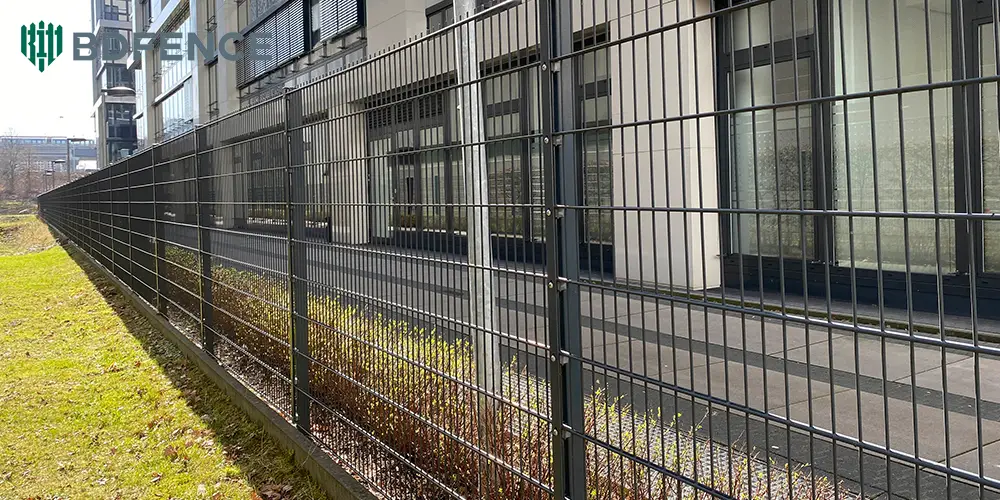
The characteristic feature of 2D mesh fencing is the pair of horizontal wires welded around the vertical wire at each horizontal reinforcement line. Unlike a typical folded 3D panel, the double-wire panel has a flat profile.
Two commonly offered configurations are 6/5/6 and 8/6/8. These numbers describe the wire diameters, not the mesh opening or the panel height.
| Panel Configuration | Wire Arrangement | Procurement Consideration |
|---|---|---|
| 6/5/6 | Two 6 mm horizontal wires with 5 mm vertical wires | Lower steel consumption than an otherwise equivalent 8/6/8 panel |
| 8/6/8 | Two 8 mm horizontal wires with 6 mm vertical wires | Heavier construction where the approved specification calls for greater panel rigidity |
Suppose the project receives two prices described simply as “2D security mesh fencing.” The lower offer uses 6/5/6 wire; the other uses 8/6/8. Without reviewing the technical descriptions, the purchasing team might treat them as equivalent products.
They are not. Assuming the mesh opening, panel dimensions and finish are identical, the heavier wire configuration contains more steel. That difference affects panel weight, material cost and handling requirements.
Neither configuration should be selected only because it sounds more secure. The facility’s approved perimeter requirements need to establish the necessary panel construction. A 2D panel offers a rigid physical boundary, but it is not automatically a certified high-security or anti-intrusion system simply because it has double horizontal wires.
The mesh opening, panel height and any project-specific performance requirements must also be defined. A commonly offered opening is around 50 × 200 mm, but that is a market reference rather than a universal project requirement.
Where the Fence Meets the Truck Entrance
The vehicle entrance is the one location where repeating standard fence panels stops being sufficient.
A commercial vehicle gate needs a clear opening appropriate to the vehicles using the site. Its support posts, foundation details and operating hardware have to be considered separately from the fixed mesh sections. The site may use a swing or sliding gate arrangement, depending on its approved layout and available space.
For a busy industrial property, the distinction between clear opening and overall gate dimensions is important. The contractor should know which dimension is being used before ordering the frame and preparing the supports.
The panels beside the entrance also need attention. A gate placed close to a corner can leave a remaining space too narrow for the standard panel. That section may need a custom-width panel, a revised post position or another approved closing detail.
The same principle applies to a pedestrian gate. Even when the gate uses mesh infill matching the perimeter, the frame, hinges, latch and support posts are separate manufactured components.
In the material schedule for this scenario, each entrance would therefore have its own description. That makes it possible to distinguish the welded fence panels from the gate assemblies and avoids a quotation that covers the perimeter but leaves the contractor to source essential gate hardware elsewhere.
The Connection Detail Can Change the Whole Installation
Double-wire panels are commonly installed with square or rectangular steel posts and a specified fixing system. Clips, brackets or clamp bars may be used, depending on the chosen design.
These fittings are small compared with the panels, but they are not minor details. The connection arrangement affects post positions, fastening locations and how the panels are secured.
A supplier might offer a nominal 2.5 m-wide panel. That does not automatically mean the posts should be installed at exactly 2.5 m centres. The panel dimensions and post-centre measurements need to be checked against the selected connection drawing.
For an industrial facility, the structural designer should also establish the post sections and foundation requirements using the relevant site conditions and loads. Posts embedded in concrete and posts mounted on base plates involve different fabrication and anchoring details.
It would be a mistake to finalize foundations from a catalogue photograph or an unapproved post-spacing assumption. The post layout should be checked against the actual panel and fixing arrangement before civil work and production proceed.
Where the approved security specification calls for tamper-resistant fasteners, the quotation should identify the required type rather than simply stating that bolts are included.
South African Conditions: One Country, Different Exposure Requirements
An industrial facility in inland Gauteng and a property near the South African coast do not necessarily face the same corrosion exposure. Humidity, salt-laden air and industrial pollutants can influence the protective system required for outdoor steelwork.
For this project scenario, the coating would be selected after the actual location and environmental conditions were established. Depending on the approved specification, the fence could require a galvanized finish, a powder-coated finish or a combined protective system.
There is also an important distinction between the appearance of a coating and its technical performance. A black or green powder-coated panel may look appropriate for a commercial site, but colour alone does not define the corrosion protection beneath it.
The purchasing documents should identify the required treatment and applicable acceptance criteria. Posts, brackets, gate frames and exposed fasteners need to be included in the review, not just the welded panels.
For overseas procurement, this is one area where an incomplete specification can create a misleading price comparison. Two suppliers may quote the same panel size and colour while offering different coating systems.
A Better Way to Compare the Complete Fence Package
For the industrial facility, the contractor would need more than a unit price for welded mesh. The final material schedule should make it possible to check exactly which components the supplier intends to manufacture and pack.
| Supply Item | Information Needed Before Approval |
|---|---|
| 2D Mesh Panels | Wire configuration, aperture, height, width, tolerances and finish |
| Line and Terminal Posts | Sections, wall thicknesses, lengths, quantities and installation arrangements |
| Panel Fixings | Connection method, brackets or clamp bars, fasteners and quantities |
| Vehicle Gate | Clear opening, gate type, frame, supports and specified hardware |
| Pedestrian Gate | Opening, frame, hinges, latch and supporting posts |
| Special Panels | Nonstandard widths, corners and closing sections |
| Surface Protection | Required coating system and acceptance criteria for each component group |
| Shipping Package | Panel bundles, post identification, accessory packing and delivery terms |
In a long perimeter order, small omissions accumulate. Missing post caps, the wrong fixing brackets or an incorrect number of corner posts may not appear significant on a quotation summary, but they can become installation problems when the shipment is checked on site.
For the same reason, the manufacturer should not receive only a total fence length if an approved BOQ and layout are available. The latest drawings should identify the individual fence runs and gate openings so that the material quantities can be checked against the intended installation.
If the project is still being priced, provisional quantities can be used for budgeting. They should remain clearly identified until the site dimensions and technical details are approved for manufacture.
What This Industrial Application Demonstrates
The main purchasing lesson is not that one 2D wire configuration is always the right choice. It is that panel specification, site layout and supply scope must describe the same fence.
For the South African industrial facility considered here, the proposed double-wire mesh could provide a rigid, visually open boundary around the operational areas. The actual selection between 6/5/6 and 8/6/8 would depend on the approved requirements, while gates, post details and coating specifications would need separate confirmation.
Before production, the contractor and supplier would ideally review one coordinated package: a current perimeter drawing, panel specification, post and fixing details, gate schedule and bill of quantities.
That is the point at which a general request for “industrial 2D fencing” becomes a manufacturing order with defined components.
Working with BDFENCE on 2D Fence Supply
BDFENCE supplies metal fencing products for overseas contractors, distributors and project buyers. Our team has more than 30 years of experience in metal fence manufacturing.
For a South African industrial fencing enquiry, buyers can provide a site drawing, technical specification or BOQ together with the requested panel configuration, post details and coating requirements.
These documents help establish the components included in the proposed supply package. Where the project requires custom widths, gates or a particular fixing arrangement, those items should be identified before final manufacturing details are confirmed.
Site-specific structural design, foundation approval and the overall security strategy remain the responsibility of the project’s qualified professionals.
For an industrial project quotation, use Contact BDFENCE and share the available drawings, material schedule and destination details.
Questions from Industrial Fence Buyers
Is 8/6/8 always better than 6/5/6 for an industrial facility?
No. An 8/6/8 panel has heavier horizontal and vertical wires, but the appropriate specification depends on the facility’s requirements, budget and approved design. A heavier panel should not be treated as a substitute for the overall security assessment.
Can 2D mesh panels be supplied with matching posts and brackets?
A complete fence package can be requested with the specified posts, connection hardware and gates. The quotation should identify the actual supply scope so the buyer can check compatibility.
What coating should be specified for a South African industrial site?
That depends on the facility’s location and environmental exposure. The required corrosion-protection system should be established in the project specification and applied to the relevant components.
Does panel width equal the distance between post centres?
Not necessarily. Post centres depend on the panel dimensions and selected connection system. The contractor should use the approved setting-out and fixing drawings.
Is a 2D security mesh fence suitable for every high-security site?
No. Double-wire panels offer a rigid welded boundary, but higher-risk sites may require additional physical security measures or a different fence system. Suitability must be assessed against the approved security requirements.
What information should be sent for a project quotation?
Provide the fence layout, required panel specification, post and fixing details, gate schedule, coating requirements, quantities and delivery destination. A current BOQ helps define the requested supply package.
Contact BDFENCE
Hebei Bendin Industrial Technology Co., Ltd. (BDFENCE)
Planning a commercial or industrial fencing project in South Africa? Send your drawings, BOQ or technical specification for a quotation based on the required 2D mesh panels, posts, gates and accessories.
Phone: +86 18703182863
WhatsApp: +86 18703287372
Email: info@bd-fence.com
Website: https://bd-fence.com/
Inquiry: Contact BDFENCE