


When a fencing contractor prices a commercial site in South Africa, the panel itself is only part of the calculation. Posts, fixing brackets, coating requirements, transport and installation all affect the final cost. A quotation that looks competitive on a panel-by-panel basis may not remain the cheapest option once the full system is included.
2D mesh fencing is worth considering where a project needs rigid welded panels with a regular, open appearance. Its double horizontal wire arrangement gives the panel a different structure from conventional single-wire welded mesh. However, the product name alone does not tell a buyer whether the quoted panel has the right wire sizes, dimensions or finish.
For South African contractors, distributors and industrial buyers, the more useful approach is to start with the site’s requirements and work backwards to the product specification. That makes it easier to compare local and imported offers without accidentally comparing different products.
What Makes 2D Mesh Fencing Different?
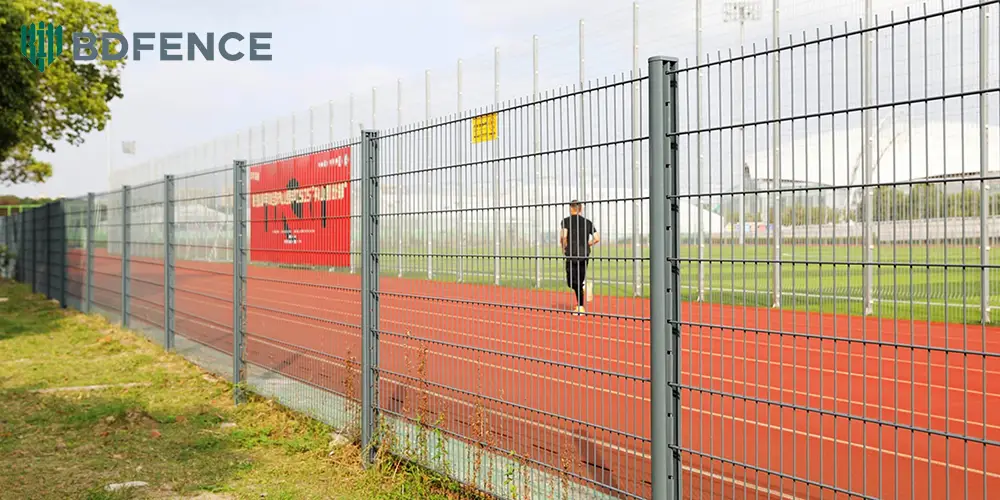
The defining feature of a typical 2D welded mesh panel is its use of two horizontal wires at each horizontal line, welded to vertical wires. This double-wire construction creates a rigid panel without the V-shaped reinforcement bends commonly found in many 3D welded mesh designs.
That distinction matters when reviewing product quotations. A supplier describing a panel as “double wire” should be able to identify the horizontal and vertical wire diameters, mesh opening and panel dimensions. The label alone does not establish the full specification.
For a commercial property, the regular panel structure can provide a neat boundary around parking areas, office compounds and shared external spaces. Industrial sites may also consider this type of fencing where a rigid welded panel suits the intended boundary function.
Not every site needs the same configuration. A low-traffic commercial boundary and a restricted industrial compound may have different requirements for height, post sections, access control and supplementary security measures. The intended application should determine the specification.
Commercial Property or Industrial Site: Start with the Intended Use
A retail complex, business park and industrial warehouse may all use welded mesh fencing, but their priorities can differ.
For a commercial property, appearance may carry considerable weight. The fence could run along a public-facing frontage, around employee parking or beside landscaped areas. Panel height, finish and gate design should fit the building and the surrounding site.
An industrial facility may place greater emphasis on the site’s boundary requirements, access arrangements and the physical specification of the fence. Where vehicles, equipment or restricted areas are involved, the layout needs to account for gates, maintenance access and the relevant security design.
The distinction is important because the same panel should not automatically be specified for every part of a large property. Some sections may use standard panels, while entrances or restricted areas require different dimensions or additional components.
Before requesting quotations, divide the site into clearly defined fence runs. Identify corners, entrances, changes in direction and any sections that require a different height. This gives the supplier a more useful basis for calculating quantities than a single total perimeter measurement.
The Specification That Separates One 2D Panel from Another
Two suppliers can offer panels with the same height and width but use different steel configurations. Those panels may look similar in a photograph, yet they are not necessarily equivalent products.
For a 2D mesh fencing RFQ, the important details include:
- Panel height and width.
- Horizontal and vertical wire diameters.
- Mesh opening size.
- Panel edge and connection arrangement.
- Post profile and wall thickness.
- Fixing system and required accessories.
- Surface treatment and colour, where specified.
The horizontal wire diameter deserves particular attention because the double-wire arrangement is a defining feature of this product category. The buyer should state the required diameters rather than rely on descriptions such as “heavy-duty 2D panel”.
Mesh opening also needs to be specified clearly. A quotation for a panel with one opening size should not be treated as equivalent to an offer using another size simply because both products are described as 2D mesh fencing.
If a project already has a technical drawing or material schedule, send it to every supplier. A common specification provides a much fairer basis for comparing quotations than asking each manufacturer to recommend its own standard product.
South Africa’s Location Matters When Choosing the Finish
South Africa covers a range of environmental conditions. A project near the coast may face different corrosion exposure from one in an inland industrial area. The coating decision should therefore follow the actual site conditions and the project specification, rather than a blanket assumption about the whole country.
Galvanized steel is a common option for outdoor fencing. Powder coating may be specified when a coloured finish is required, and some projects call for a combined protective system. The appropriate choice depends on the required performance, environmental exposure and applicable technical requirements.
For a coastal commercial development, the buyer should pay particular attention to the specified corrosion-protection system and its acceptance criteria. For an industrial site, the relevant exposure conditions and any project-specific requirements should also be reviewed.
The coating specification should cover more than the visible mesh panels. Posts, fixing brackets, bolts and gate frames form part of the installed system. If the finish requirements for these components are unclear, different suppliers may make different assumptions.
When requesting a quotation, state the required coating system, colour and any specified standard. If a particular coating thickness or inspection requirement appears in the project documents, include it in the RFQ instead of relying on a general description such as “weather-resistant”.
Posts and Fixings: Where Incomplete Quotations Become Expensive
One of the most common sources of confusion in a fencing quotation is the difference between a panel price and a complete system price.
A panel-only offer may exclude the posts, brackets and fasteners needed for installation. Another supplier may include those components but use a different post section or fixing arrangement. Comparing the headline prices without checking the supply scope can give a misleading result.
For 2D mesh fencing, the post and fixing system should match the panel dimensions and connection design. The quotation should identify the post section, wall thickness where specified, installation method and the hardware supplied with each panel.
The installation method also affects the required post dimensions. Posts embedded in concrete and posts mounted on base plates do not have identical fabrication requirements. The approved project design should determine the appropriate arrangement.
For a large commercial or industrial order, ask the supplier to list the panels, posts, fixing components and gates separately. This makes it easier to see what is included and identify missing items before the order is placed.
Local Supply or Importing from a Manufacturer?
South African buyers may compare locally available fencing with panels sourced directly from an overseas manufacturer. Neither option is automatically better; the right decision depends on the project quantity, specification, delivery schedule and total purchasing cost.
A local supplier may be convenient for smaller quantities, urgent replacements or orders where the specification is already standardized. Direct importing may be worth evaluating for larger quantities or projects that require a particular panel configuration, provided the buyer can accommodate the shipping and procurement process.
The factory price alone is not enough to make that decision. An imported order may involve international freight, customs clearance, local transport and other applicable charges. Lead time and the cost of holding inventory may also affect the overall calculation.
For a meaningful comparison, calculate the cost of the complete supply package delivered to the required destination. Use the same panel specification and accessory list for both offers, and confirm which costs each supplier has included.
For distributors, repeat-order consistency and the ability to maintain the same specification can be important. For project contractors, delivery timing and the completeness of the material package may carry more weight. The preferred sourcing route should reflect the buyer’s actual business model.
A Practical Checklist for a 2D Mesh Fencing RFQ
Before sending an enquiry, prepare as much of the following information as the project has already confirmed.
| RFQ Item | What to Specify |
|---|---|
| Application | Commercial property, warehouse, industrial site or another intended use |
| Panel dimensions | Height, width and required mesh opening |
| Wire configuration | Horizontal and vertical wire diameters |
| Posts | Section, wall thickness, length and installation method |
| Fixings | Brackets, bolts and panel connection arrangement |
| Surface treatment | Galvanized or coated finish, colour and specified requirements |
| Gates | Opening dimensions, gate type and required hardware |
| Quantity | Panel count, total fence length and special sections |
| Delivery | Destination, required delivery schedule and agreed shipping terms |
If some dimensions are still provisional, identify them as such. A supplier can prepare an initial budget quotation using stated assumptions, but those assumptions should not be mistaken for the final manufacturing specification.
For project orders, it is also worth checking that the site layout, bill of quantities and quotation refer to the same revision. A change in gate position or fence height can affect the number of panels, posts and accessories required.
Questions to Ask Before Approving the Order
Once the technical offer arrives, the buyer should be able to establish exactly what the supplier intends to manufacture.
- Does the quoted panel match the specified horizontal and vertical wire diameters?
- Are the posts and fixing brackets included, and do they match the selected panel system?
- Is the specified coating applied to the required components?
- Are gates and special closing sections included or quoted separately?
- What are the agreed production lead time, packing arrangement and delivery terms?
These questions are more useful than asking only whether the supplier can offer a lower price. They help establish whether the quotation meets the project requirements in the first place.
Request a 2D Mesh Fencing Quotation from BDFENCE
BDFENCE supplies metal fencing products to overseas contractors, distributors and project buyers. For South African commercial and industrial enquiries, a site layout, panel specification or bill of quantities provides a useful starting point for reviewing the required supply scope.
The information can be used to assess the requested 2D panels, posts, fixing components and gates. If the project has specific coating requirements or different fence configurations in separate areas, those details should be identified in the enquiry.
Where a technical requirement is not yet confirmed, it is better to identify it before the final production details are approved. This allows the quotation to distinguish confirmed specifications from provisional assumptions.
If you are comparing 2D mesh fencing suppliers for a South African project, send your drawing, BOQ or technical specification through Contact BDFENCE to request a quotation based on your requirements.
FAQ
What is 2D mesh fencing?
2D mesh fencing is a rigid welded panel system that typically uses double horizontal wires welded to vertical wires. The exact wire configuration, mesh opening and panel dimensions depend on the specified product.
Where can 2D mesh fencing be used?
It may be considered for commercial properties, warehouses, industrial boundaries and other sites where a rigid welded panel suits the intended application. The required configuration depends on the project design.
What should South African buyers check when comparing 2D fencing prices?
Compare the panel dimensions, horizontal and vertical wire diameters, mesh opening, coating, posts, fixing components, gates and delivery terms. The offers should cover the same specification and supply scope.
Is galvanized or powder-coated 2D fencing better?
The appropriate finish depends on the environmental exposure, project specification and maintenance requirements. Buyers should confirm the required protective system rather than choose by colour alone.
Can 2D mesh fencing be supplied with posts and fittings?
A quotation can be requested for panels together with the specified posts, fixing components and gates. Buyers should confirm the included items explicitly because supply scopes can differ between suppliers.
What information is needed for a 2D mesh fencing quotation?
Provide the required panel dimensions, wire diameters, mesh opening, coating, post details, quantity, gate requirements and delivery destination. A BOQ or technical drawing helps clarify the scope.
Contact BDFENCE
Hebei Bendin Industrial Technology Co., Ltd. (BDFENCE)
Looking for 2D mesh fencing for a commercial or industrial project in South Africa? Send your specifications, BOQ or drawings for a quotation based on your required panels, posts and accessories.
Phone: +86 18703182863
WhatsApp: +86 18703287372
Email: info@bd-fence.com
Website: https://bd-fence.com/
Inquiry: Contact BDFENCE