



A fence schedule for an industrial park can look surprisingly simple. The drawing shows a boundary line, the specification says 2.4 meters high, and the buyer asks for a price per meter.
For a factory, that is enough to start a conversation. It is not enough to prepare a final material list.
Consider an industrial park in Saudi Arabia with warehouse buildings, loading areas and several road entrances. The owner wants a steel tubular fence around the property. Most of the boundary uses regular panels, but the layout also includes vehicle gates, corners and a few short sections beside buildings.
This article follows that type of project from the supplier’s point of view. It is an illustrative example rather than a record of a completed BDFENCE order.
The main question is how to turn a basic fence request into a supply package that a contractor can actually use.
The First Drawing Left Several Questions Open
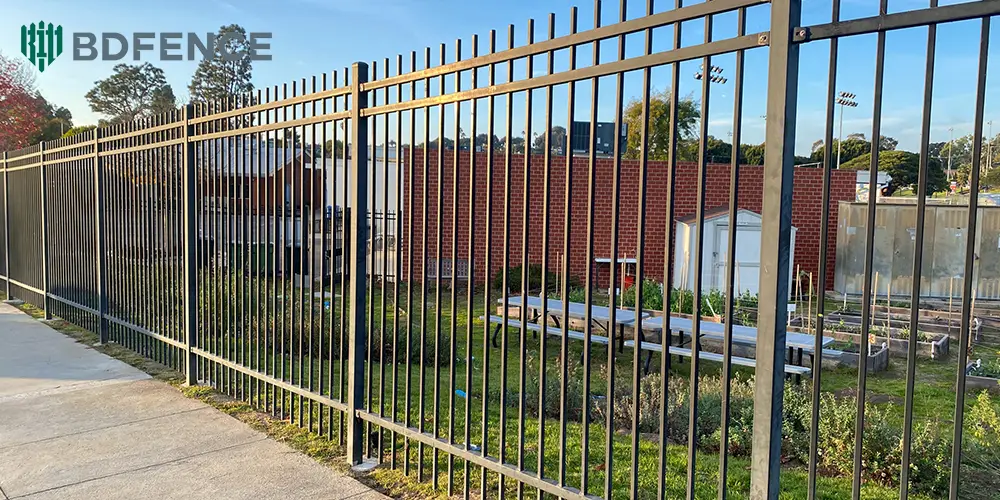
The initial project brief calls for a 2.4m high steel tubular fence. That tells us the overall height, but very little about the steel inside each panel.
We would still need to know whether the vertical pickets use square or rectangular tubes, how many horizontal rails support them, and what wall thickness the designer has specified.
The post details matter as well. A tall fence needs a suitable support system, especially where the boundary crosses open ground.
For this example, the starting information looks like this:
| Item | Project Information |
|---|---|
| Country | Saudi Arabia |
| Site | Industrial park |
| Product | Steel Tubular Fence |
| Fence height | 2.4m |
| Main application | External property boundary |
| Panel design | To follow the approved drawing |
| Posts and foundations | Subject to project design |
| Gates | Vehicle and pedestrian access where required |
| Finish | To match site conditions and project specification |
Nothing in this table confirms the tube sizes or the final material quantities.
That is intentional. A real buyer may reach the quotation stage with some details still open. Rather than fill those gaps with guesses, we prefer to identify them before production.
A 2.4m Fence Is Not Simply a Taller Standard Panel
One tempting approach is to take a familiar 1.8m tubular fence design and extend the pickets until the panel reaches 2.4m.
The finished drawing may look reasonable, but the change in height affects more than appearance.
A taller panel can place different demands on its rails, posts and connections. Wind exposure also becomes an important part of the design, particularly on open industrial sites.
Saudi Arabia has a wide range of site conditions. A fence inside a sheltered industrial estate may face different loads from one along an exposed boundary.
Therefore, we would not select the post section or foundation dimensions from the fence height alone. The project engineer should confirm the required structural details.
The factory’s job is to manufacture the agreed system accurately, not to replace the site’s engineering review with a standard product photo.
The Buyer Had Two Ways to Describe the Panels
Imagine the purchasing team receives two possible panel specifications.
The first uses square steel pickets with rectangular horizontal rails. The second uses square tubes for both parts.
Neither option is automatically wrong.
Square pickets often give a neat, regular appearance. Rectangular rails may suit certain panel designs because their section depth differs in each direction. However, the actual performance depends on the tube size, wall thickness, orientation and connections.
For a long industrial boundary, small material changes can affect the total price.
This is why the words “heavy-duty tubular fence” do not help much when comparing suppliers.
A more useful drawing shows the picket section, rail section, wall thickness and spacing. It should also make clear whether the stated spacing means center-to-center distance or the open gap between pickets.
Those two measurements are not the same.
If a supplier changes the picket size or spacing, the number of pickets in each panel may change as well.
Across hundreds of panels, that can make a noticeable difference to the material schedule.
The Road Entrance Interrupted the Regular Fence
The longest straight section of a fence is often the easiest part to manufacture. Once the project team agrees on the panel size and fixing system, the same arrangement can repeat along the boundary.
The entrance is different.
A vehicle gate needs its own frame and support arrangement. Depending on the site layout, the project may use swing gates, sliding gates or another approved design.
The gate posts also have a different job from ordinary fence posts.
For that reason, we would want the gate opening and frame specification before including it in the quotation.
A buyer might ask for 800 meters of fence without saying whether that figure includes the vehicle entrances. Another buyer may list the full boundary length and then add the gates separately.
Both methods appear in project inquiries, but they produce different material quantities unless everyone uses the same measurement basis.
Before calculating panels, we need to know which parts of the boundary are fixed fence and which parts are openings.
The Short Panel Beside the Gate
There is another detail that often appears near an entrance.
After laying out the regular fence bays, the contractor may find that the remaining distance between the last standard post and the gate support is too short for a full panel.
That gap needs a planned solution.
In some projects, the drawing allows a custom-width closing panel. In others, the post layout can change before the foundation work starts.
The right approach depends on the approved design.
From a manufacturing point of view, we prefer to keep the main fence panels at repeated sizes and identify special widths separately.
A project with 300 standard panels and four special panels is easier to manage than one where every panel has a slightly different width.
It also helps the receiving team. If the special panels have clear references, the contractor can find them without opening every bundle.
What Happens Along the Uneven Boundary?
The industrial park may have level ground near the warehouses but a change in height along a service road or drainage area.
A rigid tubular steel panel cannot bend to follow that change.
The project team may choose a stepped fence arrangement or another method that suits the approved layout.
Either way, the ground profile matters.
If the supplier only sees a flat plan, the drawing may not show where the fence needs special treatment.
For this reason, a site elevation or a marked drawing can be useful even when the buyer already knows the total fence length.
We do not need a perfect presentation drawing at the first inquiry stage. A clear note showing the difficult sections is often more helpful than another product photograph.
The Finish Needed Its Own Discussion
For an industrial park in Saudi Arabia, the coating specification deserves attention.
The country has inland industrial areas, coastal developments and sites with different levels of dust, moisture and industrial exposure.
So it would be a mistake to assume that one coating arrangement suits every location.
The project may call for galvanizing, powder coating or a combined system. The buyer should confirm the required coating standard and color before production.
A dark finish can look attractive on a steel tubular fence, but color alone says little about corrosion performance.
We would also pay attention to the details that affect the finished product, including weld areas, tube ends, drainage and handling.
These points matter because the fence will remain outdoors long after the factory has shipped it.
Where the Two Supplier Quotations Started to Differ
Suppose the purchasing team receives two offers for the same 2.4m industrial fence.
Supplier A gives a lower price per meter. Supplier B costs more.
At first, the choice seems obvious.
Then the buyer compares the specifications.
One quotation uses a different rail section. The other includes a thicker post. One price includes the fixing hardware, while the other lists only panels and posts.
Neither price is meaningful until the buyer understands those differences.
For a project of this type, we would compare the following items:
| Material Item | Question for the Supplier |
|---|---|
| Fence panels | Are the dimensions and picket layout the same? |
| Steel pickets | Do both offers use the same tube size and wall thickness? |
| Horizontal rails | Do the section, quantity and orientation match? |
| Support posts | Are the post sizes, lengths and finishes equal? |
| Connections | Does the price include brackets, bolts and other required parts? |
| Gates | Does the quotation include the complete specified gate scope? |
| Special sections | Has the supplier included custom closing panels? |
| Surface finish | Are both suppliers quoting the same coating specification? |
| Packing | Does the offer explain how the main components will be grouped? |
A factory may genuinely offer a better price for the same product.
However, a lower quotation can also result from a smaller supply scope.
For overseas buyers, checking this before placing the order is far easier than finding missing items after the container arrives.
Send BDFENCE Your Existing Fence BOQ
If you are comparing prices for a 2.4m steel tubular fence, you can send us the same drawing or BOQ that you already use for the project.
There is no need to create a new document.
We can prepare a quotation against the available panel, post, fixing, gate and finish requirements. If the drawing leaves a detail open, we can ask you to confirm it.
This gives your purchasing team a clearer basis for comparing suppliers.
Phone: +86 18703182863
WhatsApp: +86 18703287372
Email: info@bd-fence.com
From the Material List to Factory Production
Once the buyer confirms the main specification, the factory can organize the order by component type.
Regular panels form the largest group. Posts, connection parts and special panels need their own quantities.
Gates require separate attention because their frames and hardware differ from the fixed fence sections.
For a long industrial perimeter, clear part references make production and packing easier.
Consider a shipment that contains several hundred panels, multiple post types and a few custom sections. The contractor needs to know which components belong to the regular boundary and which belong near the gates or corners.
Simple identification marks can help.
The packing list should also agree with the confirmed material schedule. Otherwise, the buyer may receive the correct number of bundles without knowing whether all the required components are inside.
For an international project, that uncertainty can delay installation.
A Few Details Worth Settling Before Shipment
There are several decisions we would rather settle while the order is still on paper.
One is the connection between the panels and posts. Another is the difference between standard and special panel widths.
Gate components also need clear references, especially when the site has more than one entrance.
Finally, the buyer should confirm the required finish and any project-specific packing instructions.
These are ordinary manufacturing questions, but they become expensive when the answers arrive too late.
The goal is not to make the quotation process complicated. It is to avoid shipping a fence package that leaves the contractor searching for parts that nobody included.
What This Industrial Park Example Shows
The 2.4m height was only the beginning of the specification.
To prepare a useful supply quotation, the buyer also needed a clear panel design, post requirements, gate details and a plan for the unusual sections.
The factory needed enough information to calculate the steel and accessories without making hidden assumptions.
Meanwhile, the contractor needed the fence system to match the approved site layout.
That is the real value of reviewing a BOQ before production.
It helps the buyer compare offers on the same basis and gives the manufacturer a clearer job to carry out.
Steel Tubular Fence Supply from BDFENCE
BDFENCE is the fencing brand of Hebei Bendin Industrial Technology Co., Ltd., a metal fence manufacturer in China.
Our team has more than 30 years of metal fence manufacturing experience. The factory covers approximately 15,000㎡ and operates with more than 190 employees and over 80 machines.
We supply fencing products to buyers in more than 70 countries.
For steel tubular fence projects, we can work with the customer’s drawings and confirmed material requirements. Depending on the order, the supply may include tubular panels, steel posts, connection parts, gates and custom sections.
If your project has an existing fence schedule, send it to us. We can use it as the starting point for a quotation.
You can also share a tender drawing if the final material list is not ready.
FAQ
Is a 2.4m high tubular steel fence suitable for an industrial park?
It can suit industrial property boundaries when the complete fence system meets the owner’s security and structural requirements. The project team should confirm the panel design, post system, gates and site conditions.
What steel tube sizes should I use for a 2.4m fence?
The right sizes depend on the approved design. Pickets, rails and posts have different roles, so one tube size will not suit every part of the fence.
Can BDFENCE supply custom-width steel tubular fence panels?
Yes. We can discuss special panel widths based on the customer’s drawings and confirmed requirements. Custom closing panels may help the fence fit gates, walls and other layout changes.
Can BDFENCE include vehicle gates in the quotation?
Yes. Send the gate opening sizes, gate type and available frame details. We can include the required gate components according to the confirmed specification.
Which coating should I choose for a steel tubular fence in Saudi Arabia?
The correct finish depends on the project’s location and exposure. Confirm the coating standard, surface treatment and color requirements before production.
Can I get a quotation with only a preliminary BOQ?
Yes. Send your current BOQ, tender drawing or fence schedule. We can use the available information to prepare an initial quotation and identify details that still need confirmation.
Contact BDFENCE
Hebei Bendin Industrial Technology Co., Ltd. (BDFENCE)
Phone: +86 18703182863
WhatsApp: +86 18703287372
Email: info@bd-fence.com
Website: https://bd-fence.com/